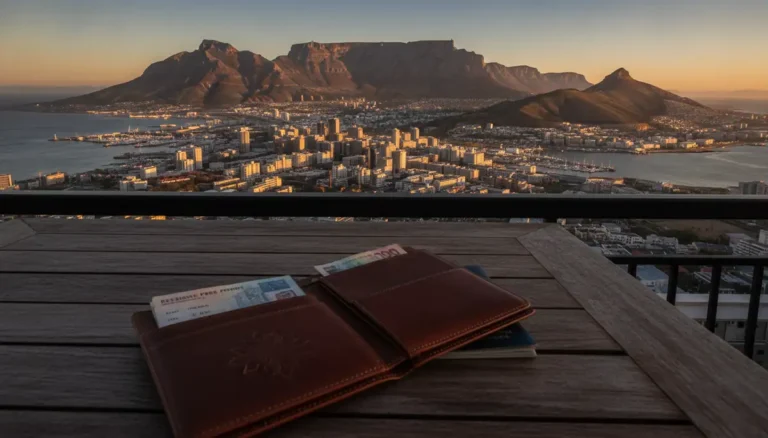
The South Africa financially independent permit is one of the cheapest direct permanent residencies on the planet, and almost nobody explains how little you have to do to keep it. You prove a net worth of R12 million (about US$725,000), pay R120,000 (about US$7,260) once Home Affairs approves you, and walk away with permanent residence on day one. There’s no temporary visa first, no minimum stay and no money parked in a South African bank.
Keeping it alive takes roughly one trip every three years.
Turning it into a passport is a different animal. South African citizenship by naturalisation comes with a 90-day annual absence limit that rarely gets a mention. This is where people get burned. This guide covers both stages. First, how to get and hold the South Africa financially independent permit with minimal time in the country. Second, exactly what the naturalisation rules demand when you decide the passport is worth the move. If you want the wider menu of visas first, our guide to every residency route in South Africa covers the lot.
Put your assets beyond reach in 57 jurisdictions.
Pick where you want your company. We handle the filing, the registered agent, and the bank introduction. From US$1,290, done in days, not months.
- Charging-order protection in jurisdictions courts can't pierce
- Zero tax on foreign income in 30+ territories
- Banking options available
- Fixed price. No surprise fees at closing
What Is the South Africa Financially Independent Permit?
The South Africa financially independent permit is a direct permanent residence permit issued under section 27(f) of the Immigration Act 13 of 2002. It goes to foreigners of good character who prove a minimum net worth of R12 million and pay R120,000 to the Director-General of Home Affairs after approval. You don’t have to work or invest locally.
The detail sits in regulation 24(12) of the Immigration Regulations and Government Notice 454 of June 2014, which set the figures. The gazette wording says the net worth is R12 million “of which R120 000 shall be paid”, so the payment comes out of the qualifying wealth. You aren’t asked to find R12.12 million.
Read that number twice, because it’s the whole pitch. The state’s cut is R120,000, roughly the price of a decent used car. Everything else stays in your own accounts.
Why does it exist at all? Pretoria wants wealthy foreigners who’ll spend money and won’t compete for jobs. The state gets a fee and a well-heeled resident. You get a permanent right to live, work, study and run a business in the country. That’s a trade, and for once the terms favour the applicant.
Does the R12 million have to be in South Africa?
No. Neither the Immigration Act, regulation 24(12) nor the 2014 gazette limits the R12 million to South African assets. None of them requires you to bring funds into the country. Compare the business route under section 27(c), where the gazette expressly demands R5 million in cash originating from outside the Republic and invested locally. The financially independent route has no such wording.
The South African Reserve Bank’s exchange control guidelines point the same way. When an immigrant takes up permanent residence, they declare their foreign assets to an authorised dealer. Those declared assets can then stay offshore without interference from the Financial Surveillance Department. Your offshore bank accounts and foreign property stay where they are.
What counts toward “net worth” isn’t defined in the official texts. In practice, applicants present a certified statement of assets and liabilities covering property, investments, cash and business interests worldwide. We see the same pattern often. A client thinks they’re short of R12 million because their cash is lower. Then someone values their home and their business shareholding properly, and they’re well past the line.
South Africa Financially Independent Permit Requirements
To qualify for the South Africa financially independent permit, you need proof of R12 million net worth and a written undertaking to pay R120,000 on approval. Add police clearances, medical and radiological reports, a valid passport and civil documents such as birth and marriage certificates. Documents must be originals or apostilled copies, with sworn translations where needed.
- Proof of net worth of at least R12 million (the regulations ask for “proof of a net worth”; an accountant-certified statement is the norm)
- Written undertaking to pay R120,000 to the Director-General upon approval
- Police clearance from every country you’ve lived in for 12 months or longer since turning 18, each no older than six months
- Medical report and radiological report (no X-ray needed for children under 12 or pregnant women)
- Full birth certificate, plus marriage or divorce documents and dependants’ documents where relevant
- A valid passport, plus biometrics for applicants aged 16 and over
- Yellow fever vaccination certificate if you’ve travelled through a yellow fever area
- Government application fee of R1,520 (from the August 2026 fee schedule)
Notice what’s missing. No language test, no minimum stay, no local bank deposit and no requirement to hold a South African visa when you apply. Home Affairs’ own 2026 White Paper confirms the applicant doesn’t need to hold any temporary residence visa at the time of application.
Police certificates cause most delays. The rule bites on every country where you lived a year or more as an adult. A certificate from a slow jurisdiction can take two or three months to arrive. Then it expires six months after issue. Order them last, after everything else is ready, or you’ll be re-ordering them.

How Much Does South Africa Permanent Residency Cost?
South Africa permanent residency through the financially independent permit costs R120,000 (about US$7,260) paid on approval, plus the R1,520 government application fee. On top come document costs: police certificates, medicals, apostilles, sworn translations and an accountant’s net worth statement. The R12 million itself isn’t spent. You only have to show it.
| Cost item | Amount (ZAR) | Approx. USD | When it’s paid |
|---|---|---|---|
| Government application fee (permanent residence permit) | R1,520 | $92 | On lodging the application |
| Payment to the Director-General | R120,000 | $7,260 | After approval only |
| Net worth to be proven | R12,000,000 | $725,000 | Shown, never paid |
| Naturalisation application (later, optional) | R300 | $18 | When applying for citizenship |
| Documents, medicals, apostilles, translations, accountant | Varies | Varies | Before lodging |
| Government total to secure PR | R121,520 | about $7,350 | Spread over roughly a year |
Dollar figures use a rate of about R16.5 to the US dollar in October 2026. The rand moves a lot, so dollar figures quoted a year or two ago for the same rand amounts can look different.
The payment-on-approval structure matters more than it looks. Several residence programs make you pay the government before a decision, and a refusal means arguing for a refund. Here, if Home Affairs says no, you’ve lost the application fee and your paperwork costs. That’s it.
South Africa PR Without Living There: The Three-Year Rule
You can hold South Africa permanent residency without living there. Section 28(c) of the Immigration Act only lets the Director-General withdraw a permit if the holder has been absent from the Republic for more than three years. The Act adds that the absence is interrupted by an admission and sojourn in South Africa, so a single visit restarts the clock.
That’s the engine of the low-presence strategy. Land in Cape Town or Johannesburg, get stamped in, stay a while, leave. Your three-year window starts again from that trip. There’s no annual minimum, no requirement to file a South African tax return as a non-resident with no local income, and no renewal fee.
Two refinements keep it safe.
First, withdrawal is discretionary. The Act says the Director-General “may” withdraw the permit, so nothing happens automatically on day 1,096. Still, you shouldn’t test a bureaucracy’s discretion. Diarise the deadline and visit well inside it. Most clients we work with make it a holiday every 18 to 24 months, so a cancelled flight never puts the permit at risk.
Second, watch section 28(d). The same section lets the Director-General withdraw a permit if the holder “has not taken up residence in the Republic within one year of the issuance” of the permit. The Act doesn’t define taking up residence. To be safe, enter South Africa within twelve months of approval and spend a few weeks there. Leave a paper trail: a local address, a South African bank account, perhaps a medical aid membership. None of that turns you into a tax resident, and it puts you on the right side of 28(d).
This combination is why the South Africa financially independent permit works so well as a Plan B. You pay once, show up occasionally, and keep the right to move whenever you like. The country speaks English, banks to first-world standards, and costs far less to live in than Europe. If you’re building a serious Plan B, few residencies cost less to maintain.
How Long After PR Can You Get South African Citizenship?
You can apply for South African citizenship by naturalisation after five years of permanent residence. Those five years must be continuous ordinary residence immediately before you apply. The Citizenship Regulations add a hard limit: anyone absent from South Africa for more than 90 days in any year of that five-year period doesn’t qualify.
The rule starts with section 5(1)(c) of the South African Citizenship Act, as amended in 2010. You must be ordinarily resident in the Republic, and have been so “for a continuous period of not less than five years immediately preceding” your application. Regulation 3(2) of the 2012 Citizenship Regulations then spells out the 90-day rule. The application form, DHA-63, asks you directly how long you’ve been out of the country in each year.
You’ll hear it claimed that Home Affairs only cares about your final year. The regulation doesn’t say that. It applies the 90-day test to every year of the five.
The regulations originally demanded ten years of residence. In a later challenge, the High Court struck that down because it conflicted with the five years in the Act. The Constitutional Court’s 2019 ruling in Mulowayi v Minister of Home Affairs confirmed that five years applies. Nobody has successfully challenged the 90-day rule, so treat it as live law.
It may be vulnerable, though. In a 2021 Stellenbosch Law Review article, Professor Fareed Moosa argued the Minister overstepped his powers in making it. Section 5(1)(c) of the Act asks only that you’re ordinarily resident, meaning South Africa is your real home, and it doesn’t count days. No court has tested that argument yet, so build your file around the 90 days.
What the 90-day rule means in days on the ground
Do the arithmetic and the “minimal presence” pitch changes shape. Ninety days away means roughly 275 days in South Africa every year.
| Stage | Legal test | Minimum time in South Africa |
|---|---|---|
| Keeping permanent residence | Not absent more than 3 years (s28(c)); take up residence within 1 year of issue (s28(d)) | One visit within the first year, then one visit at least every 3 years |
| Naturalisation qualifying period | 5 years continuous ordinary residence; no more than 90 days absent in any year (reg 3(2)) | About 275 days a year, roughly 1,375 days over five years |
| After naturalisation | No residence requirement for citizens | None |
So the honest version of the strategy has two stages. Stage one is a dormant permanent residency that costs you a holiday every few years. Stage two is a five-year move, which you trigger only when you decide you want the passport. Nothing forces you to start stage two in year one. You can hold the permit for ten years as pure insurance. Start the citizenship clock when circumstances, or the country, make it attractive.
The other naturalisation conditions are lighter. You must be an adult of good character and able to communicate in one of South Africa’s official languages (English counts). You also need to know the responsibilities and privileges of citizenship, and to state that you intend to keep living in the Republic. The application fee is R300. Home Affairs publishes no processing target for naturalisation, so budget patience.

Does South Africa Allow Dual Citizenship?
Yes. South Africa only requires a naturalising foreigner to renounce their existing nationality if their current country doesn’t allow dual citizenship. If it does, you keep both passports. And since the Constitutional Court’s May 2025 judgment, a South African citizen no longer loses citizenship automatically by acquiring another one.
The case was Democratic Alliance v Minister of Home Affairs, decided on 6 May 2025. Section 6(1)(a) of the Citizenship Act stripped citizenship from anyone who voluntarily took another nationality without ministerial permission. The court confirmed it was invalid from the day it was enacted in 1995. Anyone who lost citizenship under it is treated as never having lost it.
For a Liberty Mundo reader, that’s the important part. A naturalised South African can go on to collect a third or fourth passport without asking Pretoria’s permission. Our breakdown of the pros and cons of dual citizenship covers the trade-offs, and our guide to South African citizenship routes covers descent and marriage as well as naturalisation.
Where a renunciation is required, reg 4 of the Citizenship Regulations gives you six months from the letter of conditional approval to produce official proof from your former country.
How Strong Is the South African Passport?
The South African passport ranks 89th of 198 on the Liberty Mundo Passport Freedom Index, with visa-free or visa-on-arrival access to 106 destinations. It scores a full 100 on citizenship security and personal liberty, but residence-based taxation and an exit tax drag its financial freedom score down to 30.
Mobility isn’t the reason to hold this passport. The case for it rests elsewhere. It’s an English-speaking African passport, BRICS-aligned, from a country that permits dual citizenship and won’t strip it from you for collecting others.
| Passport | Passport Freedom Index rank (of 198) | Overall score | Visa-free destinations |
|---|---|---|---|
| Portugal | 7 | 87.0 | 184 |
| Uruguay | 17 | 86.4 | 153 |
| Mauritius | 59 | 75.3 | 150 |
| Paraguay | 61 | 74.4 | 142 |
| South Africa | 89 | 64.1 | 106 |
Bottom line: if the passport itself is your main goal and you won’t spend five years in South Africa, other residencies lead to stronger documents. Uruguay residency and Paraguay’s investor residency both feed passports that rank higher, and our list of countries where residency earns you citizenship sets out the alternatives. If you want an African option, compare Mauritius residency. Where South Africa wins is the residency stage: a permanent permit that’s cheap to obtain and nearly free to keep.
Do South Africa Permanent Residents Pay Tax?
Holding South Africa permanent residency doesn’t by itself make you a South African tax resident. SARS taxes residents on worldwide income, and residence depends only on ordinary residence (where your real home is) or the physical presence test. A dormant permit holder who lives elsewhere and visits occasionally stays a non-resident, taxed only on South African-source income.
The physical presence test has three parts. You must spend more than 91 days in South Africa in the current tax year and more than 91 days in each of the five preceding years. You also need more than 915 days in total over those five years. All three must be met. A visit every couple of years comes nowhere near.
Stage two is a different story. Spend 275 days a year in South Africa for five years and you’ll be tax resident under both tests. Worldwide income is then taxed at up to 45% (above R1,878,600 for the 2027 tax year). Dividends tax is 20%, and the effective capital gains rate for individuals tops out at 18%. Leave later and you face a deemed-disposal exit charge on your assets under section 9H of the Income Tax Act. That’s why the index scores South Africa so poorly on financial freedom, and why the naturalisation years need proper tax residency planning before you move.
Structures held outside South Africa before you become resident deserve a hard look at that point. An offshore company or trust that worked perfectly while you were non-resident can cause tax problems once you’re resident. Plan the move a year ahead, ideally with the structure already in place.
US citizens: the IRS taxes you on worldwide income wherever you live. The Foreign Earned Income Exclusion only covers earned income from employment or self-employment. It doesn’t cover pensions, Social Security, 401(k) withdrawals or investment income, so moving to South Africa won’t make retirement income tax-free.

How to Get the South Africa Financially Independent Permit: Step by Step
Step 1: Prove your net worth. Have an accountant prepare and certify a statement of assets and liabilities showing at least R12 million, with valuations, title deeds, bank and brokerage statements behind it. Your assets can stay where they are.
Step 2: Gather civil documents and medicals. Collect your birth certificate, marriage or divorce papers and dependants’ documents, apostilled and translated where needed. Book the medical and radiological reports, which must be no older than six months when you lodge.
Step 3: Order police clearances last. Request a certificate from every country where you’ve lived 12 months or more since age 18. They expire after six months, so time them to arrive just before you lodge.
Step 4: Lodge the application. Apply in person at a South African mission (or its VFS centre) in your country of usual residence or nationality. You can also apply in South Africa if you hold a valid visa. Pay the R1,520 fee and sign the undertaking to pay R120,000 on approval.
Step 5: Pay on approval and collect the permit. Home Affairs’ official target for section 27(f) is 240 working days, close to a year. Once approved, pay the R120,000 and collect your permanent residence permit.
Step 6: Take up residence within a year. Enter South Africa within twelve months of the permit being issued, establish a local address and open a bank account, so section 28(d) can’t be used against you. Declare your foreign assets to an authorised dealer for exchange control.
Step 7: Keep the permit alive. Visit at least once every three years, ideally every 18 to 24 months, and keep proof of each entry. Each admission restarts the three-year absence clock.
Step 8: Start the citizenship clock when ready. When you want the passport, move to South Africa and spend no more than 90 days abroad in any year for five continuous years. Then apply for naturalisation on form DHA-63 with the R300 fee.
On timing: the official target is a target. The Minister told Parliament in July 2026 that a new project aims to clear applications pending since before 31 March 2026 by 30 June 2027. Anyone who has dealt with Home Affairs knows a government deadline is a statement of hope. Lodge a complete file the first time, because an incomplete one goes to the back of the queue.
South Africa Permanent Residence by Investment: Comparing the Routes
South Africa offers three money-based routes to permanent residence. The financially independent permit needs R12 million net worth and a R120,000 payment. The business permit needs R5 million invested in a South African business, and the retired person permit needs R37,000 a month for life. Only the financially independent route leaves your capital untouched and offshore.
| Feature | Financially independent, s27(f) | Business, s27(c) | Retired person, s27(e) |
|---|---|---|---|
| Core requirement | R12m net worth (about $725,000) | R5m (about $302,000) cash from abroad invested in an SA business | R37,000 a month for life (about $2,240) |
| Money that leaves your hands | R120,000 to the Director-General | Full R5m invested locally | None |
| Funds must enter South Africa | No requirement in the regulations | Yes | No |
| Conditions after approval | None beyond the absence rules | Investment proven at 2 years and 3 years; 60% local staff | None beyond the absence rules |
| Chartered accountant certificate | Not required by the regulations | Required | Not required |
| Official processing target | 240 working days | 8 months | 240 working days |
The business route suits someone who wants to run a company in South Africa, and the R5 million has to be proven still invested years later. For most Plan B buyers, that’s a lot of capital locked in a volatile currency. The retired route has no age limit today, which makes it a quiet alternative for anyone with a large pension or annuity income. Our page on retiring in South Africa covers it in more depth. If you want a local operating company alongside your permit, see our guide to incorporating a South African company.
The White Paper Could Kill This Permit
Pretoria wants this route changed. Cabinet approved the revised White Paper on Citizenship, Immigration and Refugee Protection on 26 March 2026. It says the financially independent permanent residence permit will be replaced by an investment-based residence visa. Part of your net worth would have to be invested in South Africa for a set period.
The same paper proposes permanent residence by quota, with an annual application window and a points system for economic routes. Naturalisation would also run on quotas after five years of permanent residence. The Minister has said he aims to table the enabling legislation by March 2027.
None of it has become law yet, and white papers have a habit of moving slowly. But the direction is clear: the state wants your money inside its borders and wants to ration permanent residence. Permits already issued under the current Act are the best protection you’ll get, and a government that wants to tighten the tap rarely opens it again.
Common Mistakes With the South Africa Financially Independent Permit
Assuming citizenship needs only the final year. The 90-day rule applies to all five years. Plan the move properly or don’t start the clock.
Ignoring the first-year residence rule. Section 28(d) gives the Director-General a reason to withdraw a permit that was never “taken up”. Visit early and leave a paper trail.
Letting the three years run to the wire. Withdrawal is discretionary, but a missed connection shouldn’t decide your residency. Visit with a year to spare.
Moving money into South Africa unnecessarily. The financially independent route doesn’t require it, and exchange controls make getting it out again slower than getting it in.
Becoming tax resident by accident. Long, repeated stays during the dormant stage can tip you into the physical presence test or give SARS grounds to argue South Africa is your real home. Track your days.
Stale police certificates. Six months is the limit. Ordering them first is the most common reason files get bounced.
Waiting for the rules to get better. The published policy direction is toward invested capital and quotas. The current terms are the generous ones.
Is the South Africa Financially Independent Permit Worth It?
The South Africa financially independent permit is worth it if you want a cheap, permanent, low-maintenance residency in an English-speaking country and can show R12 million in net worth. It’s less compelling if your only goal is a strong passport with minimal presence. Citizenship takes five years living there, with no more than 90 days away a year.
Let’s be blunt about the country. Crime is real, power cuts and municipal failure are real, and the government has plenty of form for policy lurches. Those are reasons the permit is cheap. They’re also reasons a permanent right of residence there costs so little to hold: you aren’t obliged to live with any of it until you choose to.
Weigh it as insurance. About US$7,350 in government fees and a trip every couple of years buys a permanent right to live there. You get good private hospitals, deep capital markets and a lifestyle that’s hard to match for the money. If the day comes when you want that passport, the route is open, and you’ll know exactly what it demands.
South Africa Financially Independent Permit FAQ
How much money do I need for the South Africa financially independent permit?
Do I have to live in South Africa to keep permanent residency?
Does the R12 million have to be held in South Africa?
How long does the South Africa financially independent permit take?
How long after permanent residency can I get South African citizenship?
Can I get South African citizenship without living there?
Does South Africa allow dual citizenship?
Will the South Africa financially independent permit make me a tax resident?
Can my family be included in the South Africa financially independent permit?
Is the South Africa financially independent permit being abolished?
Final Thoughts
Strip away the hype and the South Africa financially independent permit is still one of the best-value residencies anywhere. It’s permanent from day one, needs no capital transfer, and survives on a visit every few years. The passport is a separate decision with a real price in time and tax, and you can make it later, on your own schedule.
If you’re weighing it against other options, start with our full guide to South African residency routes. Then compare the passports on the Passport Freedom Index before you commit.
Sources and References
- Department of Home Affairs, Immigration Act 13 of 2002 (consolidated), sections 27 and 28
- Department of Home Affairs, Immigration Regulations, 2014 (updated 2018), regulations 23 and 24
- Embassy of South Africa in Argentina, Government Gazette 37716, Government Notices 451 and 454 (3 June 2014)
- Department of Home Affairs, Permanent Residency, Fees and Turnaround Times
- South African Government, South African Citizenship Amendment Act 17 of 2010
- Government Gazette 36054, Regulations on the South African Citizenship Act (28 December 2012)
- Constitutional Court of South Africa, Democratic Alliance v Minister of Home Affairs [2025] ZACC 8
- Department of Home Affairs, White Paper on Citizenship, Immigration and Refugee Protection (26 March 2026)
- South African Revenue Service, Tax and Non-Residents and Rates of Tax for Individuals
- Internal Revenue Service, US Citizens and Resident Aliens Abroad