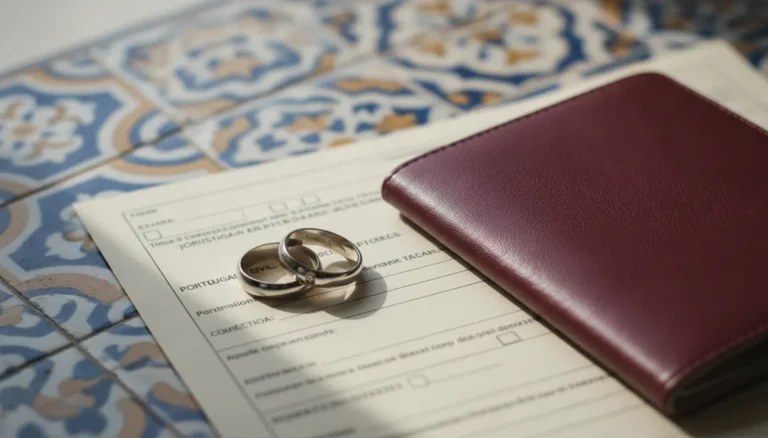
Portuguese citizenship by marriage is open to any foreigner who has been married to a Portuguese citizen, or in a court-recognised de facto union with one, for more than three years. You file a declaration with the civil registry, pay €250, and you don’t need to have lived in Portugal for a single day.
That’s the short answer, and it survived the overhaul of the Nationality Law in May 2026 almost intact. What changed is the fine print. The years between three and six now decide how much ammunition the state has to block you, and the window it has to do so got longer. If you’re weighing this route, those two details matter more than anything else in this guide.
The marriage route has always been the quiet shortcut into an EU passport. While the standard naturalisation path now takes ten years of residence, a spouse can be Portuguese in a fraction of that time from anywhere in the world.
Put your assets beyond reach in 57 jurisdictions.
Pick where you want your company. We handle the filing, the registered agent, and the bank introduction. From US$1,290, done in days, not months.
- Charging-order protection in jurisdictions courts can't pierce
- Zero tax on foreign income in 30+ territories
- Banking options available
- Fixed price. No surprise fees at closing
Who Qualifies for Portuguese Citizenship by Marriage?
You qualify for Portuguese citizenship by marriage if, on the day you file, you’ve been married to a Portuguese citizen for more than three years, or you’ve lived in a de facto union with one for more than three years and a Portuguese court has recognised it. Your spouse can hold Portuguese nationality by birth, descent or naturalisation.
The Ministry of Justice guidance measures the three years at the date of the application. The marriage also has to be alive when you sign. If the divorce is final before you file, the claim is gone.
Three points catch people out:
- Residence isn’t required. You can file through the Portuguese consulate covering the country you live in. Plenty of our clients have never spent more than a holiday in Portugal.
- Your spouse’s route to Portugal doesn’t matter. If your husband got his passport last year through Portuguese citizenship by descent, your three years of marriage still count from your wedding day.
- The marriage clock and the nationality clock are separate. You can marry a foreigner who only becomes Portuguese later. What counts is the length of the marriage when you file, and that your spouse is Portuguese at that point.
That second point is where we see the best value. A client whose wife has a pending descent claim is, in effect, standing in line for two passports. Once her registration comes through, he can file his own declaration straight away if they’ve passed the three-year mark.
What Lei Orgânica n.º 1/2026 Changed for Spouses
Parliament approved the reform on 1 April 2026, President António José Seguro promulgated it on 3 May, and it was published in the Diário da República on 18 May 2026 as Lei Orgânica n.º 1/2026. It entered into force the next day. For spouses, the three-year minimum stayed. Four things moved.
| Rule | What the amended law says | Why it matters to you |
|---|---|---|
| Minimum relationship length | Married, or in a court-recognised union, for more than 3 years (Art. 3) | Unchanged. Still the fastest legal route into Portuguese nationality. |
| Criminal bar | No final conviction with an effective prison sentence of more than 3 years for terrorism, violent or organised crime, state security offences or aiding illegal immigration (Art. 3(4) and Art. 6(1)(f)) | Narrower list of offences, but it applies to every spouse, at any relationship length. |
| Ties to Portugal | The Public Prosecutor can oppose for lack of effective ties, judged against the Article 6(1)(c) to (i) tests (Art. 9(1)(a)) | Language, culture, civic knowledge and means of subsistence are now the yardstick. |
| Six-year safe harbour | No opposition on ties grounds once the marriage or union passes 6 years, or where you have common children with Portuguese nationality (Art. 9(2)) | After six years only the criminal, security and sanctions grounds remain. |
| Opposition window | Two years from the date the acquisition is registered (Art. 10(1)) | Your registration can still be challenged for two years after it goes through. |
| Pending files | Procedures pending on 19 May 2026 stay under the old wording (Art. 7(2)) | Anyone who filed before the cut-off keeps the old rules. |
Read that last opposition row twice. Under the amended Article 10, the clock for a challenge runs from registration. A spouse who files at year three and gets registered quickly can still face an opposition case afterwards if the state decides the ties to Portugal were thin.
The 3-to-6-Year Gap: Where Applications Get Challenged
Between three and six years of marriage, Portuguese citizenship by marriage is a declaration the state can contest. The Public Prosecutor (Ministério Público) may argue you lack effective ties to the national community, measured against the Article 6(1)(c) to (i) tests: Portuguese language and culture, civic knowledge, a declaration of adherence to democratic principles, security checks and the means to support yourself.
The law doesn’t say you must sit a language test as a spouse. It says the state can use your lack of Portuguese as grounds to oppose. In practice, that means you should build the evidence file yourself before anyone asks for it.
The Ministry of Justice page still lists the older regulation’s shortcuts, where ties were treated as proven after five years of marriage plus Portuguese language knowledge, or five years for spouses born in and national of a Portuguese-speaking country. The amended statute, which sits above any regulation, names only two triggers: six years, or common Portuguese children. Our guide to the new nationality law covers the wider reform. For spouses, plan on the statute’s six years.
Evidence that shows effective ties
The Ministry of Justice lists the kind of proof that helps. Pick what fits your life:
- A Portuguese language certificate, ideally at a level you can show on paper
- Portuguese tax returns (IRS), payslips or a Social Security statement
- Rent receipts, a property deed or utility bills in Portugal
- Birth or registration records for children registered in Portugal
- Evidence of regular travel to Portugal, family visits or business there
One thing we’ve noticed: couples living outside Portugal with no children are the ones who most often underestimate this. A Portuguese language certificate costs a few weeks of study and shuts down the most obvious objection the prosecutor could raise.

Portuguese Citizenship by Marriage Requirements: The Document List
The Portuguese citizenship by marriage requirements come down to one signed declaration form (Mod. 3), your legalised birth certificate, proof of your current nationality, criminal record certificates from every country you’ve lived in since age 16, your spouse’s Portuguese birth certificate, proof of the marriage, and the €250 fee payable to IRN, IP.
| Document | Detail from the official guidance |
|---|---|
| Declaration form (Mod. 3) | Signed in front of registry staff, or with the signature recognised in person at a registry, notary or Portuguese consulate. A lawyer or solicitor can sign as your attorney. |
| Your birth certificate | Full copy, apostilled or legalised by a Portuguese consulate, with certified translation if it isn’t in Portuguese. |
| Proof of nationality | A certified passport copy is accepted. |
| Criminal records | From your country of birth, your country of nationality and every country you’ve lived in since 16, translated where needed. |
| Spouse’s birth certificate | Can be waived if you give the Portuguese registry details. |
| Marriage certificate | Waived if the marriage is already on the Portuguese civil register; you quote the registry office, year and entry number. |
| De facto union only | Certified court judgment recognising more than 3 years of cohabitation, plus a declaration from your Portuguese partner dated within the last 3 months. |
| Public office or military service abroad | Proof of the nature of any foreign public office or non-compulsory military service, if relevant. |
| Evidence of ties | Optional at six years or with Portuguese children; strongly advisable before that. |
The criminal record line is where files stall. If you lived in three countries in your twenties, you need three certificates, each apostilled and translated, and each recent enough to be accepted. We tell clients to order these last, once everything else is ready, so none of them go stale while the rest of the pack is assembled.
If you married abroad, get the marriage transcribed into the Portuguese civil register first. The Portuguese embassy guidance notes the consulate can issue the marriage certificate itself once the marriage is transcribed, which saves you a translated and apostilled foreign certificate.
How to Apply for Portugal Citizenship by Marriage: Step by Step
Portugal citizenship by marriage is filed as a declaration, so there’s no interview and no exam date to book. The work is in the paperwork.
Step 1: Confirm your spouse is registered as Portuguese. If your spouse’s own descent or naturalisation claim is still pending, wait for the registration. Your declaration rests on theirs.
Step 2: Put the relationship on the Portuguese record. Transcribe a foreign marriage into the Portuguese civil register. For a de facto union, get a Portuguese court judgment recognising more than three years of living together.
Step 3: Gather the documents. Order your birth certificate and criminal records, apostille them and have certified Portuguese translations made.
Step 4: Build your ties file if you’re under six years. Add a language certificate and any Portuguese tax, property, family or business records you have.
Step 5: Sign and file. Submit the Mod. 3 declaration in person at a civil registry office, a Balcão da Nacionalidade or your local Portuguese consulate, online through a Portuguese lawyer or solicitor, or by post to the Conservatória dos Registos Centrais in Lisbon. Pay the €250 fee.
Step 6: Track the file, then get your documents. Use the consultation code on the IRN nationality portal. Once registered, apply for your Cartão de Cidadão and Portuguese passport.
Filing through a lawyer online costs more but saves a trip, and it’s the only online channel the Ministry of Justice offers. Post works well for people abroad, provided the signature on the form has been recognised in person first.

How Long Does Portuguese Citizenship by Marriage Take?
Portuguese citizenship by marriage needs more than three years of marriage before you can file. After filing, the Ministry of Justice publishes no official processing time. Under the amended law, the Public Prosecutor then has two years from the date your nationality is registered to bring an opposition case.
So the honest timeline has three parts: the three-year wait, the registry’s processing, and a two-year tail during which the state can still contest a spouse under six years with no Portuguese children. File after six years and that tail shrinks to the criminal and security grounds only.
Is waiting worth it? For a couple at year three with no children and no Portuguese language, a strong ties file is the minimum. For a couple at year five, waiting a year removes the ties question entirely. Bottom line: the closer you are to six years, the more sense it makes to wait.
Portuguese Citizenship Through De Facto Union
Portuguese citizenship through de facto union follows the same three-year rule as marriage, with one extra step: a Portuguese court must first recognise that you’ve lived together for more than three years in conditions similar to marriage. You then file the same declaration, adding the court judgment and a recent declaration from your partner.
The court case is the slow part. It’s a civil action in Portugal, and you’ll need a local lawyer to run it. If you’re free to marry, a wedding followed by three years of marriage can be the faster path. If you’ve already been together for years, the union route lets you use time you’ve already put in.
Article 9(2) treats unions and marriages the same way. Once the union passes six years, or you have Portuguese children together, the ties objection falls away.
What a Portuguese Passport Gives a Spouse
Portugal sits 7th of 198 passports on Liberty Mundo’s Passport Freedom Index, with a freedom score of 87.0 and visa-free access to 184 destinations. It also gives you the right to live and work in 31 countries: the 27 EU states plus Iceland, Liechtenstein, Norway and Switzerland.
| Feature | Portuguese passport (via marriage) |
|---|---|
| Passport Freedom Index rank | 7th, score 87.0 |
| Visa-free destinations | 184 |
| Live and work rights | 31 countries (EU 27 + EEA 3 + Switzerland) |
| Dual citizenship | Allowed by Portugal |
| Tax basis | Residence-based; holding the passport alone creates no Portuguese tax bill |
| Residence in Portugal needed to apply | None |
| Government fee | €250 |
Portugal taxes residents, so a spouse who takes the passport and keeps living elsewhere doesn’t owe Lisbon anything for holding it. The exception is the United States. US citizens remain taxable by the IRS on worldwide income wherever they live, and a second passport changes none of that. If you do move, the IFICI regime still lets entrepreneurs in Portugal pay under 10% tax.
Whether your current country lets you keep its nationality is a separate question. Portugal doesn’t ask you to give yours up, but some countries strip citizenship from nationals who acquire another one voluntarily. Check your own country’s rules before you sign.

Common Mistakes With Portugal Citizenship by Marriage
- Filing at three years with nothing to show. This is where people get burned. The declaration is accepted, and the challenge comes later.
- Counting from the engagement. The clock runs from the wedding date, or from the start of the cohabitation a court recognises.
- Leaving the foreign marriage unregistered. An untranscribed foreign marriage means more apostilles and translations, and more chances for a document to be rejected.
- Old or missing criminal records. Every country you’ve lived in since 16 counts, including the one you left a decade ago.
- Misjudging what the state can check. Nationality acquired on false documents or false statements can be annulled, and the two-year opposition window gives the prosecutor time to look.
If marriage isn’t your situation, look at the other quick routes we cover. Italian citizenship by marriage is the obvious EU comparison, and Portuguese citizenship by descent may already be open to you through a parent or grandparent. For residence-based options, our Portugal residency routes page covers IFICI, D7, D8 and the golden visa.
Portuguese Citizenship by Marriage: FAQ
How many years of marriage do I need for Portuguese citizenship by marriage?
Do I have to live in Portugal to get Portuguese citizenship by marriage?
Is a language test required for Portugal citizenship by marriage?
How much does Portuguese citizenship by marriage cost?
Did the 2026 nationality law change citizenship by marriage?
Can a de facto partner get Portuguese citizenship?
Can my Portuguese citizenship by marriage be taken away later?
Does my spouse have to be Portuguese by birth?
Can I keep my current passport?
Final Thoughts
Portuguese citizenship by marriage is still the cheapest, quickest legal way into an EU passport for anyone with a Portuguese spouse. The 2026 law didn’t close it. It moved the risk to the years between three and six, and it gave the state a longer window to act. Know where you sit on that line, build the file to match, and the €250 declaration does the rest.
If your spouse’s own claim is still pending, start with our second passport services and get both files moving together.
Sources and References
- Diário da República, Lei Orgânica n.º 1/2026, de 18 de maio (amending Lei n.º 37/81, the Nationality Law)
- Ministério da Justiça, Nationality for spouses and de facto partners of Portuguese citizens
- Embaixada de Portugal em Lima, Mod. 3 declaration for acquisition of Portuguese nationality (Article 3)
- Embaixada de Portugal em Nicósia, Aquisição da nacionalidade (consular guidance and fee)
- Liberty Mundo, Passport Freedom Index