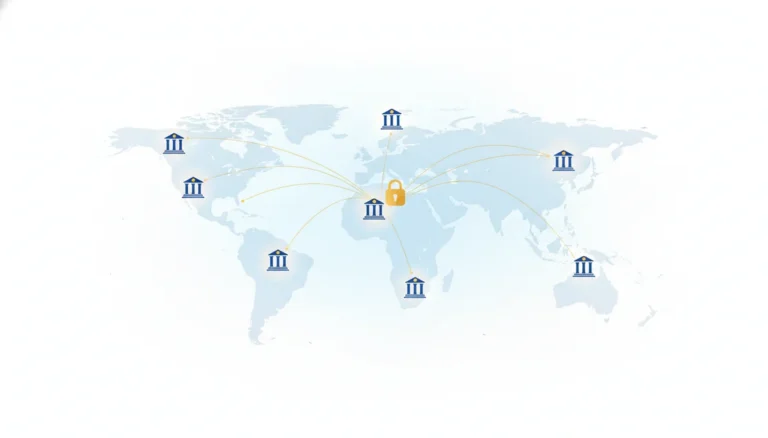
The Common Reporting Standard is the reason your foreign bank wants to know where you pay tax. Under CRS, banks, brokers and insurers in more than a hundred countries collect your tax residence, your tax number and your account balance. Every year they send it to their own tax office, which passes it to the tax office of every country where you’re resident.
Most people find out about the Common Reporting Standard the day a bank sends them a self-certification form. By then the system has been running for years. In 2024 alone, tax authorities swapped data on more than 171 million accounts worth almost EUR 13 trillion. This guide shows exactly what gets reported, who sees it, what changed in 2026, and where the system still has gaps you can use legally.
Put your assets beyond reach in 57 jurisdictions.
Pick where you want your company. We handle the filing, the registered agent, and the bank introduction. From US$1,290, done in days, not months.
- Charging-order protection in jurisdictions courts can't pierce
- Zero tax on foreign income in 30+ territories
- Banking options available
- Fixed price. No surprise fees at closing
What Is the Common Reporting Standard?
The Common Reporting Standard is the OECD’s global rulebook for automatic exchange of financial account information, approved in 2014. Banks and other financial institutions identify account holders who are tax resident abroad, report their details and balances to the local tax authority, and that authority sends the data to the account holder’s home tax office every year.
Nobody asks for it. Nobody suspects you of anything. That’s the point of “automatic”: the data flows whether or not a tax office has ever heard your name. Before CRS, a foreign tax authority had to request information about a specific person, which meant it already needed a lead. Now the leads arrive in bulk.
Early adopters made their first exchanges in 2017, and most other countries followed in 2018. Australia’s version, for example, took effect on 1 July 2017, with its first exchange in 2018. Inside the EU, the same rules run under a directive known as DAC2, which the European Commission describes as based directly on the OECD standard.
People often call it “the Common Reporting Standards” or “CRS reporting standard”. It’s one standard, and every participating country writes it into its own law with only minor local twists. Those local twists matter less than people hope. One client came to us convinced his Asian private bank “didn’t really do CRS”. It did. It had reported him every year since 2018.
How CRS Reporting Works
CRS reporting works in four steps. You give the bank a self-certification of your tax residence. The bank checks it against what it knows about you. Each year it reports your details and account figures to its local tax authority. That authority then sends the data to every country where you declared tax residence.
The bank does most of the work, and it doesn’t need your permission. Opening an account abroad now always involves a CRS form, even at a small cooperative bank. Refuse to fill it in and most banks simply won’t open the account.
This is what lands on your home tax office’s desk, according to the Australian Taxation Office’s reporting guidance:
| Data reported under CRS | Individuals | Companies and other entities |
|---|---|---|
| Name and address | Yes | Yes |
| Every jurisdiction of tax residence | Yes | Yes |
| Tax identification number (TIN) for each | Yes | Yes |
| Date of birth | Yes | No (controlling persons’ dates of birth are reported instead) |
| Account number | Yes | Yes |
| Year-end balance, or the fact the account closed | Yes | Yes |
| Interest, dividends and other income | Yes | Yes |
| Gross proceeds from selling financial assets | Yes (custodial accounts) | Yes (custodial accounts) |
Closing an account doesn’t make it vanish. The bank still reports the payments made that year and the fact that you closed it. A closure just before year end looks exactly like what it is.

Which Institutions Report Under the Common Reporting Standard?
Four kinds of financial institution report under the Common Reporting Standard: banks and other depository institutions, custodians such as brokers, investment entities including many funds and managed structures, and insurers selling cash-value life policies or annuities. If it holds money or financial assets for you, assume it reports.
That list catches more than people expect. A fund administrator, a private bank’s trust company, an online broker and a life insurance wrapper can all be reporting financial institutions. Some trusts and companies are themselves treated as investment entities when a professional manages their assets, which makes them report on their own beneficiaries and owners.
Who Counts as a Reportable Person Under CRS?
A reportable person is any individual or entity that’s tax resident in a country taking part in CRS, other than the country where the account sits. A German resident banking in Switzerland is reportable to Germany. The same German banking in Germany isn’t reported under CRS, because domestic accounts are handled by domestic rules.
Companies get a second look. If a company is a “passive” entity (one that mostly holds investments instead of running a business), the bank looks through it and reports the people who control it. Those controlling persons get the same treatment as individual account holders: name, address, tax residence, TIN and date of birth. Trusts are caught the same way, with settlors, trustees, protectors and beneficiaries all potentially reported. Our guide to CRS reporting for trusts walks through who gets named.
Are There Minimum Balances for CRS Reporting?
There’s no minimum balance for individual accounts under the Common Reporting Standard. A foreign account holding a few hundred dollars is reportable just like one holding millions. The only common threshold lets banks skip reviewing companies’ accounts that existed before CRS started and held no more than USD 250,000.
HMRC’s guidance spells out the reporting thresholds. It also confirms a newer one from the 2026 amendments: e-money accounts are excluded if their rolling 90-day average balance stays at or below USD 10,000.
| Threshold | CRS | FATCA |
|---|---|---|
| Individual accounts | None, every account counts | Banks may exempt depository accounts up to USD 50,000 |
| Company accounts opened before the start date | May be exempted up to USD 250,000 | May be exempted up to USD 250,000 |
| E-money accounts (from 2026) | Excluded at or below a USD 10,000 average balance | Not applicable |
CRS Self-Certification: The Form That Decides Everything
A CRS self-certification is the form on which you tell a financial institution every country where you’re tax resident and your tax number in each. Banks must collect one for every new account. Your answer decides which tax offices receive your data, so it has to be true.
The bank doesn’t just take your word for it. It compares the form with everything else in its file: your address, your phone number, where your salary comes from, standing orders to another country. If something doesn’t match, it asks questions. Our page on CRS self-certification covers how the form works and why the honest answer is also the one that protects you.
This is where people get burned. They pick up a second residence, put it on the form, and keep living exactly where they did before. That’s a false declaration, and the bank’s own checks are designed to catch it. The legal route runs the other way: move your real tax residence first, and the form follows.
Common Reporting Standard Countries
The Common Reporting Standard has 129 committed jurisdictions, and 116 of them were already exchanging data by the OECD’s 2025 peer review. Together they swapped information on more than 171 million accounts worth almost EUR 13 trillion in 2024. Almost every financial centre takes part, including Switzerland, Singapore, Hong Kong, the UAE and the Caribbean islands.
The network keeps thickening. The European Commission counted over 5,400 bilateral exchange relationships as of March 2024. The Global Forum that polices the system now has more than 170 member jurisdictions, according to the OECD’s peer review.
| CRS at a glance | Figure |
|---|---|
| Jurisdictions committed to CRS | 129 |
| Jurisdictions already exchanging | 116 |
| Accounts reported in 2024 | Over 171 million |
| Value of those accounts | Almost EUR 13 trillion |
| Extra revenue reported by members | EUR 97 billion |
| Jurisdictions committed to the crypto framework (CARF) | 76 |
The biggest gap is the United States. It never joined the Common Reporting Standard and runs its own FATCA system instead. That’s why US banks and US company structures come up in almost every serious privacy plan. Our list of non-CRS countries covers the US and the handful of other places outside the network, and our CRS statistics page tracks the numbers year by year.
FATCA and CRS: What’s the Difference?
FATCA and CRS both make foreign banks report accounts to tax authorities, but they target different people. FATCA is a US law aimed at US citizens and residents wherever they live. CRS is a multilateral OECD standard aimed at anyone tax resident in a participating country. A US citizen living abroad usually gets caught by both.
FATCA came first. It was passed as part of the HIRE Act, and the IRS requires foreign financial institutions to report US account holders or face withholding on US-source payments. The OECD then borrowed the model and turned it into a multilateral system that nearly every financial centre signed, apart from America.
| CRS | FATCA | |
|---|---|---|
| Who created it | OECD, endorsed by the G20 | US Congress |
| Who it targets | Tax residents of participating countries | US citizens and US tax residents |
| Trigger | Tax residence | US citizenship or US tax residence |
| Enforcement on banks | Local penalties in each country | Withholding on US payments |
| Individual account threshold | None | Banks may exempt up to USD 50,000 |
| Does the US take part? | No | It’s America’s own system |
Our full guide to FATCA and CRS goes deeper into how the two systems overlap, and how wealthy families plan around both.

CRS 2.0: What Changed in 2026
CRS 2.0 is the amended Common Reporting Standard that financial institutions apply from 1 January 2026, with the first exchanges under the new rules in 2027. It brings certain e-money products and central bank digital currencies into scope, covers indirect crypto exposure through derivatives and funds, and tightens due diligence and reporting.
The OECD’s consolidated standards also carve genuine non-profits out of scope. Everything else moved the other way. Banks now report more about how an account is held and how they reached their conclusion about you. Our CRS 2.0 guide lists every change.
Crypto got its own system alongside CRS. The Crypto-Asset Reporting Framework (CARF) makes exchanges and brokers report their customers’ transactions, and 76 jurisdictions have committed to it, most exchanging from 2027. The EU’s version, DAC8, applies from 1 January 2026, with the first data for 2026 exchanged by 30 September 2027. It reaches stablecoins, e-money tokens and some NFTs. Our guide to CARF crypto reporting covers what that means for your holdings.
Common Reporting Standard Timeline
The Common Reporting Standard went from approval to near-global coverage in about four years, then kept expanding. These are the dates that matter for anyone holding money abroad.
| Year | What happened |
|---|---|
| 2014 | The OECD approves the Standard for Automatic Exchange of Financial Account Information, including the CRS |
| 2017 | Early adopters make their first exchanges; Australia’s CRS law takes effect on 1 July |
| 2018 | Most remaining participants, including Australia, exchange for the first time |
| 2018 (October) | The OECD lists 21 jurisdictions with high-risk citizenship and residence by investment schemes |
| 2022 | The OECD publishes the Crypto-Asset Reporting Framework and amendments to the CRS |
| 2023 (October) | The EU adopts DAC8 for crypto-asset reporting |
| 2026 (1 January) | CRS 2.0 and DAC8 apply; institutions start collecting under the new rules |
| 2027 | First exchanges under amended CRS and CARF; EU crypto data for 2026 due by 30 September |
Each step widened the net and none of them has been reversed. Plan as if that trend continues.
Does a Second Passport Stop CRS Reporting?
A second passport doesn’t stop CRS reporting. The Common Reporting Standard follows tax residence, and citizenship has nothing to do with it. Banks report you to every country where you’re tax resident, whatever passport you show them. A new passport only changes your reporting if you genuinely move your tax residence too.
The OECD saw the trick coming. On 16 October 2018 it published a list of 21 jurisdictions whose citizenship and residence by investment schemes it considered high risk for CRS. They included the Caribbean CBI countries, Cyprus, Malta, Monaco, Panama, the UAE and Vanuatu. The test was simple: a low tax rate on foreign investment income combined with no real requirement to spend time in the country. Banks were told to ask more questions of anyone using those schemes.
None of that makes a second citizenship less valuable. It’s still the best insurance policy against your own government. It just isn’t a CRS shield on its own. Pair it with a real move, documented with a tax residency certificate, and the reporting follows you to your new home.
Legal Ways to Keep Your Financial Privacy Under CRS
The legal ways to keep financial privacy under the Common Reporting Standard all work with the rules: genuinely change your tax residence, bank in a country outside CRS, or hold assets that aren’t financial accounts. Each one is legal when done honestly. Lying on a self-certification isn’t, and it’s the strategy that fails first.
Move your tax residence. CRS sends your data to the country where you’re tax resident. If that’s a country with low or no tax on foreign income, the data lands somewhere that has little reason to care. Our guide to choosing a tax residency country compares the options, and the countries that don’t tax foreign income are the natural shortlist.
Bank outside the CRS network. The United States is the big one. A US LLC with a US bank account sits outside CRS. Our guide to the US bank account for non-residents explains how non-Americans set one up. FATCA still applies if you’re a US person, so this route suits non-Americans.
Hold assets that aren’t financial accounts. CRS covers accounts at financial institutions. Property you own directly and precious metals stored outside a bank sit outside its reporting. Self-custodied crypto has largely sat outside it too, though CARF now reaches the exchanges and brokers you buy through.
Use the remaining loopholes carefully. A few structural gaps still exist, and some close a little more each year. Our breakdowns of CRS loopholes and the legal ways to avoid CRS show which ones still hold up after the 2026 amendments.
Common Mistakes With the Common Reporting Standard
The mistakes we see with the Common Reporting Standard almost all come from assuming the old offshore rules still apply. They stopped applying years ago.
Thinking a small account won’t be reported. There’s no minimum for individuals. Every foreign account counts.
Putting a company in the middle. A holding company that only owns investments is passive, and the bank reports the people behind it.
Relying on a second passport. Your reporting follows your tax residence, so a new passport on its own changes nothing.
Declaring a residence you don’t live in. Banks cross-check your form with your address, payments and contact details. A paper residence won’t survive that.
Closing accounts in a panic. The closure gets reported with the year’s payments. It draws attention instead of avoiding it.
Ignoring 2026. CRS 2.0 and CARF pulled in e-money, digital currencies and crypto platforms. Plans built before 2026 need a fresh look.
Frequently Asked Questions About the Common Reporting Standard
What is the Common Reporting Standard in simple terms?
What does CRS stand for in banking?
Which countries are not part of the Common Reporting Standard?
What information is reported under CRS?
Is there a minimum balance for CRS reporting?
What is the difference between FATCA and CRS?
What is CRS 2.0?
Does CRS apply to trusts and companies?
Can a second passport help me avoid CRS reporting?
Is it legal to avoid the Common Reporting Standard?
The Common Reporting Standard Isn’t Going Away
The Common Reporting Standard has quietly become the most effective financial surveillance system ever built, and 2026 made it wider. You can’t opt out by hoping your bank is small or your balance is modest. You can plan around it: real tax residence in the right country, banking where CRS doesn’t reach, and assets it was never designed to see.
Start with the non-CRS countries list, then talk to us about a residency that puts your tax home somewhere that leaves you alone.
Sources and References
- OECD, International Standards for Automatic Exchange of Information in Tax Matters
- OECD Global Forum, Peer Review of the Automatic Exchange of Financial Account Information: 2025 Update
- OECD, OECD clamps down on CRS avoidance through residence and citizenship by investment schemes
- European Commission, DAC2: automatic exchange of financial account information
- European Commission, DAC8: crypto-asset reporting
- Australian Taxation Office, Automatic exchange of information: CRS and FATCA reporting
- HM Revenue and Customs, International Exchange of Information Manual: reporting thresholds
- Internal Revenue Service, Foreign Account Tax Compliance Act (FATCA)