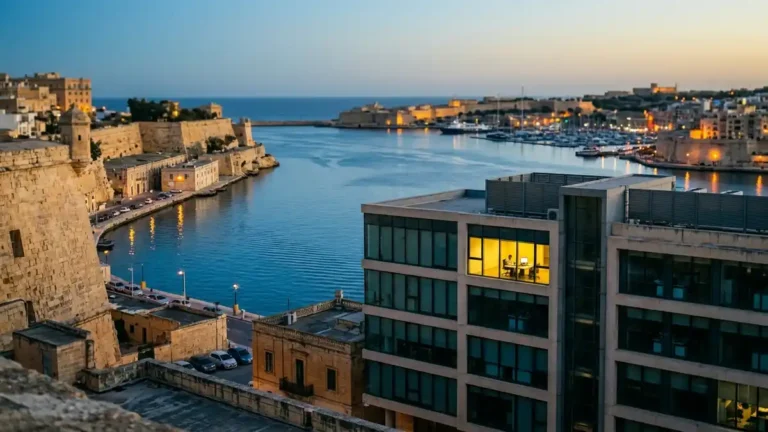
Malta tax avoidance is now the subject of a Senate inquiry, after Senator Ron Wyden wrote to the US chiefs of PwC, KPMG, Deloitte and EY demanding to know how they’ve helped American multinationals park profits in Maltese subsidiaries. The letters went out on Wednesday, and each firm has until November 10 to answer seven pointed questions.
WASHINGTON, D.C., United States – 23 October 2026
Wyden is the ranking Democrat on the Senate Finance Committee. His letter to PwC says he’s concerned the firms are “devising tax planning structures that help large multinational corporations avoid corporate income taxes,” and that the use of “employee-free shell companies in Malta” deserves a closer look.
The trigger was a New York Times investigation that, according to Accounting Today, found the Big Four “aggressively marketing” Malta-based strategies. Liberty Mundo’s offshore companies coverage has tracked this squeeze on low-tax hubs all year. A Times reporter visited a Maltese office building where many of the firms’ clients keep subsidiaries. It was mostly empty.
Put your assets beyond reach in 57 jurisdictions.
Pick where you want your company. We handle the filing, the registered agent, and the bank introduction. From US$1,290, done in days, not months.
- Charging-order protection in jurisdictions courts can't pierce
- Zero tax on foreign income in 30+ territories
- Banking options available
- Fixed price. No surprise fees at closing
What did Wyden ask the Big Four about Malta tax avoidance?
Wyden’s Malta tax avoidance letters ask each Big Four firm seven questions: whether it built Maltese structures for US clients, whether it said they could sidestep US tax or the Pillar 2 minimum tax, and whether it’ll hand over slide decks, savings estimates, client numbers, fees and dealings with Maltese officials. Answers are due 10 November 2026.
The letter to PwC CEO Paul Griggs ties the strategies to “round-tripping” and “global blending,” which Wyden says exploit flaws created by the 2017 tax law. He’s asked for marketing materials with client names redacted.
Let’s be blunt about the limits. A minority-party letter carries no subpoena power on its own, and the firms can answer narrowly. Still, paper trails are what future legislation gets built on. For anyone who uses offshore companies in 60+ jurisdictions, that’s the signal worth watching.
How does the Malta 5% tax rate actually work?
The Malta 5% tax rate comes from the Malta tax refund system. A Maltese company pays 35% corporate tax, then shareholders claim back six-sevenths of that tax when profits are distributed as dividends, according to KPMG Malta’s guide to the tax system. The result is an effective rate of roughly 5% on trading profits.
Passive interest and royalties get a five-sevenths refund instead, which lands at about 10%. Since September 2025, companies can also elect a flat 15% final tax with no refund, locked in for at least five years, per PwC’s Malta tax summary. You can see the full mechanics on our Malta company formation page.
| Malta route | Headline tax | Shareholder refund | Effective rate |
|---|---|---|---|
| Trading profits | 35% | 6/7 of tax paid | About 5% |
| Passive interest or royalties | 35% | 5/7 of tax paid | About 10% |
| Profits with foreign tax relief claimed | 35% | 2/3 of tax paid | About 11.7% (before foreign tax) |
| Optional final tax (from Sept 2025 rules) | 15% | None | 15% |
| Pillar 2 income inclusion and UTPR rules | Deferred by Malta, with the EU directive allowing a delay up to 31 December 2029 | ||
Here’s what clients miss when we set up Maltese companies for them. The 35% gets paid first, and the refund only arrives after the dividend and the claim are processed, so cash flow planning matters from day one. On paper it’s 5%. In your bank account, for a while, it’s 35%.
Why is Malta tax avoidance growing now?
Malta tax avoidance is growing because the global minimum tax hasn’t bitten there yet. Malta used an EU directive option to delay the Pillar 2 income inclusion and undertaxed profits rules until the end of 2029, according to KPMG Malta, and a January deal exempted US groups from key parts of the minimum tax, Bloomberg Tax reported.
That’s left a window, and the money’s flowing through it. The Times reported that US companies’ Maltese subsidiaries rose about 70% over three years. It also cited tax-research data showing profits US companies booked in Malta jumped from $134 million in 2017 to $5.6 billion in 2022. Read that number twice.
The paper named Thermo Fisher, Abbott Laboratories, S&P Global, Yum Brands and Crocs among the users, and said Abbott moved a zero-employee subsidiary’s tax residence to Malta 13 days before Bermuda’s new corporate tax kicked in. These are the Times’ findings, and nobody’s been charged. Profit shifting like this is why the EU tax haven blacklist keeps expanding.
Who is affected by the Wyden Big Four letters?
The Wyden Big Four letters directly affect PwC, KPMG, Deloitte and EY, which must respond by 10 November 2026, and indirectly the US multinationals using Maltese financing and IP subsidiaries with few or no local staff. Individual owners of small Malta trading companies with real operations aren’t named or targeted in any of the four letters.
The next pressure point is the minimum tax itself. Once Malta switches on the 15% rules, big groups lose most of the gap anyway. Our breakdown of how a 15% top-up tax works in practice shows what that looks like for groups caught by it.
I’ve watched this play out before. Ireland’s famous structures for US tech giants died after years of hearings and letters exactly like these.
Does this change anything for a Malta holding company?
For a Malta holding company owned by an entrepreneur, nothing changes today. The 35% rate, the refund system, the participation exemption and the optional 15% final tax all remain law in Malta. What’s rising is scrutiny of companies with no staff, no office and no decisions taken on the island.
Most clients who come to us asking about Malta run a real trading business, and the first question we push back with is simple: where do the directors actually sit and decide? If the honest answer is “nowhere near Valletta,” the structure’s weak whatever the tax rate. Substance is cheap insurance. Malta also runs separate regimes for individuals, like the Malta Individual Tax Programme, which this inquiry doesn’t touch.
Bottom line: the 5% headline survives, and empty-box structures are on borrowed time.
Malta Tax Avoidance FAQ
Is Malta tax avoidance illegal?
When do the Big Four have to answer Wyden?
What is the Malta 5% tax rate?
When will the Malta minimum tax apply?
Should I close my Malta holding company because of the Malta tax avoidance probe?
Sources and References
- US Senate Committee on Finance, Letter from Sen. Ron Wyden to PwC on Malta tax structures (21 October 2026)
- Accounting Today, Big Four probed on offshore tax shelter consulting
- KPMG Malta, The Malta Tax System
- KPMG Malta, Malta transposes the EU Minimum Tax Directive with delayed adoption of IIR, UTPR and QDMTT
- PwC Worldwide Tax Summaries, Malta: Corporate taxes on corporate income
- Bloomberg Tax, Companies’ Big Use of Tax Havens to Be Hit With New Obstacles