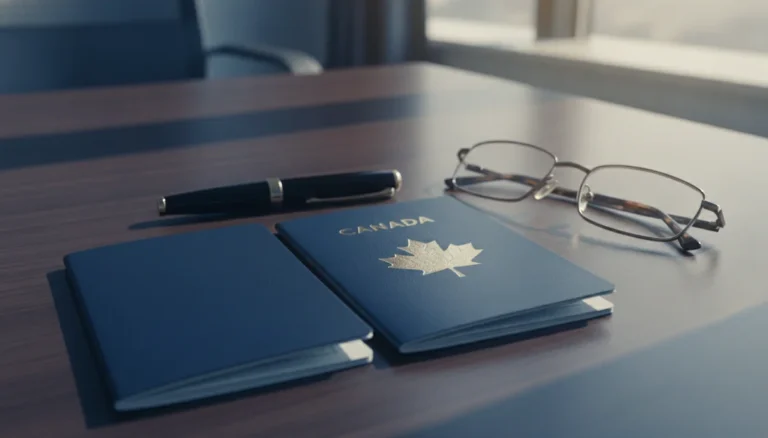
Canadian dual citizenship by descent lets an American with a Canadian parent, grandparent or older ancestor hold a Canadian passport while keeping the US one they already have. Neither government makes you choose. Ottawa doesn’t ask you to give anything up, and Washington doesn’t treat a Canadian claim as a reason to strip your American citizenship.
That’s the good news. The rest of the picture is more mixed. Uncle Sam still taxes you on everything you earn, wherever you live. Each country wants to see its own passport at the border. And the Canadian side of the paperwork currently moves at a pace that would embarrass a glacier.
Dual citizenship US Canada is one of the easiest combinations in the world to hold. This guide covers the parts of Canadian citizenship by descent that matter specifically to Americans: whether you can keep both passports, how the two tax systems treat you, which passport to use where, and what a Canadian passport actually adds to the one you hold now.
Put your assets beyond reach in 57 jurisdictions.
Pick where you want your company. We handle the filing, the registered agent, and the bank introduction. From US$1,290, done in days, not months.
- Charging-order protection in jurisdictions courts can't pierce
- Zero tax on foreign income in 30+ territories
- Banking options available
- Fixed price. No surprise fees at closing
Can Americans Have Canadian Citizenship by Descent?
Yes. Americans can have Canadian citizenship by descent if they descend from a Canadian citizen and can document each link in the chain. Under Bill C-3, in force since 15 December 2025, most people born abroad to a Canadian parent before that date are automatically Canadian. US law doesn’t stop an American from holding that status.
Bill C-3 (S.C. 2025, c. 5) received Royal Assent on 20 November 2025 and took effect on 15 December 2025. It followed the December 2023 Ontario Superior Court ruling in Bjorkquist et al. v. Canada, which struck down the first-generation limit Canada had applied since 17 April 2009. That limit had cut off citizenship for anyone born abroad to a Canadian parent who was also born abroad.
For people born before 15 December 2025, IRCC now says that “in most cases you’re automatically a Canadian citizen” if you were born outside Canada to a Canadian parent. Citizenship may also have been restored or given to people in the second generation or later. IRCC’s 2025 rules page states no cap on generations for this group, though you still have to prove every generation with documents.
Most of the Americans we work with fall into one of three groups:
- A Canadian-born parent. The simplest file. One link to prove.
- A Canadian-born grandparent whose child (your parent) was born in the US. Before Bill C-3, the first-generation limit usually blocked this. Now it’s usually fine.
- Great-grandparents and further back. Possible, but the documents get harder to find with every generation.
One pattern shows up constantly. A client from Michigan or Massachusetts tells us his grandmother “moved down from Ontario in the 1950s” and assumes the family’s Canadian link died with her. Then the paperwork turns up a provincial birth certificate in a shoebox, and suddenly he and his children all have a claim. Plenty of Americans are already Canadian on paper and don’t know it.
The new rules are different for anyone born on or after 15 December 2025. That child is Canadian only if the Canadian parent (who was born or adopted abroad) spent at least 1,095 cumulative days in Canada before the birth, unless that parent was a Crown servant at the time. If you’re an American dual citizen planning a family, that rule matters for your kids, so count your days now.
Does the US Allow Dual Citizenship with Canada?
Yes. The US State Department says US law “does not mention dual nationality or require a person to choose one nationality or another.” Canada’s travel.gc.ca site says Canada allows multiple citizenships. Dual citizenship US Canada is therefore fully lawful on both sides, and a descent claim doesn’t put your American citizenship at risk.
The State Department’s dual nationality page goes further. A US citizen can even naturalize abroad without risking US citizenship. Losing it requires a voluntary act done with the intent of giving up US nationality.
Descent claimants are in an even safer spot. You aren’t naturalizing in Canada at all. You’re asking Ottawa to confirm a status you already hold by law, through a citizenship certificate. There’s no reason for the State Department to read that as an intention to walk away from America. Our guide to dual citizenship pros and cons covers the wider trade-offs.
On the Canadian side, the Government of Canada’s dual citizenship page is short and clear: you can hold other citizenships while keeping your Canadian one.
| Question | United States | Canada |
|---|---|---|
| Allows dual citizenship? | Yes, no requirement to choose | Yes, multiple citizenships allowed |
| Basis for taxing individuals | Citizenship (worldwide income, wherever you live) | Residence (non-residents taxed only on Canadian-source income) |
| Passport rule for citizens | Must use a US passport to enter and leave the US | Canadian-American dual citizens may fly in on either valid passport |
| Lose citizenship by gaining the other? | No, loss requires a voluntary act with intent to give it up | No |
| Visa-free rank (Passport Freedom Index) | 10th (179 visa-free) | 8th (181 visa-free) |
That table is the whole relationship in five rows. The rest of this guide is detail.

How Canadian Dual Citizenship by Descent Works in Practice
Canadian dual citizenship by descent works in two stages. First, the law makes you a citizen automatically if your ancestry qualifies. Second, you apply to IRCC for a citizenship certificate (form CIT 0001), which proves that status. Only once you hold the certificate can you apply for a Canadian passport. Your US citizenship stays untouched throughout.
The certificate is the key. Without it, Canada won’t issue you a passport, and you can’t easily prove your status to a bank, an employer or a border officer.
Here’s what the process costs in government fees, all in Canadian dollars:
| Item | Official fee (CAD) | Notes |
|---|---|---|
| Citizenship certificate (proof of citizenship) | $75 per person | Non-refundable once processing begins |
| Search of citizenship records | $75 | Useful if an ancestor’s status is unclear |
| Adult passport, 10-year, applied for outside Canada | $266.25 | $163.50 if applied for in Canada |
| Adult passport, 5-year, applied for outside Canada | $194.25 | $122.50 if applied for in Canada |
| Child passport, 5-year, applied for outside Canada | $102.50 | $58.50 if applied for in Canada |
Passport fees shown apply from 31 March 2026. For a single American adult applying from the US, the Canadian government’s total take is $341.25 for the certificate plus a 10-year passport. Cheap, by second-passport standards.
The real cost is time. IRCC’s processing-time tool showed roughly 33 months for proof of citizenship in September 2026, up from about 15 months in June, with around 136,000 people waiting according to news reports citing IRCC data. We track that queue closely in our piece on the Canadian citizenship by descent backlog. Always check the live figure on IRCC’s tool before you plan around it.
Put that number next to the $75 fee and you see the real price. If you file late and the queue grows another year, that’s a year of your life spent without a passport you were legally entitled to, and nobody’s refunding that.
US Canada Dual Citizenship Taxes: What Actually Changes
US Canada dual citizenship taxes are simpler than most people fear. Adding Canadian citizenship changes nothing for the IRS: you were already taxed on worldwide income as an American. Canada taxes based on residence, so if you keep living in the US, Canada doesn’t tax your foreign income. Only Canadian-source income gets taxed by Canada.
Let’s take the two governments one at a time.
The IRS: worldwide taxation, no matter what
The United States is one of the very few countries that taxes by citizenship. The IRS page for citizens abroad states it plainly: “You are subject to tax on worldwide income from all sources.” That’s true whether you live in Ohio, Vancouver or Lisbon.
A Canadian passport doesn’t move that needle. Neither does moving to Canada. Washington will keep sending you a bill as long as you hold a US passport. The IRS says the quiet part out loud on its own website: the bill follows the passport wherever you go.
Relief exists, but it’s narrower than people assume:
- Foreign Earned Income Exclusion (FEIE). Covers wages, salaries, professional fees and self-employment income earned abroad, up to $132,900 per person for 2026 ($130,000 for 2025). It doesn’t cover pensions, annuities or Social Security, and it only helps if you actually live and work outside the US.
- Foreign Tax Credit. If you pay foreign income tax on income the US also taxes, you may be able to claim a credit or an itemized deduction for it.
- FBAR reporting. Open a Canadian bank account and you must report it to the Treasury once your combined foreign accounts top $10,000 at any point in the year, even if they earn nothing.
And the scrutiny is growing. Reuters reported in 2026 that the IRS was weighing a citizenship check-box on Form 1040, which we covered in our analysis of the IRS citizenship question. Banks already ask whether you’re a US person under CRS and FATCA reporting, so assume the IRS will know about the Canadian passport eventually and keep your filings clean.
The CRA: residence decides everything
Canada doesn’t care what passport you carry for tax purposes. It cares where you live. The Canada Revenue Agency’s non-resident page says: “As a non-resident of Canada, you pay tax on income you receive from sources in Canada.”
So an American who claims Canadian citizenship and keeps living in Texas has no Canadian tax on US salary, US investments or US property. If you inherit a Toronto rental flat, the rent is Canadian-source and Canada will want its share, usually through 25% Part XIII withholding unless the tax treaty reduces it.
Move to Canada and the picture flips. You’d become a Canadian tax resident, and the CRA would tax your worldwide income alongside the IRS. The foreign tax credit and the Canada-US tax treaty stop most double taxation, but you’ll be filing two full returns every year.

| Your situation | US tax | Canadian tax |
|---|---|---|
| Dual citizen living in the US | Worldwide income, as before | Only on Canadian-source income |
| Dual citizen living in Canada | Worldwide income; FEIE on earned income and foreign tax credit may offset it | Worldwide income as a Canadian resident |
| Dual citizen living in a third country | Worldwide income; FEIE on earned income only | Only on Canadian-source income |
| Retiree living abroad on US pension and Social Security | Taxable; FEIE doesn’t apply to pensions or Social Security | Only on Canadian-source income |
Notice the third row. A US-Canadian dual citizen living in, say, Portugal or Panama owes Canada nothing on foreign income. The second passport adds options, and Canada only joins the IRS in taxing you if you become Canadian resident.
Tax law changes and individual facts matter, so speak to a qualified cross-border tax adviser before you move anywhere. The broad rules above come straight from the IRS and the CRA.
Which Passport Do You Use at Each Border?
Use your US passport to enter and leave the United States, because US law requires it of every American, dual citizens included. To fly into Canada, Canadian-American dual citizens may use either their valid US passport or their valid Canadian passport, but Canada advises carrying both. Everywhere else, you can use whichever passport suits the trip.
The US rule is absolute. The State Department says “U.S. nationals, including dual nationals, must use a U.S. passport to enter and leave the United States.” Show up at JFK with only a Canadian passport and you’ll have a long conversation with CBP.
Canada is more relaxed with Americans than with any other dual nationals. Most dual Canadians can’t fly into Canada on a foreign passport. Canadian-Americans have a carve-out. IRCC’s page for dual Canadian citizens says you can fly in with “either your valid U.S. passport or your valid Canadian passport.” If you arrive on the US one, carry proof of your Canadian citizenship and expect possible immigration screening.
In practice, the clean routine looks like this:
- Leaving the US: show the US passport to the airline and CBP.
- Arriving in Canada: show the Canadian passport. You’re entering as a citizen, and the border officer has nothing to screen.
- Third countries: pick whichever passport gets better visa terms, and use the same one to enter and leave that country.
One mistake we see is people booking a flight with one passport and entering with the other. Airlines check the passport on the booking against the passport at the gate. Keep the names on both passports identical where you can, and if they differ, carry the documents that link them.
What a Canadian Passport Adds to Your US Passport
On visa-free access alone, a Canadian passport ranks 8th on Liberty Mundo’s Passport Freedom Index, with 181 visa-free destinations. The US passport ranks 10th with 179. Add the right to live and work in Canada, Canadian consular help and a second document, and the value is clear.
Most Americans assume their passport is the strongest in the world. On raw visa-free numbers the gap is small, just two destinations. But the Passport Freedom Index scores more than mobility. It weighs financial freedom, citizenship security, state protection and personal liberty, and that’s where Canada pulls ahead.
| Passport | Visa-free rank | Freedom Score | Visa-free destinations |
|---|---|---|---|
| Ireland | 4 | 84.5 | 185 |
| United Kingdom | 6 | 82.1 | 183 |
| Canada | 8 | 79.7 | 181 |
| United States | 10 | 71.8 | 179 |
Source: Liberty Mundo Passport Freedom Index, default weighting, October 2026.
The practical gains go beyond the scorecard:
- The right to live and work in Canada with no visa, no points test and no sponsor.
- A second document. If one passport is lost, held for a visa or stuck in a renewal queue, you can still travel.
- A different flag on the cover. Some places treat Americans with more suspicion, or more paperwork, than Canadians. Travelling on the Canadian passport is perfectly lawful there.
- A plan B for the family. Your children may have claims through you, subject to the rules for their birth date.
There’s a privacy angle too. Holding a second passport is legal, and using it outside the US is your business. We cover the wider picture in our guide to second passport privacy. Just remember the US passport rule at your own border and the bank questionnaires that ask about US status.
If you’re weighing a Canadian claim against other ancestral options, our citizenship by descent guide covers the other countries that recognise ancestry. Nothing stops you holding several. An American with a Canadian grandmother and an Irish grandfather can, and should, file both, and our guide to Irish citizenship by descent covers the second claim.

How to Claim Canadian Dual Citizenship by Descent as an American
Claiming Canadian dual citizenship by descent as an American takes six steps: confirm your line, gather documents for every generation, apply for a citizenship certificate on form CIT 0001, pay the $75 fee, wait for IRCC to process it, then apply for your Canadian passport. You keep your US passport throughout and never have to surrender it.
Step 1: Map your Canadian line. Work out which ancestor was Canadian and how each generation links to you. Note birth dates, especially whether anyone in the chain was born on or after 15 December 2025, because the 1,095-day presence rule applies to them.
Step 2: Collect documents for every generation. You need proof of parentage and Canadian citizenship for you, your parent, grandparent and anyone further back. A provincial birth certificate is the best evidence for a Canadian-born ancestor. US birth certificates show each parent-child link. If an original can’t be found, IRCC accepts alternatives such as hospital or baptismal records, provided you explain in writing and show you tried.
Step 3: Complete form CIT 0001. This is the Application for a Citizenship Certificate (Proof of Citizenship). Include the CIT 0014 document checklist, two identical citizenship photos, and clear colour copies. Sign and date it so it reaches IRCC within 90 days. Many applicants born after 15 February 1977 can apply online, and an online application has to be submitted within 60 days of starting it.
Step 4: Pay the fee and submit. The fee is $75 CAD per person, paid online. Paper applications go by tracked post or courier to the processing centre listed for your country.
Step 5: Wait for the certificate. Check IRCC’s processing-time tool for the live figure. It showed roughly 33 months in September 2026. Urgent processing is possible in limited cases, such as travel because of a death or serious illness, but qualifying doesn’t guarantee speed.
Step 6: Apply for your Canadian passport. With the certificate in hand, apply for the passport. A 10-year adult passport costs $266.25 CAD when you apply from outside Canada. Keep renewing your US passport as normal.
Every client file we’ve handled lives or dies on Step 2. Filling in the form takes an evening at most, while tracking down a 1930s Saskatchewan birth record can take months, and we’ve seen applications sent back because a single linking document was a photocopy of a photocopy. Start with the oldest generation and work forward.
Common Mistakes Americans Make with Canadian Dual Citizenship by Descent
The most common mistakes Americans make with Canadian dual citizenship by descent are waiting too long to file, assuming a claim threatens US citizenship, sending incomplete generational documents, and thinking the Canadian passport changes their US tax position. Each one costs time, and with a queue of roughly 33 months, time is the scarcest resource.
Waiting for the queue to shrink. It’s been growing all year. Your place in line only starts when IRCC receives your file.
Fearing for the US passport. A citizenship certificate confirms something you already are. It’s the furthest thing from a voluntary act to give up US nationality.
Skipping a generation. IRCC wants evidence for every link. A great family story isn’t evidence, and third-party records alone can’t support the application.
Expecting a tax break. This is where people get confused. The Canadian passport gives you more places to live, work and travel, while your IRS bill stays exactly the same.
Forgetting the kids. Children born before 15 December 2025 may be citizens through you. Children born after it depend on your days in Canada. Map both before you file.
Should You Renounce Either Citizenship?
No one is required to renounce either citizenship to hold Canadian dual citizenship by descent. Both countries allow you to keep both indefinitely. Renouncing US citizenship is a separate, permanent decision with its own tax consequences, and it has nothing to do with filing a Canadian claim.
Some Americans do eventually look at giving up US citizenship, usually because of the worldwide tax rules. It’s a formal, permanent step, and the US can charge an exit tax on some people who leave. We cover the mechanics in our guide to renouncing citizenship. Whatever you decide on that front later, a second citizenship you qualify for is worth holding, so file the Canadian claim regardless.
Canadian Dual Citizenship by Descent: Frequently Asked Questions
Can I keep my US citizenship if I get Canadian dual citizenship by descent?
Can Americans have Canadian citizenship by descent through a grandparent?
Does Canadian dual citizenship by descent mean I pay Canadian taxes?
Do US Canada dual citizenship taxes mean filing two returns?
Which passport should a US-Canadian dual citizen use to enter the US?
How long does it take to get proof of Canadian dual citizenship by descent?
How much does Canadian dual citizenship by descent cost?
Is the Canadian passport stronger than the US passport?
Does the FEIE cover all income for Americans living in Canada?
Will my children get Canadian citizenship through me?
Final Thoughts on Canadian Dual Citizenship by Descent
For Americans with a Canadian ancestor, the legal side of dual citizenship US Canada was settled long ago. The open question is how soon you file, because the queue keeps getting longer. Canadian dual citizenship by descent costs very little, puts nothing American at risk, and leaves your tax position exactly where it was unless you move north.
Gather the documents, file the CIT 0001, and keep renewing your US passport while you wait. For the full eligibility rules, go back to our main Canadian guide linked at the top, and see all our Canada coverage for updates as IRCC works through the backlog.
Sources and References
- Immigration, Refugees and Citizenship Canada, Changes to citizenship rules as of 2025
- Parliament of Canada, LEGISinfo: Bill C-3, An Act to amend the Citizenship Act (2025)
- Immigration, Refugees and Citizenship Canada, Dual Canadian citizens need a valid Canadian passport
- Government of Canada, Dual citizens: travel and tourism
- US Department of State, Dual Nationality
- Internal Revenue Service, US citizens and resident aliens abroad
- Internal Revenue Service, Figuring the foreign earned income exclusion
- Canada Revenue Agency, Non-residents of Canada