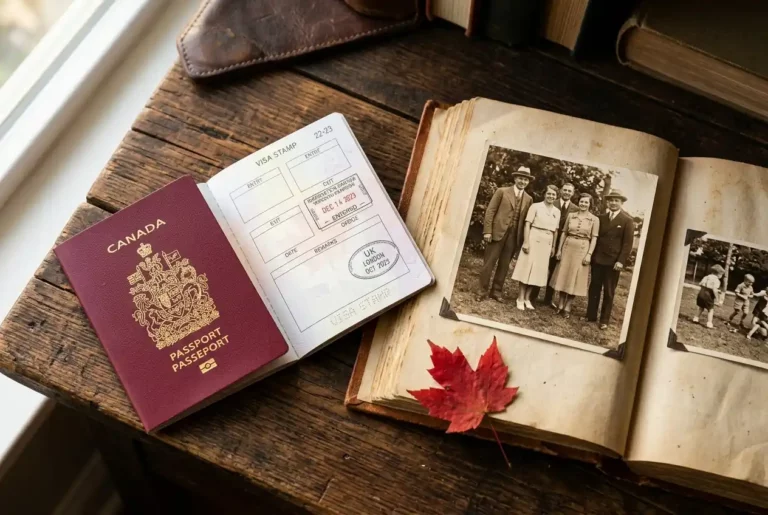
Canadian citizenship by descent just became the most generous ancestry passport programme on earth. On December 15, 2025, Canada’s Bill C-3 permanently removed the first-generation limit, and millions of Americans with Canadian parents, grandparents, or even great-great-grandparents now qualify for a Canadian passport. The cost? A $75 CAD application fee. No investment. No residency requirement. No language test.
If that sounds too good to be true, it isn’t. But there are rules most people are getting wrong, documents that trip up nearly every applicant, and a critical date split that changes everything depending on when you were born. This guide covers every angle: who qualifies for Canadian citizenship by descent under the new law, what it costs, how to prove your lineage, what a Canadian passport actually gets you, and the mistakes that delay applications by months.
Most guides stop at “check if you have a Canadian ancestor.” That’s the easy part. The hard part is assembling an unbroken chain of certified documents across multiple generations and jurisdictions, understanding the 1,095-day rule that affects future generations, and knowing how Canadian citizenship for Americans interacts with US tax obligations. We’ll cover all of it.
What Changed: Bill C-3 and Canadian Citizenship by Descent
The backstory matters because it explains why this law exists and why it’s so generous.
In 2009, Canada’s Conservative government introduced the “first-generation limit.” If you were a Canadian citizen born outside Canada, your children could claim Canadian citizenship by descent. But your grandchildren couldn’t. The bloodline, legally speaking, stopped after one generation born abroad.
Thousands of families fell through the cracks. Canadians who moved to the US for work, started families, and watched their grandchildren grow up with no claim to the citizenship their own parents held. The government called it a security measure. Many called it absolute lunacy.
On December 19, 2023, the Ontario Superior Court of Justice agreed with the “lunacy” camp. In Bjorkquist v. Canada (2023 ONSC 7152), the court ruled the first-generation limit unconstitutional. It violated Section 15 (equality rights) by creating two classes of Canadians: those born in Canada who could pass citizenship forever, and those born abroad who couldn’t. It also violated Section 6 (mobility rights) by effectively punishing Canadians who lived or worked overseas.
The government didn’t appeal. Instead, it drafted Bill C-3, An Act to Amend the Citizenship Act. The bill received Royal Assent on November 20, 2025, and came into force on December 15, 2025.
The result? The first-generation limit is gone. Permanently. Retroactively. If you have a Canadian ancestor anywhere in your family tree, the door is now open.
Who Qualifies for Canadian Citizenship by Descent in 2026
Bill C-3 created two tracks, and the distinction between them is the single most important detail in this entire guide. Getting them confused will cost you time and possibly your application.
Track 1: Born Before December 15, 2025 (No Generational Limit)
If you were born before December 15, 2025, and you can trace an unbroken line of descent back to a person who was born or naturalised in Canada, you are already a Canadian citizen. Right now. Automatically. Retroactively.
Read that again. You don’t need to “apply for Canadian citizenship by descent.” You already have it. What you’re applying for is a citizenship certificate, a piece of paper that proves what the law already says is true.
There is no generational limit. Your parent was born in Canada? You qualify. Your grandparent? You qualify. Your great-great-grandmother was born in Manitoba in 1890? You qualify. The chain can go back as far as your records can prove it.
No residency requirement. No language test. No citizenship exam. No minimum income. Dead simple.
Track 2: Born On or After December 15, 2025 (The 1,095-Day Rule)
Babies born on or after December 15, 2025 face tighter rules. If your Canadian parent was also born outside Canada, that parent must have accumulated at least 1,095 days of physical presence in Canada before your birth. That’s three cumulative years, and the days don’t need to be consecutive. Childhood summers, university semesters, work stints, they all count as long as you can prove them.
Miss that threshold, and Canadian citizenship by descent does not pass to the child. Full stop.
Why does this matter to you right now? Because it means Canadian citizenship by descent has a built-in expiry for future generations. Your children, born abroad after December 2025, only inherit your Canadian citizenship if you meet the 1,095-day physical presence requirement first. The current generation of Americans with Canadian ancestry has a free pass. The next generation might not.
| Criteria | Born Before Dec 15, 2025 | Born On/After Dec 15, 2025 |
|---|---|---|
| Generational limit | None | None (with conditions) |
| Residency required | No | Canadian parent born abroad must have 1,095 days in Canada |
| Citizenship status | Automatic and retroactive | Conditional on parent’s physical presence |
| Language or citizenship test | No | No |
| Application type | Proof of citizenship (certificate) | Proof of citizenship (certificate) |
| Application fee | $75 CAD | $75 CAD |
Canadian Citizenship by Descent for Americans: Why This Matters Now
CNN reported in March 2026 that thousands of Americans are gathering paperwork to claim Canadian citizenship “just in case.” The political motivations are their own business. The practical reality is what matters.
An estimated 2 to 3 million Americans in New England alone are eligible. Between 1870 and 1930, massive waves of Canadians migrated south into the United States, settling across Maine, Vermont, New Hampshire, Massachusetts, Connecticut, and Rhode Island. Many came from Quebec and the Atlantic provinces. Their descendants, millions of them, are now sitting on a free second passport.
Canada fully recognises dual citizenship. Always has. You don’t lose your US citizenship by claiming a Canadian one. Both countries allow you to hold both passports simultaneously, travel on whichever one is more convenient, and live in either country. The Canadian Citizenship Act places no restrictions on dual nationals.
And the numbers are stark. As of early March 2026, nearly 48,000 people are waiting for decisions on citizenship certificate applications, with processing times running about 11 months. That backlog will grow. Every week the story gets more coverage, more people start digging through their family records.
How to Prove Canadian Citizenship by Descent: Documents You Need
Eligibility is the easy part. Proof is where applications die.
IRCC (Immigration, Refugees and Citizenship Canada) doesn’t care what Ancestry.com says. They don’t accept screenshots from genealogy websites. They don’t accept photocopies. They want official, certified documents creating an unbroken chain from you back to your Canadian ancestor.
The Document Chain
Think of it as links in a chain. Every link must be an official, certified document. One missing link and the chain breaks.
- Your birth certificate showing your parents’ names
- Your parents’ birth certificates showing their parents’ names
- Your grandparents’ birth or baptismal certificates (and further back as needed)
- Marriage certificates for every generation to track name changes between maiden and married names
- The anchor document: proof your Canadian ancestor was a Canadian citizen, either a birth certificate showing birth in Canada, a naturalisation certificate, or a prior citizenship certificate
Every single document must be an official copy or a certified true copy from the issuing authority. Birth certificates come from provincial vital statistics offices in Canada, or equivalent state offices in the US. Marriage certificates, same deal. If your ancestor was born in Quebec in 1905, you’re contacting the Directeur de l’etat civil du Quebec, not downloading something from a website.
What to Do When Records Are Missing
Old records get lost. Buildings burn down. Archives move. Parish records from the 1800s aren’t always digitised. When primary documents are unavailable, IRCC accepts supporting evidence to fill gaps: census records, death certificates, immigration records, property deeds, church records, and school enrolment documents.
For anyone with French-Canadian ancestry (and that’s a huge number of New England applicants), the Genealogie Quebec database is an invaluable research tool. It can help you identify which records exist and where to find them. But remember, IRCC wants the official paper, not the database screenshot. Use genealogy databases to locate records, then order the certified copies.
Practical Tips That Save Months
Budget $200 to $500 for document retrieval costs on top of the $75 application fee. Certified copies from vital statistics offices typically cost $15 to $75 each, and you’ll need several across multiple jurisdictions.
Start with the anchor. Work backwards from your Canadian ancestor to you, not the other way around. If the anchor document doesn’t exist or can’t be found, nothing else matters.
Request documents from multiple jurisdictions simultaneously. Waiting for one certificate before ordering the next turns an 11-month process into a 15-month one.
How to Apply for Canadian Citizenship by Descent: Step by Step
Step 1: Research your Canadian ancestor. Identify the “anchor” in your family tree, the person born or naturalised in Canada. Talk to family members, check family records, and use genealogy databases like Genealogie Quebec, Ancestry.ca, or provincial archives to confirm their Canadian birth or citizenship. You need a name, approximate date, and location.
Step 2: Order certified documents for every link in the chain. Contact vital statistics offices in each province or state where your ancestors’ events occurred. Order certified copies of birth certificates, marriage certificates, and the anchor’s proof of Canadian citizenship. Do this for all jurisdictions simultaneously to save months of waiting.
Step 3: Complete form CIT 0001. Download the Application for a Citizenship Certificate for Adults and Minors (Proof of Citizenship) from the IRCC website. Fill it out completely. Incomplete forms are the most common cause of processing delays.
Step 4: Pay the $75 CAD application fee and submit. Pay online through the IRCC fee portal. Submit your completed application with all supporting documents. Applications from outside Canada may take an additional 3 to 4 months for mailing. Current processing time is approximately 11 months.
Step 5: Receive your citizenship certificate, then apply for a Canadian passport. Once IRCC confirms your citizenship, apply for a Canadian passport separately. A 10-year adult passport costs $163.50 CAD, a 5-year passport costs $122.50 CAD. Starting April 1, 2026, IRCC guarantees passport processing within 30 business days or it’s free.
Total Cost of Canadian Citizenship by Descent in 2026
One of the biggest advantages of Canadian citizenship by descent is the cost. Or rather, the lack of it. Compared to every other second passport route, this is practically free.
| Expense | Cost (CAD) | Cost (Approx. USD) |
|---|---|---|
| Citizenship certificate application (CIT 0001) | $75 | ~$55 |
| Document retrieval (estimated, varies) | $275 – $685 | ~$200 – $500 |
| 10-year Canadian passport | $163.50 | ~$120 |
| Total estimated cost | $513 – $923 | ~$375 – $675 |
Compare that to other second passport options. Caribbean citizenship by investment programmes start at $200,000 USD for Dominica, $250,000 for St. Kitts, and $130,000 for Vanuatu. Portugal’s golden visa costs over $500,000 EUR. Even other ancestry-based routes typically run $2,000 to $10,000 when you factor in legal and genealogical assistance.
Canadian citizenship by descent for Americans costs under $700 in most cases. For a G7 passport ranked in the global top ten. Here’s the kicker: you’re not buying citizenship. You already have it. You’re just paying for the paperwork to prove it.
What a Canadian Passport Actually Gets You
You’ve got an American passport. It works in most places. So why bother with a Canadian one?
The Canadian passport currently ranks 7th on the Henley Passport Index (March 2026 update), granting visa-free or visa-on-arrival access to 182 destinations worldwide. The US passport sits at 10th with 179 destinations. The gap isn’t massive on paper, but the differences are in the details.
Travel power is only half the story. Visa-free access tells you where Canada’s passport can take you, not how free the country behind it leaves you. The Liberty Mundo Passport Freedom Index re-ranks 197 passports on tax, extradition protection, conscription and civil liberties, not just visa-free travel, so you can see where Canada really lands once freedom is in the mix.
Visa-Free Access to China
As of February 17, 2026, Canadian passport holders can enter China visa-free for stays up to 30 days. Americans still need a visa. If you do business in Asia, travel frequently, or want the flexibility to visit China without a pre-planned application, a Canadian passport gives you that.
Diplomatic Flexibility
Canada has different diplomatic relationships than the US. There are countries and situations where presenting a Canadian passport gets you a smoother experience than an American one. Is that fair? Doesn’t matter. It’s practical.
A Real Plan B
Let’s be blunt. A Canadian passport isn’t a Caribbean island CBI passport that raises questions at European border control. Canada is a G7 nation with universal healthcare, strong property rights, an independent judiciary, and a stable banking system. If you ever need to actually use your second citizenship (not just flash the passport at an airport) Canada is one of the most livable countries on earth.
You get the right to live and work in Canada permanently. Access to the Canadian healthcare system once you establish provincial residency. The ability to study at Canadian universities at domestic tuition rates. And a safety net that most second passport holders can only dream of.
Canadian Citizenship by Descent vs Other Ancestry Passports
How does Canadian citizenship by descent stack up against the other big ancestry passport programmes? The comparison isn’t even close.
| Country | Generational Limit | Government Fee | Processing Time | Passport Rank (Henley 2026) | Key Restrictions |
|---|---|---|---|---|---|
| Canada | None (born before Dec 2025) | $75 CAD (~$55 USD) | ~11 months | 7th (182 destinations) | 1,095-day rule for future generations |
| Ireland | Grandchildren only | EUR 175 (~$190 USD) | 12+ months | 3rd (190 destinations) | Must register in Foreign Birth Register |
| Italy | Now restricted (2024 reform) | EUR 600 (~$650 USD) | 2-5 years (commune backlogs) | 3rd (190 destinations) | 2024 law limits claims to grandparents; fees doubled; consulate backlogs of 5+ years |
| Poland | None | ~$60 USD | 3-12 months | 5th (184 destinations) | Must prove citizenship never lost through WWII |
| Hungary | None (simplified naturalisation) | Free | 3-6 months | 6th (183 destinations) | Basic Hungarian language interview required |
| Germany (Article 116) | None (Nazi persecution descendants) | Free | 6-12 months | 2nd (191 destinations) | Only for descendants of Nazi persecution victims |
Ireland limits Canadian citizenship by descent to grandchildren, which locks out anyone whose connection is further back. Italy passed restrictions in late 2024 that now limit claims to grandchildren, doubled the application fee to EUR 600, and consulate backlogs stretch beyond five years in many jurisdictions. Poland technically has no limit, but proving your ancestor never voluntarily renounced Polish citizenship through two world wars and the Communist era is a genealogical nightmare.
Canada? No generational limit. $75 fee. Clear documentation requirements. Roughly 11 months processing. And you walk away with a G7 passport in the global top ten. The numbers don’t lie.
Put your assets beyond reach in 57 jurisdictions.
Pick where you want your company. We handle the filing, the registered agent, and the bank introduction. From US$1,290, done in days, not months.
- Charging-order protection in jurisdictions courts can't pierce
- Zero tax on foreign income in 30+ territories
- Banking options available
- Fixed price. No surprise fees at closing
US Tax Implications of Canadian Citizenship by Descent
This is where most guides go silent. Don’t make that mistake.
The United States taxes its citizens on worldwide income regardless of where they live. This does not change when you acquire Canadian citizenship by descent. The IRS doesn’t care how many passports you hold. If you’re a US citizen, you file a US tax return every year, reporting income from everywhere.
That said, dual citizenship with Canada offers genuine tax planning opportunities when done correctly. The US-Canada Tax Treaty prevents most double taxation through the Foreign Tax Credit (FTC), which lets you offset taxes paid to Canada against your US tax bill. For most dual citizens earning under the FEIE threshold, the practical US tax burden on Canadian-source earned income is zero.
If you hold Canadian citizenship and eventually establish Canadian tax residency, you’ll report worldwide income to the Canada Revenue Agency (CRA) as well. Canada taxes based on residency, not citizenship, so simply holding a Canadian passport while living in the US creates no Canadian tax obligation.
The Renunciation Angle: How Canadian Citizenship by Descent Eliminates Worldwide Taxation
Here is where Canadian citizenship by descent becomes genuinely transformative for Americans who are serious about tax planning.
The United States is one of only two countries on earth (Eritrea being the other) that taxes its citizens on worldwide income regardless of where they live. Move to Dubai, Singapore, or Paraguay, and the IRS still expects a return. The only legal way to permanently escape US worldwide taxation is to renounce US citizenship. And to renounce, you need a second citizenship first. You cannot become stateless.
This is where the Canadian passport changes the entire calculus. A US citizen who claims Canadian citizenship by descent and then renounces their US citizenship is no longer subject to US worldwide taxation. Full stop. They are now a Canadian citizen, and Canada taxes based on residency, not citizenship. That means a former American, now holding only a Canadian passport, can relocate to any territorial tax jurisdiction or zero-tax country and pay precisely nothing on foreign-sourced income.
Move to the UAE, and your income tax rate drops to zero. Establish residency in Panama, Paraguay, Costa Rica, Malaysia, or Thailand, all of which operate territorial tax systems, and you only pay tax on locally-sourced income. Earn your money online, from investments, or from a business outside that country? Your tax bill is zero or close to it. Canada doesn’t chase you for taxes once you leave and cut residential ties. Unlike the US, there is no citizenship-based taxation following you around the globe.
For high-net-worth Americans trapped by FATCA reporting, FBAR filings, and a worldwide tax net that reaches into every foreign bank account, Canadian citizenship by descent offers something no amount of offshore structuring can: a clean, legal exit from the most aggressive tax jurisdiction in the developed world. And it costs $75.
The smart move? Claim your Canadian citizenship by descent now, hold the passport, and consult a cross-border tax advisor before making any residency changes. The citizenship itself has no tax consequences. It’s where you choose to live, and which citizenships you hold, that determines your tax obligations.
Common Mistakes That Delay Canadian Citizenship by Descent Applications
IRCC isn’t rejecting applications for fun. They’re rejecting them because people make the same handful of errors over and over.
Mistake 1: Submitting Ancestry.com Printouts as Proof
Genealogy websites are research tools, not evidence. IRCC requires certified copies from official vital statistics offices. A printout from any genealogy database, no matter how detailed, will not be accepted. Use databases to find the records, then order the real thing.
Mistake 2: Incomplete Document Chains
Missing even one link in the generational chain from you to your Canadian ancestor means your application stalls. The most commonly missed documents are marriage certificates (needed to track name changes) and the anchor document itself (proof the Canadian ancestor was actually born in or naturalised in Canada).
Mistake 3: Submitting Photocopies Instead of Certified Copies
A photocopy is not a certified copy. A certified copy bears an official seal or stamp from the issuing authority. If your document doesn’t have that stamp, it won’t be accepted. Contact the vital statistics office in the relevant province or state and specifically request a “certified true copy.”
Mistake 4: Not Accounting for Name Changes
Women in your family tree who married and changed their surname need marriage certificates to bridge the gap between their maiden name (on their birth certificate) and their married name (on their children’s birth certificates). Skip this, and IRCC can’t connect the links.
Mistake 5: Confusing the Two Tracks
People born before December 15, 2025 apply under Track 1 (no conditions). People born on or after that date fall under Track 2 (1,095-day rule). Submitting under the wrong track wastes months. If you’re applying for a child born after December 2025, you’ll need to prove the Canadian parent’s physical presence in Canada on top of the ancestry chain.
Canadian Citizenship by Descent vs Citizenship by Investment: Full Comparison
If you’re shopping for a second passport and you qualify for Canadian citizenship by descent, stop shopping. The math speaks for itself.
| Factor | Canadian Citizenship by Descent | Caribbean CBI (Dominica) | Caribbean CBI (St. Kitts) |
|---|---|---|---|
| Total cost | ~$375 – $675 USD | $200,000+ USD | $250,000+ USD |
| Processing time | ~11 months | 3-6 months | 3-6 months |
| Passport ranking (Henley 2026) | 7th (182 destinations) | 34th (145 destinations) | 25th (156 destinations) |
| G7 nation | Yes | No | No |
| Right to live and work | Full rights in Canada | Full rights in Dominica | Full rights in St. Kitts |
| Investment risk | Zero | Donation is non-refundable | Donation is non-refundable |
| Eligibility requirement | Canadian ancestor | Clean background + funds | Clean background + funds |
| Renewal complications | Standard passport renewal | Periodic due diligence reviews | Periodic due diligence reviews |
CBI programmes have their place. If you need a passport fast and you don’t have qualifying ancestry anywhere, they’re the only option. But if you qualify for Canadian citizenship by descent and you’re considering spending $200,000 on a Caribbean passport instead, you need to seriously reconsider your priorities.
The Canadian passport opens more doors, carries more weight at border control, gives you access to a fully developed G7 economy, and costs less than a weekend trip to the Caribbean.
Genealogy Resources for Tracing Canadian Ancestry
Proving your Canadian citizenship by descent starts with finding your ancestor. These are the most useful resources, ranked by how likely they are to actually help.
Official Provincial Archives
Each Canadian province maintains vital statistics records. Quebec’s Directeur de l’etat civil, Ontario’s ServiceOntario, and similar offices across all provinces hold birth, marriage, and death records going back to the 1800s in most cases. These are your primary sources for certified copies.
Library and Archives Canada
Library and Archives Canada holds immigration records, census data, military service records, and naturalisation files. If your ancestor immigrated to the US from Canada, their departure or arrival records may be here.
Genealogie Quebec
For the millions of Americans with French-Canadian ancestry, Genealogie Quebec is essential. Their database includes baptismal records, marriage records, and burial records from Quebec parishes going back to the 1600s. Use it to map your family tree, then order certified copies from the provincial authorities.
Ancestry.ca and FamilySearch
Both platforms have extensive Canadian records. Ancestry.ca offers Canadian census records, immigration records, and vital statistics indexes. FamilySearch (free) has similar collections. Again, use these for research, not as evidence for your IRCC application.
Local Church and Parish Records
Before civil registration became standard, churches kept the records. If your ancestor was Catholic in Quebec (most were), the parish records are often the oldest and most complete documentation available. Many have been digitised and are accessible through Genealogie Quebec or diocesan archives.
The Closing Window: Why Acting Now Matters for Canadian Citizenship by Descent
Every headline screams “millions of Americans qualify.” True. But almost none of them mention what happens next.
If you qualify under Track 1 (born before December 15, 2025) and you don’t claim your citizenship, your children born abroad after that date face the 1,095-day residency requirement under Track 2. Your free pass does not automatically cascade to the next generation without conditions.
The fix is straightforward. Apply now. Get your citizenship certificate. Once you’re a confirmed Canadian citizen, you can eventually spend three cumulative years in Canada to ensure your own children qualify, if that matters to you down the road.
Waiting costs nothing today. But 11 months from now, when that certificate arrives, you’ll have options you didn’t have before. Options are the whole point of international diversification. A second citizenship isn’t about running from anything. It’s about having choices.
The clock is ticking. Not because the law is about to change again, but because that 48,000-person backlog grows every single day.
Frequently Asked Questions About Canadian Citizenship by Descent
Who qualifies for Canadian citizenship by descent under Bill C-3?
How much does it cost to apply for Canadian citizenship by descent?
How long does Canadian citizenship by descent processing take in 2026?
Can Americans hold dual Canadian and US citizenship?
What is the 1,095-day rule for Canadian citizenship by descent?
Do I need to speak French or English to claim Canadian citizenship by descent?
What documents do I need to prove Canadian citizenship by descent?
Does Canadian citizenship by descent affect my US tax obligations?
How powerful is a Canadian passport compared to an American passport in 2026?
Can I pass Canadian citizenship by descent to my children if I claim it now?
Is Canadian citizenship by descent cheaper than citizenship by investment?
What was the Bjorkquist v. Canada court case that led to Bill C-3?
Your Move: Canadian Citizenship by Descent Is the Opportunity of a Generation
Canadian citizenship by descent is the cheapest, most accessible, and most powerful ancestry passport available to Americans right now. The law is clear. The cost is $75 plus documents. The passport ranks in the global top ten. And the window, while open today, narrows for every generation that follows.
Whether you’re looking for a genuine Plan B, travel flexibility, access to a G7 economy, or simply want to honour the Canadian roots your family has carried for generations, the path is the same: find your ancestor, gather the documents, file form CIT 0001, and wait about 11 months.
If you want to go beyond Canadian citizenship by descent and build a complete second citizenship strategy, the resources below will help. For a fully personalised plan covering asset protection, tax planning, and residency, a strategy call is the fastest path to clarity.
Sources and References
- Government of Canada, Bill C-3: An Act to Amend the Citizenship Act (2025) Comes into Effect
- Government of Canada, Change to Citizenship Rules in 2025
- Government of Canada, Citizenship and Immigration Application Fees
- Government of Canada, Guide for Application for a Citizenship Certificate (CIT 0001)
- Government of Canada, Passport and Travel Document Fee Changes
- Department of Justice Canada, Bill C-3: An Act to Amend the Citizenship Act (2025), Charter Statement
- H&R Block, U.S./Canada Dual Citizenship Taxes: 5 Things to Know