
A Canadian citizenship by descent application is a request for paper proof of something Ottawa already says you are. If your parent, grandparent or a more distant ancestor was Canadian, Bill C-3 may have made you a citizen the day it came into force. The government won’t tell you, though. You have to file form CIT 0001, prove every link in your family chain and wait.
Most people who get refused or sent back didn’t fail on eligibility. They failed on paperwork. A missing translator’s affidavit, a photo with no studio address on the back, a form signed four months before it reached Sydney, Nova Scotia. Each of those sends the whole package back to you, and the queue doesn’t hold your place.
This guide covers how to apply for Canadian citizenship by descent in practice: which forms, which documents, how to pay the $75 fee from outside Canada, where to send it and what to do once the certificate lands. If you’re still working out whether you qualify, start with our main guide to Canadian citizenship by descent and come back here when you’re ready to file.
Put your assets beyond reach in 57 jurisdictions.
Pick where you want your company. We handle the filing, the registered agent, and the bank introduction. From US$1,290, done in days, not months.
- Charging-order protection in jurisdictions courts can't pierce
- Zero tax on foreign income in 30+ territories
- Banking options available
- Fixed price. No surprise fees at closing
What Is a Canadian Citizenship by Descent Application?
A Canadian citizenship by descent application is the IRCC request for a citizenship certificate, filed on form CIT 0001 under section 3 of the Citizenship Act. It confirms Canadian status you already hold through a Canadian parent or earlier ancestor, and the certificate it produces is what you need to get a Canadian passport.
That distinction matters more than it sounds. The grant route, where immigrants naturalise after years of residence, costs $653 for an adult and comes with a test and an oath. The proof route costs $75 and asks one question: can you document the chain? Nobody tests your French or checks how many days you’ve slept in Toronto.
Bill C-3 (S.C. 2025, c. 5) received Royal Assent on 20 November 2025 and came into force on 15 December 2025. For anyone born abroad to a Canadian parent before that date, IRCC now says that “in most cases you’re automatically a Canadian citizen.” People who were shut out by the old first-generation limit from 2009 “will be Canadian and can now apply for proof of citizenship.” IRCC’s own pages state no generational cap for people born before 15 December 2025. Eligibility depends on proving each link. If you want the wider picture of how Canada compares with Ireland, Italy and the rest, our citizenship by descent guide lays out every country side by side.
One thing I tell every client at the start: Ottawa has declared you a citizen and then left the burden of proving it on you, at your own expense and on its timetable. Accept that early and the process gets a lot less frustrating.
Which Forms Make Up the Canadian Citizenship by Descent Application Form Package?
The Canadian citizenship by descent application form is CIT 0001, the Application for a Citizenship Certificate for Adults and Minors (Proof of Citizenship) under Section 3. You file it with the completed CIT 0014 Document Checklist. Add CIT 0555 only if a parent’s physical presence matters, and IMM 5476 only if someone represents you.
| Form | What it’s for | Who needs it |
|---|---|---|
| CIT 0001 | The main application for a citizenship certificate (proof of citizenship) | Every applicant, one per person |
| CIT 0014 | Document checklist, completed and included in the envelope | Every paper applicant |
| CIT 0555 | Calculates a Canadian parent’s physical presence in Canada (the 1,095-day test) | Only people born or adopted abroad on or after 15 December 2025 whose Canadian parent was also born abroad |
| IMM 5476 | Use of a Representative | Only if a lawyer, consultant or other person deals with IRCC for you |
| IRM 0002 | Request to change a sex or gender identifier | Only if relevant |
| IRM 0005 | Statutory declaration for a reclaimed Indigenous name | Only if relevant |
The guide that accompanies CIT 0001 was last modified on 23 September 2026. Download the forms fresh from canada.ca on the day you start. IRCC revises them without fanfare, and an outdated version is a reason to return your file.
Most adults can ignore CIT 0555 completely. Appendix F of the guide says applicants born before that date don’t need to complete the physical presence section. The 1,095-day rule only bites for children born or adopted abroad on or after 15 December 2025 to a Canadian parent who was also born or adopted abroad. Those days are counted cumulatively before the child’s birth, and the rule doesn’t apply if the parent was a Crown servant at the time.
Online or Paper: Which Route Can You Use?
You can file the Canadian citizenship by descent application online if you were born on or after 15 February 1977 outside Canada to a parent born in Canada on or after that date, or to a parent granted citizenship on or after 17 April 2009, plus a few other cases. Everyone else files on paper. Online applications must be submitted within 60 days of starting.
Paper is required in several situations, including people born in Canada on or before 14 February 1977, legal guardians applying for minors and families applying for four or more children. If the online eligibility questions don’t fit your facts, the portal pushes you to the paper form anyway.
| Feature | Online application | Paper application |
|---|---|---|
| Who can use it | Born on or after 15 Feb 1977, with a parent born in Canada on or after 15 Feb 1977 or granted citizenship on or after 17 Apr 2009 (and some other cases) | Everyone, and mandatory for the excluded cases |
| What you need | Email address, scanner or digital camera, payment card | Printed forms, colour copies, two printed photos, fee receipt |
| Time limit | Submit within 60 days of starting | Signature can’t be more than 90 days old when IRCC receives it |
| Fee | $75, paid online | $75, paid online, receipt printed and enclosed |
| Urgent request | Answer yes to the urgent question and upload proof | Explanation letter in the package, envelope marked |
Grandparent and great-grandparent claims usually involve older records, foreign birth certificates and translations. Whichever route you end up on, assemble the full document chain first. A 60-day online clock is short if you’re still waiting for a vital statistics office in Manitoba to post you a certificate.
Canadian Citizenship by Descent Documents Needed for Every Generation
The Canadian citizenship by descent documents needed are proof of parentage and proof of Canadian citizenship for each generation, from you back to the Canadian ancestor. Usually that means your long-form birth certificate, your parent’s, and so on, plus the ancestor’s Canadian birth certificate or citizenship certificate. IRCC wants authentic, reliable and verifiable records.
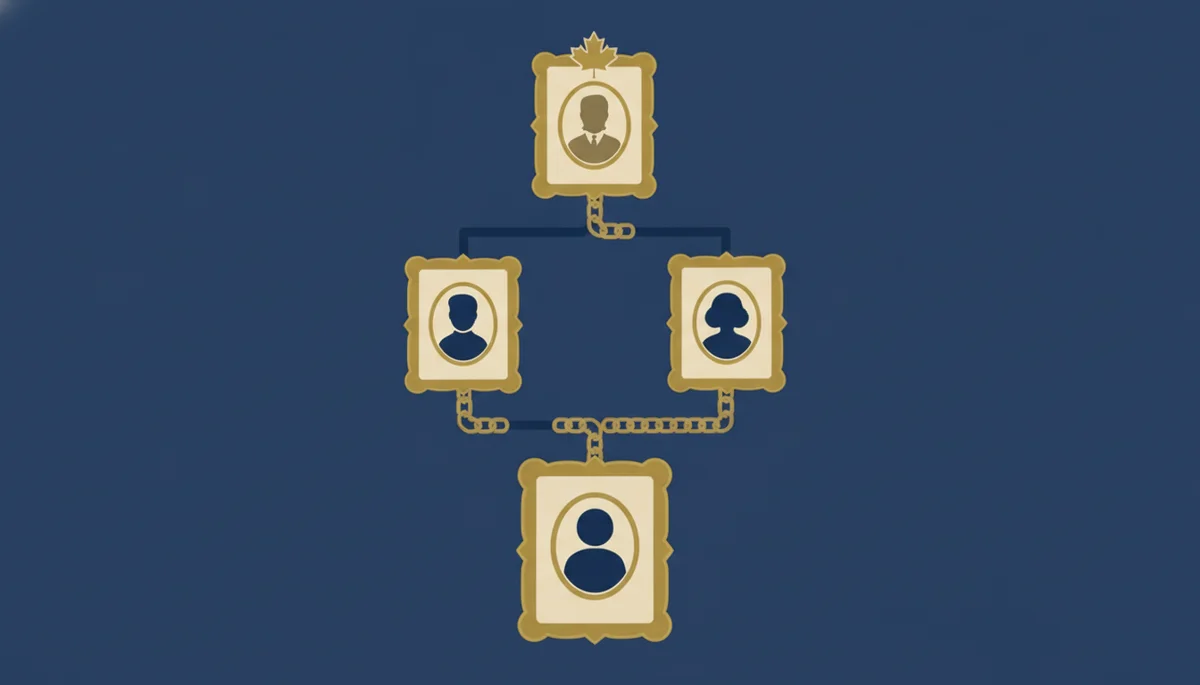
The chain is the whole game. Every birth certificate has to name the parents, so the officer can follow the line link by link without guessing.
| Generation | What it proves | Typical documents |
|---|---|---|
| You | Your identity and who your parents are | Long-form foreign birth certificate naming both parents; government photo ID |
| Your parent | The link to the next generation up, or Canadian status directly | Birth certificate naming their parents; Canadian citizenship certificate if they have one |
| Your grandparent and further back | Each further link in the chain | Birth certificates showing each parent-child link |
| The Canadian ancestor | Canadian citizenship (or pre-1947 status) | Provincial or territorial birth certificate; Canadian citizenship or naturalization certificate; Certificate of Registration of Birth Abroad; Certificate of Retention; British naturalization certificate issued in Canada or Newfoundland; proof of British subject or landed immigrant status before 1947 (1949 for Newfoundland and Labrador) |
Colour copies and originals
IRCC wants clear, easy-to-read colour copies of supporting documents unless the guide says otherwise. Don’t send your only original birth certificate. The exception catches people out: any original Canadian citizenship or naturalization certificate must go in with the application, along with any pink transmission copies. If an ancestor’s old certificate is in the family, it goes in the envelope.
When records are missing
The primary proof of birth in Canada is a provincial or territorial birth certificate. If one doesn’t exist, IRCC lists alternatives: a hospital birth record, a physician or midwife record, a baptismal record, census records or a boat manifest. If you can’t get an original, explain why in writing and show proof that you tried, such as a refusal letter from the archive. Third-party records alone can’t carry the application. Treat an Ancestry.com printout as a research lead and go find the official record it points to.
Older claims are where files go wrong. In the files we prepare, the Canadian end of the chain is rarely the problem. Provincial records are decent. The trouble sits in the middle generations, where a US county issued a short-form certificate that names nobody’s parents, or a grandmother’s first name is spelled three different ways across three records.
Name changes
Every name change along the chain needs a linking document: a Canadian change-of-name document, a court order or an adoption order. Marriage and divorce documents work for family-name changes only. Outside Canada, IRCC asks for an amended foreign passport plus the linking document plus government photo ID.
Translations and affidavits
Any document that isn’t in English or French needs an English or French translation plus the translator’s affidavit. You skip the affidavit if the translator belongs to a Canadian provincial or territorial translators’ organisation. You can’t translate your own records, and neither can parents, siblings, spouses, children or first cousins. Outside Canada, the affidavit is sworn before a notary public.
Citizenship Photos, Signatures and the 90-Day Rule
Paper applicants include two identical printed citizenship photos, 50 mm wide by 70 mm high, taken no more than six months before submission. On the back, write the person’s full name, the photographer’s or studio’s name and address, and the date taken. Don’t staple or glue them. Then sign and date CIT 0001 no more than 90 days before IRCC receives it.
IRCC publishes its photo specifications for mail applications on canada.ca. Print that page and hand it to the photographer. The face has to measure between 31 mm and 36 mm from chin to crown, against a plain white or light background, with a neutral expression and no glare. Passport-photo booths built for US passports produce the wrong size, which is a common and avoidable return.
The signature rule is the one that trips up people who prepare slowly. IRCC calls a form “stale-dated” if it was signed more than 90 days before it receives it, and post-dated forms are refused too. So sign last. Gather the documents, get the photos, pay the fee, then sign and post within the same week. Unsigned forms are simply returned.
Canadian Citizenship by Descent Application Fee: $75 and How to Pay It From Abroad
The Canadian citizenship by descent application fee is $75 CAD per person, paid online through IRCC. It becomes non-refundable once processing begins, whatever the outcome. Outside Canada and the US, you can pay at a Canadian consulate only if you can’t pay online. Print two copies of the receipt, enclose one and keep the other.
Americans and most other foreign applicants pay online with a payment card. Consular offices won’t accept receipts for fees paid in Canada or personal cheques, so don’t try either. If you overpay, IRCC refunds the difference automatically to the name in the receipt’s payer information section. One family of four pays four fees: $300 for the batch.
| Item | Government fee (CAD) | Notes |
|---|---|---|
| Citizenship certificate (proof) | $75 per person | Non-refundable once processing begins |
| Search of citizenship records | $75 | Separate application, useful when you need to know whether an ancestor held a certificate |
| Adult passport, 10-year | $163.50 in Canada / $266.25 outside Canada | Rates from 31 March 2026 |
| Adult passport, 5-year | $122.50 in Canada / $194.25 outside Canada | Rates from 31 March 2026 |
| Child passport, 5-year | $58.50 in Canada / $102.50 outside Canada | Rates from 31 March 2026 |
| Grant of citizenship (for comparison) | $653 adult / $100 minor | The naturalisation route; descent claims don’t use it |
Add those up and an adult living abroad pays $341.25 in government fees to go from nothing to a 10-year Canadian passport. Your real costs sit elsewhere: ordering certified birth records from several states or provinces, translations, notary fees and courier charges. In our experience the document hunt costs more than the government does, especially when one record has to come from an archive that only answers by post.
How to Apply for Canadian Citizenship by Descent: Step by Step
If you’re wondering how to apply for Canadian citizenship by descent, the short version is this: confirm which route you qualify for, build the document chain back to your Canadian ancestor, complete CIT 0001 and CIT 0014, get two citizenship photos, arrange translations, pay the $75 fee online, sign within 90 days of IRCC receiving it, and submit online or by tracked mail.
- Confirm eligibility and pick online or paper.
- Map your family chain.
- Order certified records for every generation.
- Translate anything not in English or French.
- Download and complete CIT 0001 and CIT 0014.
- Get two citizenship photos.
- Pay the $75 fee online.
- Sign and date the form last.
- Submit by tracked courier or online.
- Apply for the passport once the certificate arrives.
Step 1: Confirm eligibility and pick online or paper. If you’re an adult, Bill C-3 most likely already made you a citizen, and you’re applying for proof. Check whether your case fits the online criteria, or let our eligibility checker answer both questions in about a minute.
Step 2: Map your family chain. Write out every generation between you and the Canadian ancestor, with full names, birth dates, birthplaces and any name changes. This list becomes your shopping list for records and your cover sheet for the officer.
Step 3: Order certified records for every generation. Request long-form birth certificates that name the parents, from provincial vital statistics offices in Canada and from the relevant state or national registries abroad. Get name-change documents at the same time. Start the slowest request first.
Step 4: Translate anything not in English or French. Use an independent translator who isn’t family, with an affidavit sworn before a notary public if you’re outside Canada. Certified members of a Canadian provincial translators’ body don’t need the affidavit.
Step 5: Download and complete CIT 0001 and CIT 0014. Use the current versions from canada.ca, fill every field, and tick the checklist against what’s actually in your envelope. Add IMM 5476 if you’re using a representative, and CIT 0555 only for a child born on or after 15 December 2025.
Step 6: Get two citizenship photos. Two identical prints, 50 mm by 70 mm, taken within the last six months, with your name, the studio’s name and address, and the date written on the back. Put them in a small envelope; never staple them.
Step 7: Pay the $75 fee online. Pay through IRCC’s online payment page for each person applying, print the receipt twice, and put one copy in the package. Pay at a consulate only if you genuinely can’t pay online.
Step 8: Sign and date the form last. IRCC rejects forms signed more than 90 days before it receives them. Signing should be the final thing you do before sealing the envelope.
Step 9: Submit by tracked courier or online. Use IRCC’s “where to submit” tool for your country, and send paper files by a tracked postal or courier service. Online filers upload scans and submit within 60 days of starting.
Step 10: Apply for the passport once the certificate arrives. The citizenship certificate is your proof of Canadian citizenship for the passport application. Abroad, you file form PPTC 040 at the nearest Government of Canada office.
Where Do You Send a Canadian Citizenship by Descent Application?
Paper Canadian citizenship by descent applications go to the IRCC case processing centre in Sydney, Nova Scotia, unless IRCC’s country-specific “where to submit” tool sends you elsewhere. Pick your country in the tool on canada.ca before you post anything. Use a tracked postal or courier service so you can prove delivery.
Never bundle several families’ applications in one envelope. If one application in the envelope is incomplete, IRCC returns all of them. Separate envelopes cost a little more and protect everyone else’s place in line.
After IRCC opens the file, applicants in Canada or the US get an acknowledgment of receipt by email (or by post if no email was given), showing a ten-digit Unique Client Identifier, your UCI. Applicants elsewhere get a receipt from the consulate where they applied, plus the email if they gave an address. Keep the UCI safe. Every follow-up with IRCC uses it.
How Long Does a Canadian Citizenship by Descent Application Take?
Expect a long wait. IRCC’s processing-time tool showed 34 months for proof of citizenship in October 2026, up from about 15 months in June, with roughly 130,700 people in the queue according to news reports citing IRCC data. The figure moves monthly, so check IRCC’s live tool before you plan around it.
Read that number twice. Thirty-three months is close to three years for a $75 certificate, and the figure more than doubled over one summer as the post-C-3 wave of applicants hit the system. We track the queue in detail in our Canadian citizenship by descent backlog report.
The practical conclusion: file now. A tidy, complete file is the only part of the timeline you control. Every month you spend polishing is a month further back in a queue that’s growing. If you need to know whether an ancestor held a certificate before you can even build the chain, the separate search of citizenship records was running at around 19 months on IRCC’s 7 October 2026 data, so start that early too.

Can You Get Urgent Processing for a Canadian Citizenship by Descent Application?
Yes, in limited cases. IRCC accepts urgent requests for reasons such as employment or education, travel because of a death or serious illness in the family, statelessness, moving a minor child to Canada, renouncing another citizenship by a deadline or accessing social benefits. You need an explanation letter and proof. Qualifying doesn’t guarantee faster processing.
On a new paper application, include the letter and supporting documents in the package and write “Urgent – Citizenship Certificate (Proof)” on the envelope in large, dark letters. Online, answer yes to the urgent question and upload the evidence. Supporting documents can include a plane ticket with proof of payment, an employer’s or school’s letter, a doctor’s note or a death certificate.
Already filed? Outside Canada and the US, contact the embassy, consulate or high commission where you applied. In Canada or the US, use IRCC’s web form and start the message with “Request for urgent processing”. Don’t send a second application. A duplicate urgent online application won’t be processed at all.
Be realistic about this. IRCC wants a concrete deadline backed by paper, such as a job offer in Vancouver with a fixed start date and the employer’s letter to prove it. A general wish to travel on a Canadian passport soon won’t get you moved up.
From Citizenship Certificate to Canadian Passport
Once the certificate arrives, you apply for a Canadian passport. Adults abroad use form PPTC 040, with a guarantor and two references who’ve known you at least two years, and submit it to the nearest Government of Canada office. A 10-year adult passport costs $266.25 outside Canada. The certificate serves as your proof of citizenship.
For certificates issued on or after 1 February 2012, Passport Canada accepts either a copy or the original. Older certificates must be sent as originals. Neither your guarantor nor your references can be family members, and the references can’t be the guarantor.
Was it worth it? On Liberty Mundo’s Passport Freedom Index, Canada ranks 8th on visa-free access, with 181 visa-free destinations. The US passport sits 10th with 179. For an American, that’s a step up in mobility, a second consular option and a place to go if things at home turn ugly. Our piece on the benefits of having a second passport covers the wider case.
A note for US citizens: Canadian citizenship changes nothing for the IRS, which taxes Americans on worldwide income wherever they live. Canada taxes on residence. A Canadian citizen who doesn’t live in Canada isn’t taxed by Canada on foreign income. For those weighing their options with the IRS, our guide to renouncing US citizenship covers that route, and our breakdown of dual citizenship pros and cons covers holding both.
Common Mistakes That Get a Canadian Citizenship by Descent Application Returned
The most common reasons a Canadian citizenship by descent application comes back are an unsigned or stale-dated CIT 0001, photos that don’t meet citizenship specifications, missing translations or affidavits, short-form birth certificates that don’t name parents, and gaps in the chain where a name changed without a linking document. Each one costs you months.
- Every birth certificate in the chain names the parents
- Every name change has a linking document
- Every non-English or non-French record has a translation and affidavit
- Copies are in colour and easy to read
- Original Canadian citizenship certificates go in the envelope as originals
- Two identical photos, 50 x 70 mm, labelled on the back, unattached
- Fee receipt printed and enclosed
- Form signed and dated within 90 days of arrival
- One application per envelope, sent tracked
One more pattern I see constantly: siblings filing separately with different versions of the same family records. If one sibling’s file has the grandmother as “Marie” and the other has “Mary”, you’ve just invited a query on both. Coordinate the family file before anyone posts anything.
Bottom line: if you qualify, file. Canada has now recognised a citizenship that the 2009 first-generation limit denied to a lot of families, and about 20,000 people came forward for proof after the 2009 and 2015 changes alone. Ottawa can change the rules again. A certificate in your drawer is far harder to argue with than an eligibility you never claimed. Compare the Canadian process with our Irish citizenship by descent walkthrough if you suspect you’ve got more than one ancestry claim, because nothing stops you holding several passports.
Canadian Citizenship by Descent Application FAQ
What form do I use for a Canadian citizenship by descent application?
How much does a Canadian citizenship by descent application cost?
Can I submit a Canadian citizenship by descent application online?
What documents are needed for Canadian citizenship by descent?
Do I send original documents with my application?
How long does a Canadian citizenship by descent application take right now?
Can I pay the citizenship certificate fee from outside Canada?
What do I write on the back of my citizenship photos?
Who can translate documents for a Canadian citizenship by descent application?
Do I need a citizenship certificate to get a Canadian passport?
Final Thoughts on Filing Your Canadian Citizenship by Descent Application
The Canadian citizenship by descent application is dull, fiddly and slow. It’s also cheap, and it ends with a passport that ranks well above the American one. Build the chain properly, follow the photo and signature rules to the letter, and get your file into the queue before it grows any longer. If you want a hand, our team prepares these files for clients through our Canadian citizenship service, and the full Canada archive has everything else we’ve published on the country.
Sources and References
- Immigration, Refugees and Citizenship Canada, Guide CIT 0001: Application for a Citizenship Certificate for Adults and Minors (Proof of Citizenship) under Section 3
- Immigration, Refugees and Citizenship Canada, Apply for a Canadian citizenship certificate: How to apply
- Immigration, Refugees and Citizenship Canada, Changes to citizenship rules (2025)
- Parliament of Canada, LEGISinfo: Bill C-3, An Act to amend the Citizenship Act (2025)
- Immigration, Refugees and Citizenship Canada, Proof of citizenship by mail: photo specifications
- Immigration, Refugees and Citizenship Canada, When and how do I apply urgently for a citizenship certificate?
- Immigration, Refugees and Citizenship Canada, Fee list and Check processing times
- Government of Canada, Apply for a new passport abroad
- Internal Revenue Service, U.S. citizens and resident aliens abroad