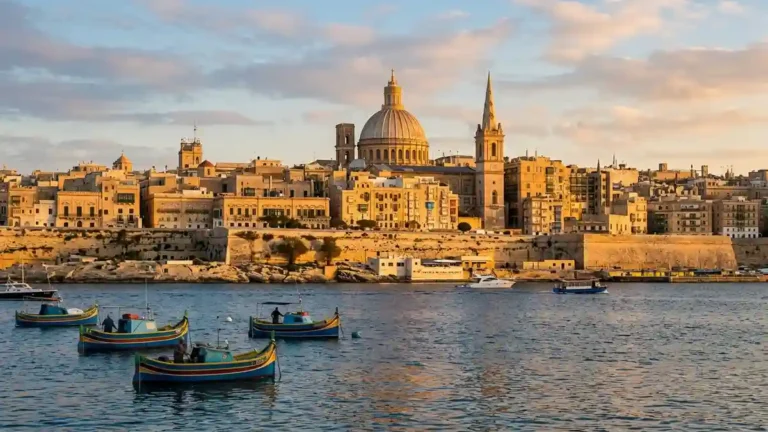
The Malta Individual Tax Programme starts on 1 January, and anyone still weighing a move to Valletta now has 90 days to file under the old, far cheaper rules. The new regime more than doubles the minimum annual tax for non-EU and EU residents, from €15,000 to €35,000, and lifts the property bar to €700,000.
VALLETTA, Malta – 1 October 2026
The change comes from Legal Notice 195 of 2026, published on 14 July. It folds the Global Residence Programme, The Residence Programme, the Malta Retirement Programme and the UN pensions scheme into one framework from 2027. Today marks the start of the final quarter for anyone hoping to be grandfathered.
Malta’s headline tax break survives. Qualifying foreign income remitted to the island is still taxed at a flat 15%, which keeps it near the top of most tax residency planning shortlists for Europe. What’s changed is the price of the ticket, and it’s gone up sharply.
Put your assets beyond reach in 57 jurisdictions.
Pick where you want your company. We handle the filing, the registered agent, and the bank introduction. From US$1,290, done in days, not months.
- Charging-order protection in jurisdictions courts can't pierce
- Zero tax on foreign income in 30+ territories
- Banking options available
- Fixed price. No surprise fees at closing
What Changes Under the Malta Individual Tax Programme?
The Malta Individual Tax Programme merges four schemes into four statuses: Global Resident, EU/EEA/Swiss Resident, Retired Pensioner and UN Pensioner. The 15% rate on remitted foreign income stays, but minimum tax, property thresholds and fees all rise from 1 January 2027, according to PwC’s Malta tax summary.
Read that number twice. A non-EU family that paid Malta €15,000 a year under the old Global Residence Programme will owe at least €35,000 from 2027, even in a year when they remit almost nothing. Retirees take a similar hit, with the €7,500 floor (plus €500 per dependent) replaced by a flat €15,000.
Property is the bigger shock for many. Most clients we’ve placed under the old scheme rented in Sliema or St Julian’s, because €9,600 a year bought a perfectly decent flat. At €14,000 a year, that budget now gets you something a lot smaller. For a wider look at where Malta sits among non-dom tax systems, the comparison still favours the island on rate, just not on entry cost.
How Much More Will Malta Residency Cost From 2027?
Under the Malta Individual Tax Programme, a Global or EU resident faces a €35,000 minimum annual tax, a €700,000 property purchase or €14,000 annual rent, and an €8,500 application fee with €2,500 renewals every five years. Retirees pay at least €15,000 a year, and UN pensioners at least €20,000.
| Requirement | Old rules (GRP / TRP / MRP) | From 1 January 2027 |
|---|---|---|
| Minimum tax, Global and EU residents | €15,000 a year | €35,000 a year |
| Minimum tax, retired pensioners | €7,500 plus €500 per dependent | €15,000 flat |
| Minimum tax, UN pensioners | Separate UN pensions scheme | €20,000 a year |
| Property purchase | €275,000 (€220,000 in the south and Gozo) | €700,000 nationwide |
| Annual rent | €9,600 (€8,750 in the south and Gozo) | €14,000 nationwide |
| Tax on remitted foreign income | 15% | 15% |
| Application / renewal fee | Programme-specific | €8,500, then €2,500 every 5 years |
The south and Gozo discount disappears completely. That’s the detail most people miss, and it hits the budget end of the market hardest.
Eligibility tightens too. Forvis Mazars notes applicants must have no intention of becoming Malta-domiciled within five years, hold valid sickness insurance, and communicate adequately in Maltese or English. Retired pensioners still need their pension to make up at least 75% of chargeable income.
Who Keeps the Old Malta Terms Until 2031?
Anyone who already holds Malta special tax status, or secures it by 31 December 2026, keeps the old minimum tax and property thresholds until 31 December 2031, provided they stay compliant. Some advisers read the cut-off as an application filed by that date, so file early and don’t gamble on the reading.
BDO Malta frames the transition as protection for status already granted. The clock is ticking, and the paperwork isn’t quick. In our experience, the lease alone, plus police certificates, apostilles and insurance, eats six to eight weeks before a file is even ready to lodge.
This is where people get burned. They sign a lease in December, scramble for documents, and land in January under the new €35,000 floor. Five years of grandfathering at €15,000 versus €35,000 is a €100,000 difference in minimum tax alone.
Is Malta Still Competitive Against Italy and Greece?
Yes, for most mid-tier earners. Even at €35,000, Malta’s minimum is a fraction of Italy’s lump-sum flat tax, which now costs new arrivals €300,000 a year. Greece’s lump-sum regime, which keeps pulling big names out of London (see our Greece tax residency coverage), also sits well above Malta’s new floor.
Malta’s real edge is the remittance basis. You’re taxed at 15% only on foreign income you bring onto the island, which is why wealthy families keep picking it for an EU base. Pair it with income held through asset protection trusts or an offshore company, and the 2027 increase becomes a cost you can model with some precision.
One caveat for Americans: none of this changes your IRS position. US citizens owe tax on worldwide income wherever they live, and the Foreign Earned Income Exclusion doesn’t cover pensions or investment income.
Bottom line? Malta’s still open for business, at a higher price and with three months’ notice. For the full route map, our guide to Malta residency options covers every permit alongside the tax statuses.
Frequently Asked Questions
When does the Malta Individual Tax Programme start?
What is the new Malta minimum tax under the Individual Tax Programme?
Can I still apply for the Malta Global Residence Programme in 2026?
How much property do I need under the Malta Individual Tax Programme?
Does Malta’s 15% tax rate help US citizens?
Sources and References
- Government of Malta, Legal Notice 195 of 2026: Individual Tax Programme Rules
- PwC, Malta: Individual Taxes on Personal Income
- BDO Malta, Malta Introduces the Individual Tax Programme Rules 2026
- Forvis Mazars Malta, Malta’s New Individual Tax Programme Rules