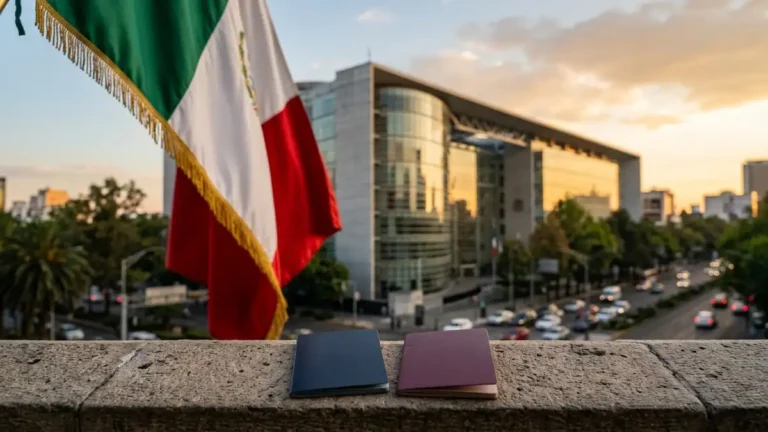
Mexico dual citizenship just got a hard ceiling: the Senate voted 86 to 42 on Tuesday to bar anyone holding a second nationality from running for president, governor or head of Mexico City’s government. The amendment now heads to the state legislatures for ratification.
MEXICO CITY, Mexico – 30 September 2026
The reform was proposed by President Claudia Sheinbaum and passed the Chamber of Deputies on 22 September by 344 votes to 116. It rewrites Articles 82, 116 and 122 of the Mexican Constitution, according to reporting by El Financiero and Expansión Política. Morena, the Green Party (PVEM) and the Labor Party (PT) voted in favour. PAN, PRI and Movimiento Ciudadano voted against.
Sheinbaum’s framing was blunt. “No president can have two flags,” she said on 26 September. Opponents, including Movimiento Ciudadano senator Luis Donaldo Colosio Riojas, argued the text conflates nationality with loyalty and stigmatises millions of Mexicans with ties abroad.
Put your assets beyond reach in 57 jurisdictions.
Pick where you want your company. We handle the filing, the registered agent, and the bank introduction. From US$1,290, done in days, not months.
- Charging-order protection in jurisdictions courts can't pierce
- Zero tax on foreign income in 30+ territories
- Banking options available
- Fixed price. No surprise fees at closing
What Did Mexico’s Senate Approve on Dual Citizenship?
Mexico’s Senate approved a constitutional amendment requiring presidential, gubernatorial and Mexico City executive candidates to be Mexican by birth, hold no other nationality, and renounce any foreign citizenship before registering. Once in office they can’t use a foreign passport, exercise foreign political rights or accept another country’s diplomatic protection. Congress then has 90 days to align the Nationality Law.
That 90-day clock starts only after the decree takes effect, which needs a majority of Mexico’s 32 state legislatures to sign off first. With Morena and its allies controlling most state congresses, ratification looks like a formality. The Senate’s own official communiqué confirms the text has been sent to the states.
Mexican press reports tie the push to a handful of candidates with US passports. One Morena hopeful in Nayarit has already said she’ll renounce her American nationality. Morena senator Ricardo Sheffield told the chamber he gave up his own US citizenship 31 years ago.
Who Does the Mexico Dual Citizenship Ban Affect?
The Mexico dual citizenship ban affects only candidates for three executive posts: president, state governor and head of government of Mexico City. Everyone else who holds Mexican nationality alongside another passport keeps both, including the large Mexican-American population, naturalised citizens and people who claimed Mexican citizenship by descent through a parent.
| Group | Before the reform | After ratification |
|---|---|---|
| Presidential candidates | Mexican by birth, with existing Article 32 limits | Must renounce any foreign nationality before registering |
| State governor candidates | Rules set largely by state constitutions | Same single-nationality rule under Article 116 |
| Mexico City head of government | No explicit single-nationality rule | Same rule under Article 122 |
| Ordinary Mexican dual nationals | Keep both nationalities | No change |
| Mexicans by descent born abroad | Mexican by birth under Article 30 | No change |
| Office holders during their term | No specific passport restrictions | Can’t use foreign passports or seek foreign diplomatic protection |
So if you’re one of the thousands of people who’ve quietly secured a Mexican passport as a Plan B, you can relax. Nothing in this text touches you. We get this question a lot from clients who hold a Mexican passport through a parent, and the answer today is dead simple: your status is unchanged.
Does Mexico Still Allow Dual Citizenship?
Yes, Mexico still allows dual citizenship for almost everyone. Since a 1998 constitutional reform, Mexicans by birth can’t be stripped of their nationality under Article 37, and that protection survives this amendment. Children born abroad to a Mexican parent remain Mexican by birth, and naturalised foreigners keep the same rights they had before Tuesday’s vote.
That’s why our guide to getting a second passport in Mexico still stands. Naturalisation normally needs five years of legal residence, cut to two for Latin American and Iberian nationals or direct descendants of Mexicans. The usual entry point is temporary or permanent residency, covered in our Mexico residency guide.
For readers building second passport strategies, Mexico remains one of the more practical naturalisation routes in the Americas. Its travel strength is tracked in the Liberty Mundo Passport Freedom Index, which scores passports on real-world freedom as well as visa-free access.
Why the Mexico Dual Nationality Reform Matters Beyond Politics
Let’s be blunt. The number of people who’ll run for governor in Mexico is tiny. The reason this story matters is the direction of travel.
Governments that once courted their diaspora are starting to treat a second passport as a question of loyalty. Ireland is lengthening its naturalisation wait, as we covered in our piece on the new Irish citizenship rules. Politicians in several European countries have floated tighter limits too. The Mexico dual citizenship change is narrow, but it puts the idea of single-nationality loyalty tests into a constitution that was among the most generous in the region.
I’ve watched this play out before. A restriction starts at the top, gets framed as common sense, and a few years later someone proposes extending it to senators, judges, then civil servants. There’s no bill doing that in Mexico today. But the precedent now exists, and precedent is how rules creep.
That’s the real wake-up call. Your citizenship rights live inside a document that a two-thirds majority can rewrite in a single week. Anyone relying on one passport, or one country’s goodwill, should think about how dual citizenship actually protects wealthy families and whether a third option belongs in the plan.
Mexico Dual Citizenship: Frequently Asked Questions
Is Mexico ending dual citizenship?
Can dual citizens run for president in Mexico?
When does the Mexico dual citizenship ban take effect?
Does the reform affect Mexican citizenship by descent?
Is Mexico still a good option for a second passport?
We’ll update this story as the state legislatures vote on the Mexico dual citizenship amendment. In the meantime, the Portugal citizenship by descent rules show how quickly another country’s nationality law can shift under your feet.
Sources and References
- Senado de la República, Aprueba Pleno del Senado reforma sobre doble nacionalidad; envía dictamen a congresos estatales
- El Financiero, Senado aprueba reforma contra la doble nacionalidad para candidatos: ¿a quiénes aplica?
- Expansión Política, Senado aprueba prohibición: personas con doble nacionalidad no podrán ser candidatas a la presidencia
- Excélsior, Senado aprueba reforma contra doble nacionalidad; envía dictamen a congresos estatales
- Liberty Mundo, Passport Freedom Index