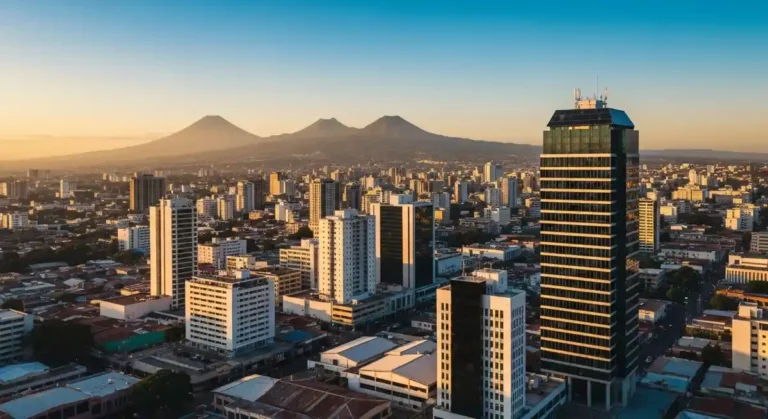
El Salvador residency 90 days is now the law. President Nayib Bukele’s government has cut the annual physical presence threshold for temporary residents by two-thirds, replacing a roughly nine-month obligation with a flat 90 calendar days per year, consecutive or accumulated. Decree No. 531 took effect on 31 March 2026 and rewrites three articles of the Special Law on Migration and Foreigners.
SAN SALVADOR, El Salvador, 18 May 2026.
The reform reshapes the calculus for anyone eyeing El Salvador as a Plan B base. Under the old framework, residents who travelled too often for work returned home to find their status cancelled and the application clock reset. The new Article 119 sets a clean 90-day floor and lets residents bank the days in any pattern, as long as the annual total clears the threshold. Failure triggers cancellation under the rewritten Article 49.
Put your assets beyond reach in 57 jurisdictions.
Pick where you want your company. We handle the filing, the registered agent, and the bank introduction. From US$1,290, done in days, not months.
- Charging-order protection in jurisdictions courts can't pierce
- Zero tax on foreign income in 30+ territories
- Banking options available
- Fixed price. No surprise fees at closing
What Decree 531 actually changes
The Executive Branch submitted the bill on 9 March 2026. The Legislative Assembly passed it 57 votes to 0 on 17 March. Bukele signed on 20 March, the decree was published in Diario Oficial No. 57 on 23 March, and it took effect 31 March 2026.
Three articles of the Ley Especial de Migración y de Extranjería were rewritten. The new Article 119 sets the El Salvador residency 90 days threshold: every temporary resident must remain in Salvadoran territory for at least ninety calendar days within each year, whether consecutive or accumulated. Article 49 is the enforcement leg. Missing the threshold without a justified excuse cancels residency outright.
A force majeure exception exists. Salvadoran law calls it caso fortuito o fuerza mayor, and the decree puts the burden on the resident to justify it before the General Directorate of Migration and Foreigners. Casual noncompliance will not qualify. Eleonora de Marroquín, who heads the foreigners division at the DGME, told legislators that the prior nine-month rule was forcing investors and executives to restart applications every time work travel ran long.
Denaturalization grounds and children born abroad
The decree also rewrites Article 279 to codify two grounds on which a naturalized Salvadoran loses citizenship. First, residing in the country of origin for more than two consecutive years, or being absent from El Salvador for more than five consecutive years without an Article 280 permit. Second, a final conviction for the commission of serious intentional crimes. Anyone who loses nationality through a criminal conviction cannot recover it.
The constitutional text has sat in Article 94 since 1983, but implementing legislation never spelled out the procedural detail. The five-year absence clause matters most for holders of El Salvador’s Freedom Passport CBI program, which prices at US$1 million in Bitcoin or USDT. A naturalized passport that requires regular return trips is not the same product as a Caribbean citizenship that asks for nothing.
Article 164 picks up a separate gap. Children under eighteen born abroad before their parents acquired Salvadoran nationality can now be deemed Salvadoran upon parental request, through a special DGME procedure. The catch is the affirmative-declaration rule. On reaching adulthood the child must declare an intention to keep Salvadoran nationality. Skip the declaration, lose the status.
How it stacks against other Latin American residency tracks
| Jurisdiction | Annual presence required for temporary residency | Naturalization track |
|---|---|---|
| El Salvador (from 31 March 2026) | 90 calendar days (consecutive or accumulated) | 1 year (Spanish/Latin American), 5 years (others) |
| Paraguay | No strict minimum; tax residency depends on 120 days | 3 years |
| Uruguay | ~60 days per year on the naturalization track | 3 to 5 years |
| Panama (Friendly Nations) | 1 entry every 2 years to preserve PR | 5 years after PR |
| Mexico (Residente Temporal) | No fixed minimum; 4 years residence to apply for citizenship | 5 years |
The El Salvador residency 90 days floor sits in the middle of the Latin American pack on paper, but the rest of the package is what makes it different. The country runs a territorial tax system, treats Bitcoin as legal tender, and layered Simplified Joint-Stock Company (S.A.S.) free-registration extensions through 2026 alongside a March 2026 MYPE Law reform that cut business-formalization friction. Bottom line, the new presence rule is part of a deliberate sequencing that mirrors what the UAE built in stages.
What it means for the existing visa stack
El Salvador offers three meaningful inbound options. The digital nomad visa carries a path to permanent residency and eventually citizenship. The independent means visa runs on a US$1,200 monthly income threshold. The Freedom Passport citizenship by investment program prices at US$1 million in Bitcoin or USDT and remains the only CBI in the world denominated in crypto. All three sit under the Special Law on Migration and Foreigners, so the El Salvador residency 90 days rule applies across the stack.
Liberty Mundo’s residency coverage walks through how to combine a low-presence residency with a tax-residency strategy. The tax category lays out how territorial systems behave for US citizens (the IRS still wants worldwide reporting) and for non-Americans. For readers eyeing Latin America more broadly, the Paraguay Investor Pass and Turkey territorial tax guides cover two more clean options.
When did the new El Salvador residency 90 days rule take effect?
Do the 90 days have to be consecutive?
What happens if I miss the 90-day threshold?
Does this affect the Freedom Passport CBI program?
How long until I can naturalize as a Salvadoran citizen?
Where can I learn more about El Salvador’s broader offshore stack?
Sources and References
- Asamblea Legislativa de El Salvador, Approval of reforms to the Special Law on Migration and Foreigners.
- Consortium Legal, Proposed Amendments to El Salvador’s Special Law on Migration and Foreigners (March 2026).
- Infobae, El Salvador adjusts migration rules amid rising foreign investment (17 March 2026).
- The Central American Group, Migration and an Increase in Foreign Investment in El Salvador.
- Dinero.com.sv, El Salvador will require a minimum of 90 days of stay for temporary residents.