
The Turkey territorial tax overhaul that Erdogan announced on April 24, 2026 just rewrote the playbook for high earners shopping for a tax base. Twenty years. Zero tax on foreign-source income and capital gains. Inheritance and gift tax slashed to a flat 1%. If you have not been a Turkish tax resident for the previous three years and you relocate, you ride the new Turkey tax free regime for two decades. That is not a typo. That is policy.
Most countries dangle five to ten years on a special expat regime and pretend it is generous. Turkey just blew the doors off. The bill heads to parliament in the near term, and the smart money is already lining up paperwork. Here’s the kicker: the existing Turkish residency framework is fast, the property route to citizenship is still open at USD, and Istanbul has spent five years quietly building the financial infrastructure to actually deliver on this promise.
This guide breaks down exactly how the Turkey territorial tax regime works, who qualifies, what income stays untaxed, the realistic timeline to lock it in, and where it sits versus the Portugal NHR replacements, the UAE 0% setup, and the Italian flat-tax option. The numbers don’t lie, and the comparison gets uncomfortable for the old guard.
What Erdogan Actually Announced (And Why It Matters)
On April 24, 2026, Erdogan stood up in front of the cameras and called the package a “radical step.” For once, the political language matched reality. The headline measure: a 20-year exemption from Turkish tax on foreign-source income and capital gains for qualifying new residents. Foreign rental income? Untouched. Dividends from a Delaware LLC? Untouched. Capital gains on a UK share portfolio? Untouched. Crypto gains from a Swiss exchange? Untouched.
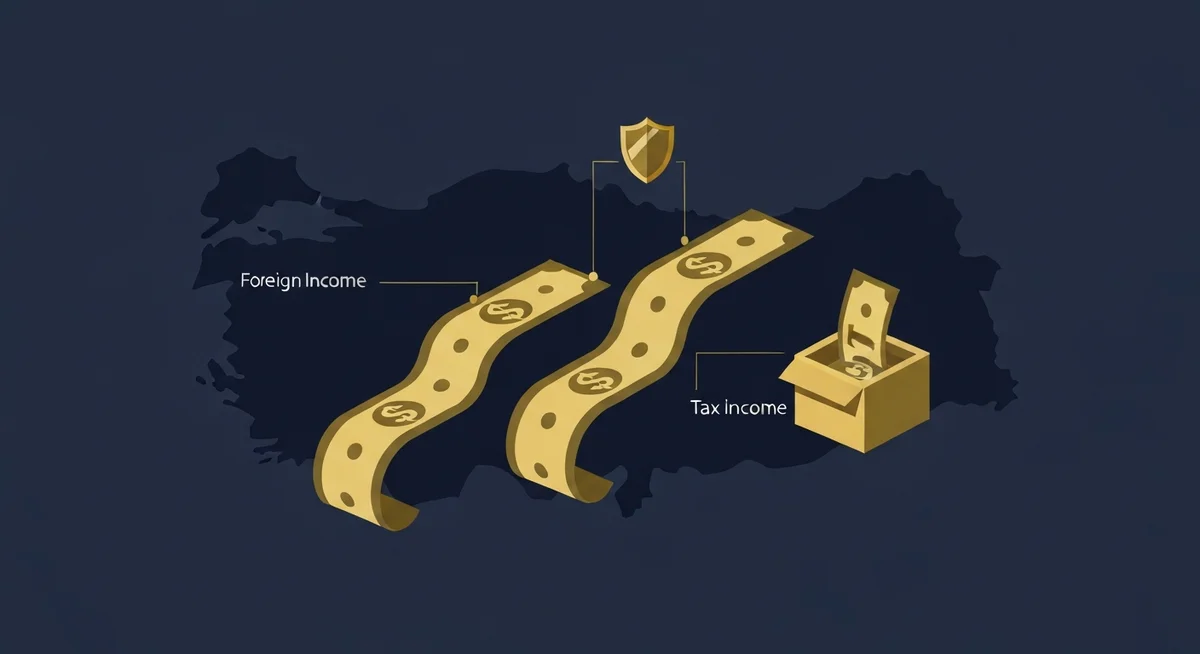
The only Turkish tax these participants pay is on income actually earned inside Turkey, plus that flat 1% inheritance and gift tax. Compare that to Turkey’s normal resident regime, which applies progressive brackets up to 40% on worldwide income. The gap between the two regimes is the entire point.
The same announcement bundled in corporate tax cuts (manufacturing exporters drop from 25% to 9%, other exporters get 14%), a 100% deduction on transit-trade income for Istanbul Finance Centre companies, and a single-stop digital bureau coordinated by the Presidential Investment and Finance Office to handle company registration, work permits, tax filings, and incentive applications in one workflow. Turkey is not just opening the door. It is rolling out a red carpet, hiring concierges, and replacing the maze with one elevator.
The Three-Year Lookback Rule
Here is the gating condition: you cannot have been a Turkish tax resident at any point in the previous three calendar years. That is the bright line. If you spent six months in Istanbul in 2024, you are out. If your last Turkish tax filing was 2022 or earlier, you are in.
This three-year clean-slate requirement is identical in spirit to the rules used by Italy’s flat-tax regime, the UK’s old non-dom rules (now sunset), and Portugal’s IFICI program. Turkey is borrowing the proven structure. The difference is the headline number. Italy gives you 15 years. Portugal gives you 10. Turkey is offering 20.
What Counts as Foreign-Source Income Under the Turkey Territorial Tax
The text uses the standard OECD definition of foreign-source income. In practice, that covers:
- Dividends paid by non-Turkish companies
- Interest from foreign bank accounts and bonds
- Rental income on real estate located outside Turkey
- Capital gains on foreign securities, foreign real estate, and foreign business interests
- Royalties from intellectual property held offshore
- Pension and annuity income paid from foreign sources
- Salary earned for work performed outside Turkey for a non-Turkish employer
- Crypto gains from non-Turkish exchanges (subject to final regulations)
What does NOT count as foreign-source: salary paid by a Turkish company for work performed in Turkey, rent on Turkish property, gains on Turkish-listed shares, dividends paid by Turkish companies. Those stay inside the regular Turkish brackets. That is the deal. Foreign income flows through tax-free. Turkish-source income pays normal rates.
How the Turkey Territorial Tax Compares to the Old Worldwide System
To understand why this matters, you need to know what was there before. Turkey’s existing personal income tax law works on a worldwide basis once you cross 183 days in country in a calendar year, or once you establish a “permanent place of residence.” Cross either threshold and Turkey claims taxing rights on every dollar of income you earn anywhere on earth. According to PwC’s Worldwide Tax Summaries, the resident brackets in 2026 climb to 40% at the top.
Turkey has long offered relief through its 90-plus double-taxation treaty network, but treaty relief is not the same as exemption. A treaty splits the pie. The new Turkey territorial tax regime carves out the pie entirely for 20 years.
This is a structural shift. Turkey is moving from “we tax everything you earn” to “we tax what you earn here and leave the rest alone, for 20 years, if you bring yourself and your assets in.” It is the same logic that built Dubai, Singapore, and Hong Kong as wealth magnets. Turkey watched the playbook and ran it.
| Feature | Old Turkish Regime | New Turkey Territorial Tax |
|---|---|---|
| Tax base | Worldwide income | Turkish-source only |
| Foreign dividends | Up to 40% (with treaty credit) | 0% for 20 years |
| Foreign capital gains | Up to 40% | 0% for 20 years |
| Foreign rental income | Up to 40% | 0% for 20 years |
| Inheritance & gift tax | 1% to 30% sliding scale | Flat 1% |
| Duration | Permanent | 20 years |
| Three-year prior non-residency required? | No | Yes |
Who Should Actually Care About the Turkey Tax Free Regime
This is not a universal upgrade. It is a targeted bet that suits a specific profile. Be honest about which side of the line you sit on before you book a flight.
The Right Fit
If most of your income comes from foreign-listed equities, foreign real estate portfolios, foreign business holdings, IP licensing offshore, or remote work for non-Turkish employers, Turkey just became one of the most attractive bases on earth. A retiree with a $500,000 portfolio of US dividend stocks and a UK rental flat would owe zero Turkish tax on that income for two decades.
Same story for digital nomads with foreign clients, founders with offshore holding companies, traders running crypto from non-Turkish exchanges, and crypto natives sitting on appreciated tokens they want to harvest. The lower cost of living in Istanbul, Antalya, or Bodrum versus Zurich or London is the cherry on top.
The Wrong Fit
If you are a US citizen, slow down. The IRS taxes US persons on worldwide income regardless of where you live. Moving to Turkey does not eliminate your US filing obligations. The Foreign Earned Income Exclusion (FEIE) only shields earned income from employment or self-employment, not pensions, dividends, capital gains, or 401(k) distributions. You can still benefit from Turkey’s territorial regime for the Turkish side of the equation, but Uncle Sam still wants his cut on most of it. Talk to a US-qualified advisor before assuming “tax free” means tax free for you.
If your income is mostly Turkish-source already (you run a Turkish business, you earn salary from a Turkish employer for work in Turkey), the regime gives you nothing. Domestic income still pays full progressive rates. The territorial carve-out only helps if you have meaningful foreign-source income to shelter.
The Existing Path: Turkish Residence Permits That Get You Tax-Resident Fast
You cannot use the new Turkey territorial tax regime without becoming a Turkish tax resident first. The two main routes are the short-term residence permit (kısa dönem ikamet) and citizenship by investment.
Short-Term Residence Permit (Kısa Dönem Ikamet)
This is the workhorse. Issued for one to two years initially, renewable. Required documents include a valid passport, biometric photographs, proof of address in Turkey, private health insurance, and proof of financial means. The income threshold sits at roughly 1.5 times the Turkish minimum wage, which translates to around 700 to 900 USD per person per month in 2026.
Citizens of the US, UK, Canada, EU member states, and Schengen countries are typically not asked for bank statements on the initial application, and are granted a six-month permit on first issue. Renewals require income proof and three months of recent Turkish bank statements. The whole application runs through the e-Ikamet portal at e-ikamet.goc.gov.tr. Paper applications are dead.
The $400,000 Property Route to Citizenship
If you have the capital, citizenship by investment is the fastest setup. Buy $400,000 of Turkish real estate, hold for three years, and you collect a Turkish passport in roughly three to six months. Spouse and minor children come along on the same application. No language test. No physical residency requirement during processing.
The Turkish passport ranks 51st on the 2026 Henley Passport Index with visa-free or visa-on-arrival access to 114 countries, including Japan, Singapore, South Korea, Hong Kong, and most of Latin America. Not the strongest passport in the world, not even close to top tier, but a respectable second passport for diversification, with the bonus of a quick path to E-2 treaty investor visa eligibility for the United States.
Travel power is only half the story. Visa-free access tells you where Turkey’s passport can take you, not how free the country behind it leaves you. The Liberty Mundo Passport Freedom Index re-ranks 197 passports on tax, extradition protection, conscription and civil liberties, not just visa-free travel, so you can see where Turkey really lands once freedom is in the mix.
Other investment routes exist: $500,000 in government bonds, bank deposits, or qualifying business investments, or job creation for 50 Turkish workers. Real estate is by far the most popular path.
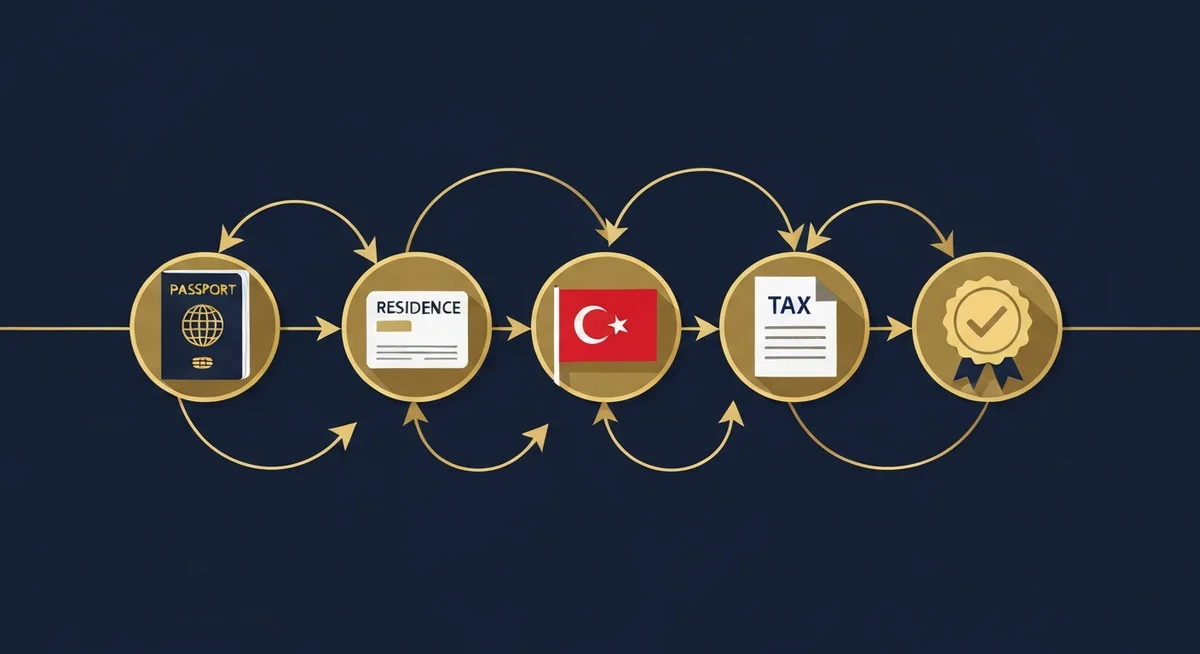
How to Qualify for the Turkey Territorial Tax: Step by Step
Step 1: Verify your three-year non-residency. You cannot have been a Turkish tax resident at any point in the past three calendar years. This means no permanent address in Turkey, no Turkish tax filings, and fewer than 183 days in country during each of the last three years. Pull your travel records and confirm.
Step 2: Choose your immigration pathway. The two practical routes are the short-term residence permit (around 700 to 900 USD income per month) or the $400,000 real estate citizenship-by-investment program. Pick based on your capital, your timeline, and whether you want a second passport in the package.
Step 3: Secure a Turkish address and tax ID. Rent or buy a residence in Turkey. Apply for a Turkish tax identification number through the Revenue Administration, which is now available online for foreigners. The address goes on every form from the residence permit application onward.
Step 4: File your residence permit via e-Ikamet. Submit through e-ikamet.goc.gov.tr with passport scans, biometric photos, proof of address, private health insurance, and proof of income. Processing typically runs 30 to 90 days. Show up for your biometric appointment, then wait for the card.
Step 5: Cross the 183-day threshold. Tax residency triggers either through 183 days in country in a calendar year, or by establishing a “permanent place of residence.” Most participants will hit the day count, especially in year one. Track your days obsessively. Border-stamp records and bank-statement geolocation are the evidence you’ll need.
Step 6: Register under the new regime. Once the legislation passes parliament, the Revenue Administration will publish an opt-in or registration form for the territorial regime. Your tax adviser files this alongside your first Turkish tax return as a resident. The 20-year clock starts from the registration date or from the first day of tax residency, depending on the final regulations.
Step 7: Restructure your foreign holdings. The territorial regime works best when your investments are held through clearly foreign vehicles: a US LLC, a Cayman fund, a Cyprus holding company, or similar. Review what passes the foreign-source test and what doesn’t. Move what needs moving before you become tax resident, not after.
Where Turkey Sits Versus the Other Heavyweights
Let’s be blunt: Turkey is not the only game in town. It is competing with the UAE, Italy, Greece, Cyprus, Malta (now ex-CBI), Monaco, and the post-NHR Portugal regime called IFICI. Each has trade-offs. The honest comparison goes like this.
| Country | Tax on Foreign Income | Duration | Minimum Investment | Time to Tax Residency |
|---|---|---|---|---|
| Turkey (new) | 0% on foreign-source | 20 years | None for residency, $400K for CBI | 183 days |
| UAE | 0% (no personal income tax) | Indefinite | $200K Golden Visa | 90 days physical presence |
| Italy (Flat-Tax) | €300,000 flat fee covers all foreign income | 15 years | None | 183 days |
| Portugal (IFICI) | 0% on most foreign income for qualifying professionals | 10 years | None for residency | 183 days |
| Greece (Non-Dom) | €100,000 flat fee covers all foreign income | 15 years | €500,000 investment | 183 days |
| Cyprus (Non-Dom) | 0% on dividends and interest | 17 years | None | 60 days (under conditions) |
Turkey’s pitch beats Italy on duration (20 vs 15 years) and beats it on cost (no €300K annual fee). It beats Portugal on duration and breadth. It loses to the UAE on permanence (UAE has no personal income tax at all, while Turkey’s regime expires after 20 years), but wins on cost of living, cultural depth, geographic convenience to Europe, and access to a developed real estate market with capital appreciation potential.
Cyprus has the lightest physical presence requirement at 60 days under the right conditions, but the regime is narrower. Greece’s program demands a €500,000 investment that Turkey does not require. None of the EU options offer a path to a second passport in three to six months the way Turkey does.
The Istanbul Finance Centre Angle
The same announcement supercharged the Istanbul Finance Centre (IFC). Companies relocating to the IFC pay effectively zero corporate tax on transit-trade income (100% deduction inside the IFC, 95% outside it), and qualifying employees get wage exemptions under specific conditions. The 20-year regional headquarters exemption layers on top. For someone running a portfolio of international businesses, basing the holding structure inside the IFC alongside personal residency under the territorial tax framework is a genuine one-two punch.
Common Mistakes That Will Blow Up Your Turkey Tax Free Status
The regime is generous. The way people lose it is dumb mistakes that should never happen. Here are the traps.
The first mistake is conflating the residence permit with tax residency. Holding an ikamet does not automatically make you tax resident. Spending 183 days does. Some people get the permit, spend 90 days a year in Turkey, and never trigger tax residency. They get the immigration benefit and never qualify for the tax benefit. Decide which you want and live the calendar accordingly.
The second mistake is income recharacterization. If you remote-work from Istanbul for a Delaware C-corp you own, what is the source of that income? Turkey will look at where the work is performed (Istanbul) and may treat the salary as Turkish-source even though the payer is American. Structure matters. Having the foreign company invoice for services rendered offshore, paying yourself dividends rather than salary, or running employment through a foreign employer-of-record can all change the source classification.
The third mistake is forgetting the US trap. American citizens still owe US tax on worldwide income. Turkey’s regime is a Turkish-tax benefit, not a US-tax benefit. Combine it with the US foreign tax credit, the FEIE on earned income, and careful entity selection or you’ll save Turkish tax and pay every dollar back to the IRS.
The fourth mistake is poor record-keeping. Turkish authorities can and do audit. Keep travel records, lease agreements, utility bills, bank statements, and entry-exit stamps. The tax holiday is a privilege you have to be able to prove you earned every year you claim it.
Cost of Living and What You Actually Get for the Trade
Turkey is cheap by Western European or North American standards. Numbeo data and local cost-of-living indices in 2026 put a comfortable single-person budget in Istanbul at around $1,200 to $2,000 per month including rent in a decent neighborhood. A couple lives well on $2,000 to $2,500. Antalya, Izmir, and Bodrum run cheaper still. Healthcare is high quality and inexpensive. A typical doctor visit at a private clinic costs 40 to 80 USD. International schools exist in major cities. Internet is fast, fiber is widespread, and the digital nomad infrastructure is excellent.
The trade-offs: lira volatility, occasional political turbulence, language barrier outside major cities, and the bureaucratic learning curve that comes with any developing-market relocation. The Turkey tax free regime is generous because the country has reasons to attract you, not because they’re being charitable.

What Happens After 20 Years?
This is the most overlooked question. The legislation grants 20 years of territorial treatment. After that, you fall back into Turkey’s regular worldwide-income regime unless the law is extended. For someone relocating at age 45, the holiday runs to 65. For someone relocating at 55, it runs to 75. Plan for what happens at the back end.
Three options exist for handling year-21. First, leave Turkey and become tax resident somewhere else (UAE, Cyprus, or wherever the rules look favorable then). Second, restructure your assets so most income is held in Turkish-tax-efficient vehicles by year 21. Third, hope parliament extends or renews the regime, which is plausible if it works as a wealth magnet. Smart planning today maps out all three contingencies, not just one.
Wealth Tax, Exit Tax, and Other Risks
Turkey does not currently impose a wealth tax or an exit tax. That could change. Most countries that have offered generous expat regimes (Spain Beckham, Portugal NHR, UK non-dom) eventually narrowed or scrapped them, often retroactively for new entrants. Lock in early. Document every step. Diversify your domicile holdings so that if Turkey reverses course in year 12, you have the option to move without losing everything.
Frequently Asked Questions About the Turkey Territorial Tax
When does the Turkey territorial tax regime actually take effect?
Does the Turkey tax free regime apply to crypto gains?
What happens to my income if I become Turkish tax resident before the new regime is enacted?
Can US citizens benefit from the Turkey territorial tax regime?
How long do I need to spend in Turkey each year to keep the regime?
Is the 20-year duration guaranteed or can Turkey end it early?
Can I get Turkish citizenship and the territorial tax benefit together?
What is the inheritance and gift tax rate under the new regime?
Does the Turkey territorial tax cover income from a foreign company I own?
What are the residency permit costs and timelines for getting started?
How does the Turkey territorial tax compare to UAE 0% tax?
Can I bring my family under the same Turkey tax free regime?
Final Word: This Is the Window That Always Closes
Tax-friendly regimes have a lifecycle. They open generously to attract early adopters, get publicized in the international press, attract competitors, and then narrow once the political math gets uncomfortable. Portugal’s NHR ran from 2009 to 2024. Spain’s Beckham law has been hollowed out. The UK’s non-dom system is gone. Italy’s flat tax has tripled, climbing from €100K originally to €200K in 2024 and €300K in the most recent revision.
The Turkey territorial tax regime is in its honeymoon phase right now. The legislation is generous because Turkey wants the headline. The three-year clean-slate rule favors people who act before they need to. Once the program is full and the lira has stabilized further, expect tightening. The clock is ticking from the moment parliament passes the bill.
For the right profile (foreign income, willingness to spend half the year in Istanbul or somewhere on the Aegean coast, comfort with emerging-market dynamics) this is one of the better deals available on the planet today. Combine it with a strategic second passport, offshore asset protection structuring, and international banking diversification, and you have a complete framework that no single jurisdiction can offer alone.
The numbers don’t lie. Twenty years. 0% on foreign-source. 1% on inheritance. The Turkey territorial tax may be the strongest single-jurisdiction expat regime on offer in 2026. The question is whether you’ll have your paperwork in order when the parliament gavel drops, or whether you’ll spend the next year reading articles about people who did. For deeper context on the broader landscape, see our guides on global residency programs and international tax planning strategies.
Sources and References
- Turkiye Today, Erdogan Unveils 20-Year Tax Holiday to Lure Relocating Foreign Residents (April 24, 2026)
- PwC Worldwide Tax Summaries, Turkey: Individual Residence
- PwC Worldwide Tax Summaries, Turkey: Taxes on Personal Income
- KPMG, Taxation of International Executives: Turkey
- Republic of Turkey Directorate General of Migration Management, Official e-Ikamet Residence Permit Portal
- Internal Revenue Service, United States-Turkey Tax Treaty Documents
- Republic of Turkey Presidential Investment Office, Turkey Investment Incentive Programs
- Republic of Turkey Revenue Administration, Turkish Revenue Administration Official Portal