
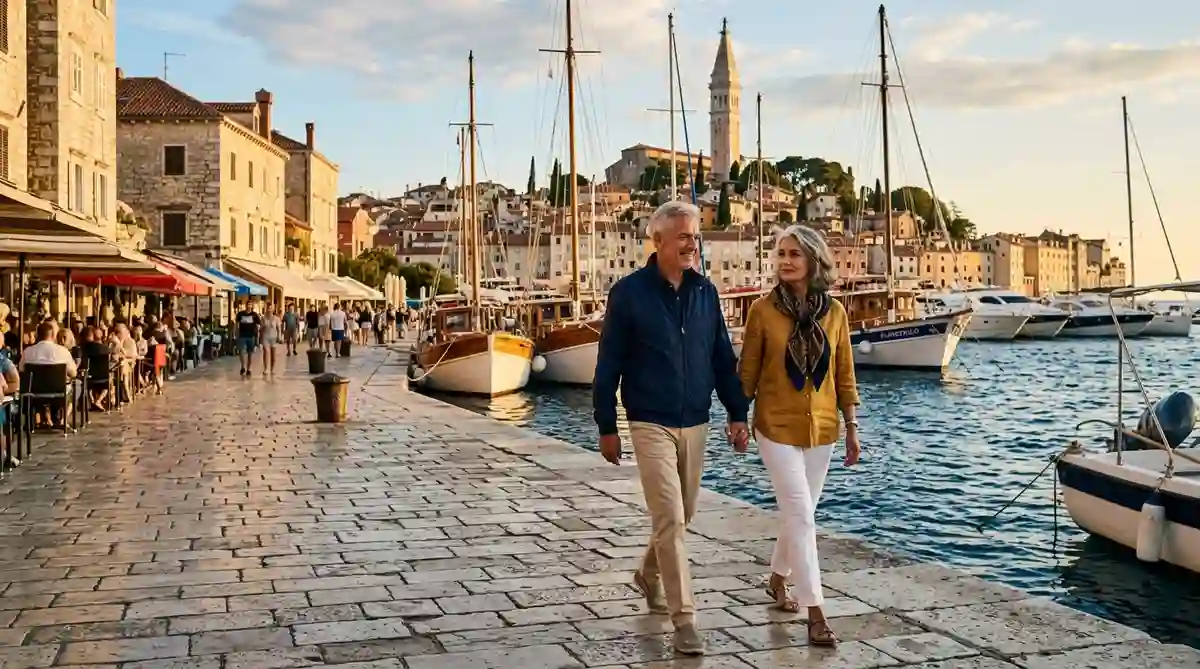
People who retire in Croatia tend to share one reaction after the first month: why did nobody tell me about this sooner? You get a thousand-mile Adriatic coastline, walled medieval towns, Mediterranean food, EU-grade healthcare, and a cost of living that undercuts Italy, France, and Spain. It is one of Europe’s best-kept retirement secrets, and it is hiding in plain sight.
But a beautiful coastline does not pay your bills or file your taxes. The decision to retire here comes down to cold practicalities: what a visa requires, how your pension gets taxed, what healthcare actually costs, and whether the maths works on your income. This guide runs those numbers honestly, including the tax traps that catch unprepared retirees, especially Americans.
Croatia is a full EU member, joined Schengen in January 2023, and uses the euro. So if you hold an EU passport, settling here is paperwork-light. If you are coming from outside the bloc, the road is longer, and there are a few things nobody mentions until you are knee-deep in the process. Let’s get into it.
Put your assets beyond reach in 57 jurisdictions.
Pick where you want your company. We handle the filing, the registered agent, and the bank introduction. From US$1,290, done in days, not months.
- Charging-order protection in jurisdictions courts can't pierce
- Zero tax on foreign income in 30+ territories
- Banking options available
- Fixed price. No surprise fees at closing
What It Really Costs to Retire in Croatia
The headline pitch is simple: Mediterranean Europe at a discount. The numbers back it up. Outside Dubrovnik and the peak-season tourist magnets, a retired couple can live well on roughly 2,000 to 2,800 euros a month, rent included. A single person can do it on noticeably less. Compare that to coastal Italy or southern France and the gap is not subtle.
Here is a realistic monthly budget for a couple living inland or in a mid-sized coastal town, away from the most expensive postcards.
| Expense | Monthly cost (couple, EUR) |
|---|---|
| Rent (1-2 bed apartment, mid-tier town) | 600 – 950 |
| Groceries | 400 – 550 |
| Utilities and internet | 180 – 260 |
| Private health insurance (two people) | 120 – 250 |
| Transport | 80 – 150 |
| Dining, leisure, extras | 350 – 600 |
| Total | ~1,730 – 2,760 |
Zagreb, the capital, and the glamorous coastal cities cost more, especially in summer when rents spike for the tourist season. Pick an inland town or a quieter island and the same lifestyle gets cheaper fast. If keeping more of your money is the whole point of retiring abroad, our guide to low-tax European havens is worth a look alongside this one.
Visas and Residency: How Non-EU Retirees Stay Legally
Here is the part the brochures skip. Croatia does not have a dedicated retirement or pensioner visa the way Portugal or Spain market theirs. EU and EEA citizens can settle freely and simply register their residence. Everyone else has to find a qualifying basis for a temporary stay permit.
Common routes for non-EU retirees who want to settle in Croatia include temporary stay based on owning property, family reunification with a Croatian or EU spouse, or long-stay arrangements tied to other grounds. The digital nomad permit exists too, but it is built for people still working remotely, not pure retirees, and it does not count toward permanent residence. Entrepreneurs who keep earning often anchor their stay by forming a company, which our guide to incorporating in Croatia walks through. Mapping the right residency in Croatia strategy upfront saves a lot of grief later.
Stay legally and continuously for five years and you reach permanent residence. That is the milestone that unlocks long-term security and, eventually, a path toward citizenship. For a wider view of fast and slow options across Europe, browse our residency guides.
How Your Pension Is Taxed When You Retire in Croatia
This is where dreams meet the tax office. Croatia taxes its residents on worldwide income. Become a Croatian tax resident, by spending more than 183 days a year there or making it your centre of vital interests, and your foreign pension can fall into the Croatian net.
Personal income tax in Croatia is progressive and set locally. The default rates land around 20% on annual income up to 60,000 euros and 30% above that, though municipalities can choose rates within national ranges of roughly 15% to 33%. Investment income such as interest, dividends, and capital gains is generally taxed at a flat 12%. Whether your specific pension is taxable here depends on the type of pension and any double-taxation treaty between Croatia and your home country, so personalised advice matters.

Healthcare for Retirees in Croatia
Healthcare is a make-or-break factor for anyone over 60, and Croatia holds up well. The country runs a public health system through the national insurance fund, and once you are a legal resident contributing to it, you gain access to subsidised public care. Many expat retirees pair that with affordable private insurance for faster appointments and English-speaking doctors.
Out-of-pocket costs are low by Western standards. A private GP visit, a specialist consult, or routine dental work cost a fraction of US prices. The bigger cities and coastal hubs have modern hospitals, while remote islands can mean a ferry ride for serious treatment. Factor location into your healthcare planning, not just your view.
Retire in Croatia vs Other Mediterranean Options
Croatia does not exist in a vacuum. Retirees weighing it usually have Portugal, Spain, Greece, and Italy on the same shortlist. Here is the honest comparison on the factors that actually move the needle.
| Country | Resident tax on worldwide income | Couple cost of living | Retiree access |
|---|---|---|---|
| Croatia | Yes, 15-33% progressive, 12% on capital income | Lower | No pensioner visa; temporary stay routes |
| Portugal | Yes; the old NHR pension regime was replaced by the newer IFICI rules | Moderate | Residency via D7 and others |
| Spain | Yes, worldwide, progressive up to the high 40s percent | Moderate | Non-lucrative visa for retirees |
| Greece | Yes, with a 7% flat-tax option for qualifying foreign pensioners | Lower to moderate | Financially independent person visa |
| Italy | Yes, worldwide; regional flat-tax schemes in some southern areas | Higher on the coast | Elective residence visa |
The pattern is clear. Croatia wins on raw cost and coastline, while Portugal and Greece counter with retiree-specific tax incentives. If a low headline tax rate is your priority, compare these against each other and against our Cyprus versus Greece breakdown before deciding.
How to Retire in Croatia: Step by Step
Step 1: Confirm your residency route. EU citizens register residence directly. Non-EU retirees identify a qualifying temporary stay basis, since there is no dedicated pensioner visa.
Step 2: Prove income and insurance. Show stable pension or savings income and secure valid health insurance, which immigration will require for the permit.
Step 3: Plan your tax position. Check whether you will become a Croatian tax resident and how the relevant double-taxation treaty treats your pension before you move.
Step 4: Choose your location. Balance cost, healthcare access, and climate. Inland and mid-sized coastal towns stretch a pension far further than the marquee cities.
Step 5: Build toward permanent residence. Maintain continuous lawful residence for five years to unlock permanent status and long-term security.
Common Mistakes Retirees Make in Croatia
- Assuming a retirement visa exists. It does not. Non-EU retirees must use another temporary stay basis to retire here.
- Ignoring worldwide taxation. Croatia can tax your foreign pension once you become tax resident there.
- Americans forgetting the IRS. US citizens still owe US tax abroad, and FEIE does not shelter pension or Social Security income.
- Underbudgeting the coast. Summer rents in tourist hotspots can double; plan for the season or live inland.
- Picking a remote island without checking healthcare access. A great view is worth less than a nearby hospital.
Before you commit, take two minutes with our free Freedom Score self-assessment to see how Croatia lines up against your income, tax, and lifestyle goals.
Is there a retirement visa to retire in Croatia?
How much money do you need for retirement in Croatia?
Will Croatia tax my foreign pension?
Do US citizens still pay US tax if they retire in Croatia?
How good is healthcare in Croatia?
Can I get permanent residence and citizenship after retiring there?
Is it cheaper to retire in Croatia than in Spain or Italy?
Where is the best place to retire on the Croatian coast?
Final word. To retire in Croatia is to trade a little bureaucracy for a lot of lifestyle. The coastline is world-class, the costs are gentle, and the healthcare is dependable. Just go in with a residency plan and a tax plan, not only a Pinterest board. Sort the paperwork and the pension question first, and the Adriatic sunsets take care of themselves. For deeper planning, read our tax strategy guides and consider how a future EU citizenship could anchor your retirement.
US tax disclaimer: US citizens and green card holders are subject to worldwide taxation by the IRS regardless of where they reside. The Foreign Earned Income Exclusion applies to earned income only and does not cover pensions, Social Security, or investment income, and foreign accounts may trigger FBAR and Form 8938 reporting. This article is general information, not tax advice. Consult a qualified US cross-border tax professional for your situation.
Travel power is only half the story. Visa-free access tells you where Croatia’s passport can take you, not how free the country behind it leaves you. The Liberty Mundo Passport Freedom Index re-ranks 197 passports on tax, extradition protection, conscription and civil liberties, not just visa-free travel, so you can see where Croatia really lands once freedom is in the mix.
Sources and References
- PwC, Croatia Taxes on Personal Income
- Croatian Tax Administration (Porezna uprava), Official Tax Authority Portal
- Ministry of the Interior of the Republic of Croatia, Temporary Stay Rules
- US Internal Revenue Service, Foreign Earned Income Exclusion
- Wikipedia, Visa Requirements for Croatian Citizens (2026 Henley Passport Index)