
The Foreign Births Register is how Ireland turns a grandchild of an Irish-born person into an Irish citizen. You register, you pay €278, you wait about a year, and from the day your name goes on the register you’re Irish, with the right to an EU passport. No residence, no language test and no interview.
Most people with an Irish grandparent never use it, and the ones who do often get tripped up by a witness who’s a cousin or a surname that changed in 1952. This guide walks through the whole process, using the Department of Foreign Affairs’ own rules. For the wider picture, see our guide to Irish citizenship by descent.
Put your assets beyond reach in 57 jurisdictions.
Pick where you want your company. We handle the filing, the registered agent, and the bank introduction. From US$1,290, done in days, not months.
- Charging-order protection in jurisdictions courts can't pierce
- Zero tax on foreign income in 30+ territories
- Banking options available
- Fixed price. No surprise fees at closing
What Is the Foreign Births Register?
The Foreign Births Register is Ireland’s official record of people born abroad who are Irish citizens by descent. It’s kept by the Department of Foreign Affairs. Being entered on it makes you a citizen if your link runs through an Irish-born grandparent, and you can apply for an Irish passport the moment you’re registered.
It exists because Irish law treats generations differently. A child born abroad to a parent born in Ireland is Irish automatically and never needs the register. One generation further out, the grandchild has an entitlement, but nothing more until the registration goes through.
That gap catches a lot of families. In our experience, the most common surprise is a parent who assumed they’d “always been Irish” through their own Irish-born mother or father, never registered, and only finds out the problem when their adult children try to apply.
Who Can Use the Foreign Births Register?
You can use the Foreign Births Register if you were born outside Ireland and either a grandparent was born on the island of Ireland, or a parent was an Irish citizen when you were born but wasn’t born in Ireland. A great-grandchild qualifies only if their parent was already registered by the time of their birth.
| Your Irish link | Do you use the register? | Condition |
|---|---|---|
| Parent born on the island of Ireland | No | You’re already Irish; apply for a passport |
| Grandparent born on the island of Ireland | Yes | Prove the chain from you to the grandparent |
| Parent registered on the register before your birth | Yes | Parent’s registration certificate is the key document |
| Parent naturalised Irish before your birth | Yes | Parent’s naturalisation certificate |
| Parent registered after your birth | No | You’re not eligible through that parent |
Northern Ireland counts as the island of Ireland, so a grandparent born in Belfast or Derry qualifies you exactly as one born in Cork would. The great-grandparent route is the one that breaks most often, and our Irish citizenship by descent guide covers it in full.
Foreign Birth Registration Documents
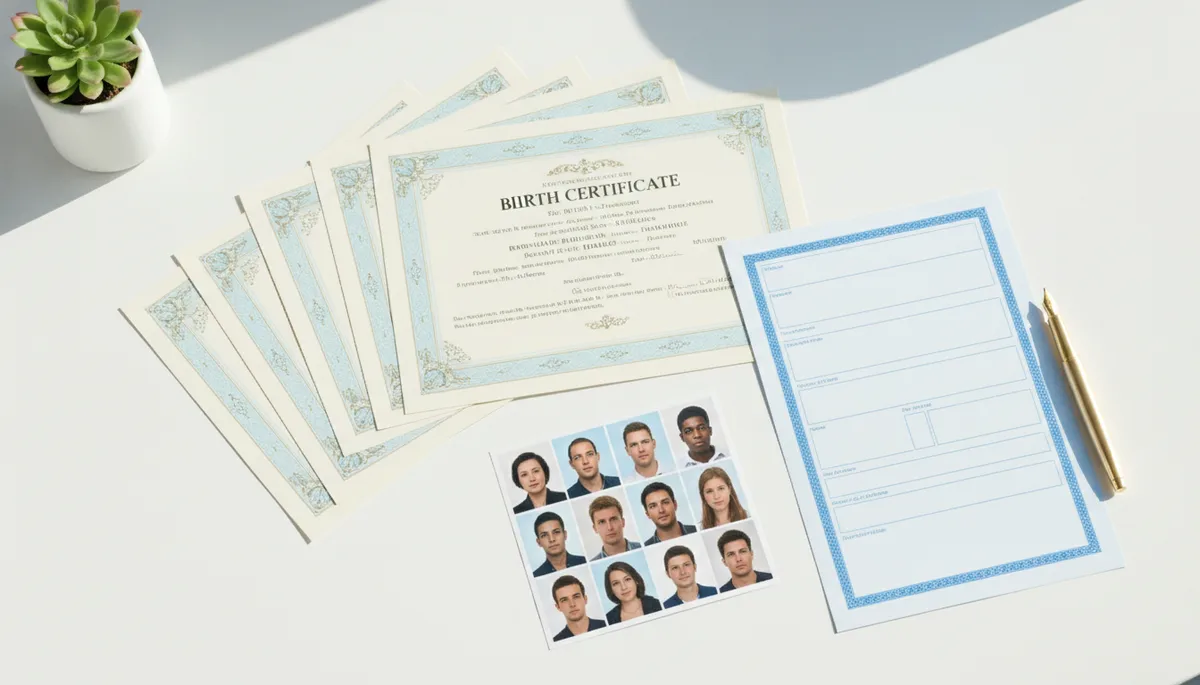
Foreign birth registration documents cover three people: you, your Irish citizen parent and your Irish-born grandparent. For each, the department wants an original civil birth certificate showing the parents’ names, a marriage certificate wherever a surname changed, and certified photo ID, or a death certificate if the person has died. You add proofs of address and photos.
- The signed and witnessed application form, printed from fbr.dfa.ie.
- Your original civil birth certificate showing your parents’ details.
- Your marriage certificate or change-of-name document, if your name has changed.
- A certified photocopy of your current state-issued photo ID.
- Two separate original proofs of address.
- Four colour passport-style photos, two of them witnessed.
- Your parent’s original civil birth certificate and, if relevant, marriage certificate.
- Your parent’s certified photo ID, or their death certificate.
- Your grandparent’s original Irish civil birth certificate and, if relevant, marriage certificate.
- Your grandparent’s certified photo ID, or their death certificate.
Irish civil registration started in 1864. For a grandparent born before then, the department accepts a baptismal certificate instead. Irish birth certificates themselves come from the General Register Office.
Every original comes back to you by recorded post after processing, so you won’t lose the family’s only copy of a 1930s marriage certificate. You’ll have to sign for the return.
Who Can Witness a Foreign Births Register Application?
Your witness must know you personally, be currently practising in an approved profession and not be related to you. Approved witnesses include police officers, teachers and lecturers, clergy, doctors, nurses, pharmacists and dentists, lawyers and notaries, bank or credit union managers, accountants, elected representatives, vets and chartered engineers.
The witness signs the form and two of your four photos. A cousin who happens to be a doctor doesn’t count, and it’s a common reason files come back. Pick someone you know through work or the community, outside the family.
How to Apply to the Foreign Births Register
The process is dead simple once the papers are ready. Six steps cover it, all online except the final posting.
Step 1: Confirm your route. Check that your grandparent was born on the island of Ireland, or that your Irish parent was a citizen when you were born.
Step 2: Order every certificate at once. Request birth and marriage certificates for all three generations from each registry at the same time. Waiting on one before ordering the next costs months.
Step 3: Start the online application. Fill in the form at fbr.dfa.ie and pay €278 for an adult or €153 for a child, including postage. There’s no paper form.
Step 4: Print, sign and witness. Print the form, sign it in front of an approved witness and have them sign two of your photos.
Step 5: Post the originals. Send the form and every original document to the address printed on your form. Use recorded post, because the department doesn’t confirm receipt.
Step 6: Wait, then apply for a passport. Once you’re entered on the register, you get a Foreign Birth Registration Certificate and can apply for an Irish passport online.
Brothers and sisters in the same country can apply together. They send separate forms in one envelope and share one set of family documents, which saves ordering everything twice.
Foreign Births Register Processing Time
The Foreign Births Register processing time is about 12 months, according to the Department of Foreign Affairs, and files are handled in strict date order. The clock starts when your complete documents reach the department. Filling in the online form doesn’t start it. An incomplete file comes back to you, and you join the queue again when you resend it.
Add the passport and the full timeline from first certificate order to passport in hand looks like this.
| Stage | Typical time | Source |
|---|---|---|
| Ordering certificates for three generations | Weeks to a few months | Varies by registry |
| Registration processing | About 12 months | Department of Foreign Affairs |
| First adult passport online | 20 working days on average | Department of Foreign Affairs, plus postage abroad |
| Total | Roughly 14 months or more | Our estimate from the figures above |
Read that number twice before planning a move. If you need an EU passport for a job or a relocation next spring, the time to post the file was last year.
When Does Irish Citizenship Start?
Irish citizenship through the register starts on the date you’re entered on it. It isn’t backdated to your birth. That single rule decides whether your children can follow you, because a child born before your registration isn’t eligible through you, while a child born after it is.
Bottom line for anyone planning a family: register first. The department says plainly that if you aren’t on the register when your child is born, that child won’t be entitled to Irish citizenship through you. Children born after your registration can then apply on the register themselves.
Foreign Births Register Fees
The Foreign Births Register costs €278 for applicants aged 18 or over and €153 for under-18s, including €8 postage, paid online. That’s the whole government fee. A first adult passport afterwards costs €75 online, plus €15 postage for first-time applicants living abroad.
| Item | Adult | Under 18 |
|---|---|---|
| Registration and certificate | €270 | €145 |
| Postage | €8 | €8 |
| Registration total | €278 | €153 |
| First passport online (abroad) | €75 + €15 postage | Child rate |
Certified copies of birth and marriage records from US states, UK registries or the General Register Office add their own fees, and they’re often the bigger bill for a three-generation file.
Common Foreign Births Register Mistakes
Most rejected files fail on paperwork the applicant could have caught at the kitchen table. These are the ones we see most.
- Using a relative as the witness, even one in an approved profession.
- Sending a short birth certificate that leaves the parents off.
- Leaving a married name unexplained, so the grandmother on one record doesn’t match the next.
- Sending photocopies where the department wants originals.
- Assuming a parent’s late registration covers children already born.
- Posting without tracking and having no proof the file arrived.
If any document is missing, fix it before you post. A file that comes back after months in the queue costs you far more than a few extra weeks of preparation. Our Irish citizenship service builds and checks the document chain for you if you’d rather hand it over.
Foreign Births Register vs Other Routes to Irish Citizenship
The register is the only route for grandchildren and later generations of Irish-born people. Anyone with an Irish-born parent skips it entirely. Everyone else needs residence: five years in the last nine for naturalisation, or three for spouses of Irish citizens, as set out in our guide to Irish citizenship requirements.
The residence route is also getting tougher. A bill now being drafted would raise it to eight years, as covered in our report on the new Irish citizenship rules. The register isn’t affected.
Once you’re registered, an Irish passport opens 31 European countries for living and working, plus the UK through the Common Travel Area, and reaches 185 visa-free destinations on our Passport Freedom Index. If you also have Canadian roots, our Canadian eligibility checker is worth a minute.
Foreign Births Register FAQ
What is the Foreign Births Register?
How long does the Foreign Births Register take?
How much does the Foreign Births Register cost?
Can I register through a great-grandparent?
Who can witness a Foreign Births Register form?
Do I get my original documents back?
Can my children register after me?
Can I apply for an Irish passport at the same time?
Final Thoughts on the Foreign Births Register
The register asks for paper and patience. It doesn’t ask for money or residence. Order every certificate together, choose a witness outside the family, and post the lot by tracked mail. Then plan for a year. When the passport comes, our guide to getting an Irish passport by descent covers the last step.
Sources and References
- Department of Foreign Affairs, Registering a foreign birth
- Citizens Information, The Foreign Births Register
- Citizens Information, Irish citizenship through birth or descent
- Department of Foreign Affairs, Passport fees
- Department of Foreign Affairs, Passport turnaround times