
An offshore bank account for Canadians is fully legal: Canada has no exchange controls, so any resident can open an account abroad and move money to it. What you can’t do is keep it quiet, because the CRA receives data on Canadians’ foreign accounts every year and expects a Form T1135 once your foreign property costs more than $100,000.
That’s the whole answer in two sentences. The useful part is everything around it: which banks will actually take a Canadian address, how much of your money is insured once it leaves CDIC cover, what the CRA receives and from whom, and the filing rules that turn a forgotten form into a five-figure penalty.
Most Canadians who ask about an offshore bank account in Canada’s context want one of three things. US dollars without a Canadian bank’s conversion spread. Some of their cash sitting outside the reach of a single Canadian institution. Or a working account for a move abroad. Each points to a different bank, and to different paperwork.
Put your assets beyond reach in 57 jurisdictions.
Pick where you want your company. We handle the filing, the registered agent, and the bank introduction. From US$1,290, done in days, not months.
- Charging-order protection in jurisdictions courts can't pierce
- Zero tax on foreign income in 30+ territories
- Banking options available
- Fixed price. No surprise fees at closing
Can Canadians Have Offshore Bank Accounts?
Yes. Canadians can legally open offshore bank accounts in any country whose banks accept them, and there’s no Canadian cap on how much you send. The conditions are reporting ones: interest is taxable in Canada, foreign property over $100,000 goes on Form T1135, and cash of $10,000 or more carried across the border must be declared.
The hard part is finding a bank that wants you. Plenty of offshore banks won’t onboard a Canadian resident at all. Swiss and Singaporean private banks want large balances, and smaller banks often see a Canadian address, think about the compliance file, and pass. The banks that actively court Canadians are mostly the US subsidiaries of Canadian banks and a handful of private banks in the Crown Dependencies.
We see the same pattern with Canadian clients. They come in asking for “an account somewhere outside Canada” and picture the Caribbean. Then they learn that their RBC or TD US-dollar account in Toronto already gives them currency diversification with CDIC cover, and that what they actually lack is jurisdictional diversification. That second goal is the one an offshore account solves. If you’re weighing the general case first, our offshore bank accounts guide compares the main banking centres.
Does the CRA Know About Offshore Bank Accounts?
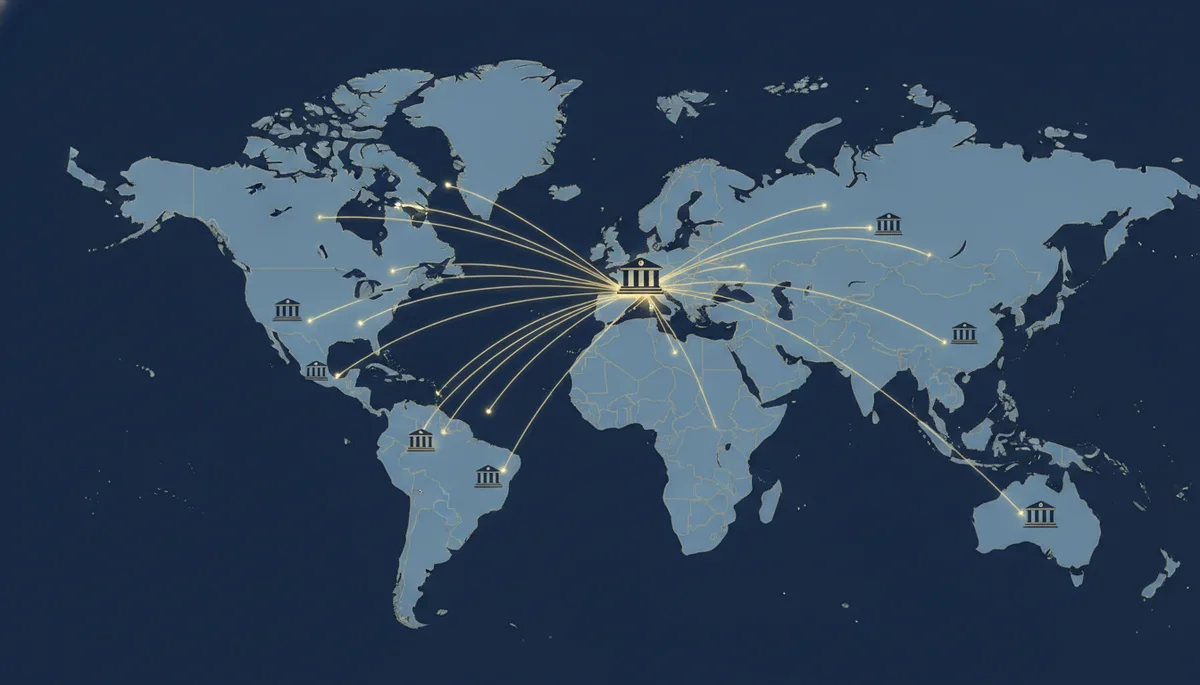
Yes, in almost every case. Since 2018 the CRA has received annual reports on accounts Canadians hold abroad: the CRA says the US and its Common Reporting Standard partners send it your name, address, account balance and income. Banks also report every international wire of $10,000 or more.
Three separate pipes feed that picture.
- CRS. Canada wrote the Common Reporting Standard into Part XIX of the Income Tax Act, with Canadian banks collecting data on new accounts from July 1, 2017. The deal is reciprocal. Jersey, the Isle of Man, Switzerland, Singapore and the other participating centres report Canadian residents’ accounts back to Ottawa.
- The US deposit-interest rule. The US isn’t in CRS, and that’s where many Canadians assume a US account stays quiet. It doesn’t. US banks must report deposit interest paid to residents of listed countries, and the IRS’s own list in Rev. Proc. 2022-35 names Canada as a country it automatically exchanges that data with.
- Wire reporting. Since 2015, banks and money services businesses send the CRA the same report on international electronic funds transfers of $10,000 or more that they file with FINTRAC, under a measure announced in Budget 2013.
Carrying cash out yourself doesn’t dodge this either. The CBSA’s reporting rule applies to currency or monetary instruments of $10,000 or more, in Canadian dollars or the equivalent, and unreported funds can be seized at the border.
So privacy from the CRA isn’t on the menu for a Canadian tax resident. If that’s the real goal, the conversation moves to where you’re tax resident, because the reporting follows residence, and to the shrinking group of non-CRS countries.
Do I Need to Report Foreign Bank Accounts to the CRA?
You need to report a foreign bank account on Form T1135 if the total cost of all your specified foreign property was more than $100,000 at any time in the year. The CRA’s T1135 guidance counts funds deposited or held outside Canada, so one offshore account with $60,000 and a US brokerage holding $50,000 together trigger the form.
Read that threshold carefully, because this is where people get burned. It’s an aggregate test, it uses cost rather than market value, and it’s “at any time in the year”. A balance that touched $101,000 for one week in March counts, even if you spent it down by April.
A few details the summaries skip:
- A US-dollar account at a bank in Canada isn’t foreign property. The test is where the funds are deposited. USD sitting at a Canadian branch stays off the T1135. The same dollars at a US subsidiary of the same bank go on it.
- Two methods. If your foreign property cost more than $100,000 but under $250,000 all year, you can use the simplified Part A and tick boxes by property type. Above $250,000 at any point, you list each account in Part B.
- Deadlines match your return. April 30 for most individuals, June 15 if you or your spouse are self-employed.
- Extra audit window. If you skip the form and don’t report the foreign income, the CRA gets an additional three years to reassess that year.
The penalties are where the form earns its reputation. These come from the CRA’s table of penalties, checked November 2026:
| T1135 failure | Penalty |
|---|---|
| Filing late | $25 a day for up to 100 days ($100 minimum, $2,500 maximum) |
| Knowingly or through gross negligence not filing | $500 a month for up to 24 months (maximum $12,000) |
| Ignoring a CRA demand to file | $1,000 a month for up to 24 months (maximum $24,000) |
| Still not filed after 24 months | 5% of the cost of the foreign property, less penalties already charged |
| False statement or omission | Greater of $24,000 or 5% of the property’s cost |
No due-diligence defence applies to the T1135, so “my accountant forgot” doesn’t reduce the bill. Read the late-filing line twice: the penalty applies even when you owe no tax at all.
Best Offshore Bank Account Options for Canadians
The best offshore bank account for Canadians depends on balance. Under about $100,000, a US cross-border account at a Canadian bank’s American subsidiary is the realistic choice. Above that, Isle of Man and Jersey private banks that list Canada as eligible open up, and Swiss or Singaporean banks make sense for larger, longer-term balances.
The table uses each bank’s or regulator’s own published terms, checked in November 2026. Banks change thresholds and eligible-country lists without notice, so confirm before you apply.
| Option | Where the money sits | Entry point | Deposit cover | Reported to CRA? |
|---|---|---|---|---|
| USD account at a Canadian bank (for comparison) | Canada | Ordinary account | CDIC, C$100,000 per category, foreign currency included (CDIC) | Domestic tax slips; not T1135 property |
| RBC Bank cross-border checking | United States (RBC Bank (Georgia), N.A.) | Apply online with a Canadian address and SIN; US$50 to open; Direct Checking US$39.50 a year (RBC Bank) | FDIC, US$250,000 | Yes, through US deposit-interest exchange |
| Isle of Man private bank | Isle of Man | High-net-worth balances; Nedbank Private Wealth’s enquiry list includes Canada | £50,000 per individual | Yes, CRS |
| HSBC Expat | Jersey branch of HSBC Bank plc | £75,000 relationship balance (£10,000 with HSBC Premier elsewhere), eligible-country list applies (HSBC Expat) | £50,000 per banking group | Yes, CRS |
| Swiss bank | Switzerland | Set by each bank, and usually far above retail levels for non-residents | CHF 100,000 per depositor per bank (esisuisse) | Yes, CRS |
| Singapore bank | Singapore | Set by each bank; see our Singapore guide below | S$100,000, Singapore-dollar deposits only (MoneySense) | Yes, CRS |
Two things stand out. First, every option on the list reports to the CRA. Second, almost every one covers less than the C$100,000 per category you get from CDIC at home, and Singapore covers nothing at all on US-dollar balances. Moving money offshore trades deposit insurance for jurisdictional spread, and you should know that’s the trade before you make it.
US cross-border accounts are the dead simple starting point. You can apply from Canada with a SIN instead of a US Social Security number, the money sits under FDIC cover up to US$250,000, and transfers between the Canadian parent and the US subsidiary are routine. For many clients that’s the first offshore account and the only one they need for spending in US dollars. Our guide to a US bank account for non-residents covers the alternatives to the cross-border route.
The Crown Dependencies are the next step up. Our Isle of Man bank account guide walks through which banks take residents of which countries, and the Jersey bank account guide explains why several “Channel Islands” brands actually book international customers in the Isle of Man. Expect source-of-wealth questions, certified documents and a wait of several weeks.
Switzerland and Singapore suit larger balances held for the long term, usually as part of a Swiss bank account or Singapore bank account relationship that includes investment custody. They’re poor value for anyone holding less than a six-figure sum.

Is Interest on an Offshore Bank Account Taxable in Canada?
Yes. A Canadian resident pays Canadian tax on interest from an offshore bank account at their normal marginal rate, exactly as on interest from a Canadian bank. CRA guidance for line 12100 says to report foreign interest in Canadian dollars, generally converted at the Bank of Canada rate, and to claim a foreign tax credit for any foreign tax withheld.
In practice there’s rarely foreign tax to credit. Jersey, the Isle of Man and most offshore centres don’t tax a non-resident’s deposit interest, and the IRS doesn’t tax bank deposit interest paid to nonresident aliens that isn’t connected to a US business. The interest arrives gross, and the whole bill lands on your Canadian return.
Holding the account through an offshore company doesn’t change that for a Canadian resident who controls it. Canada’s foreign accrual property income (FAPI) rules generally attribute passive income such as interest earned inside a controlled foreign company to its Canadian shareholders as it’s earned. Our explainer on CFC rules covers how these regimes work and when a company genuinely helps.
Offshore Bank Account for Canadians Moving Abroad
An offshore bank account becomes far more useful once you stop being a Canadian tax resident. After you leave, the T1135 no longer applies, foreign interest stops being taxable in Canada, and the bank reports your account to your new country of residence under CRS instead of to the CRA.
Getting there takes more than a plane ticket. Residence for Canadian tax purposes turns on your ties: a home, a spouse or dependants, and economic links. Keep the house and the family in Calgary and you’re likely still resident, wherever you sleep. Our guide on whether you can be a resident of two countries explains how treaty tie-breakers settle conflicts.
Leaving also triggers a deemed disposition of most of your property at fair market value. We’ve covered how that works in our guide to Canada’s departure tax. The order matters here. Open the offshore account while you’re still in Canada, with a Canadian address the bank can verify, then update your CRS self-certification when your residence changes. Banks are much quicker to onboard someone with a stable address than someone who’s mid-move with a temporary one.
We’ve watched clients sell the house first and apply for their first non-Canadian account afterwards, from a short-term rental with no fixed address in either country. Banks decline that file quickly. Sequencing fixes the problem for free.

How to Open an Offshore Bank Account From Canada
Step 1: Decide what the account is for. Spending US dollars, spreading jurisdictional risk and preparing for a move each point to a different bank. Settle this first and the shortlist writes itself.
Step 2: Check eligibility and deposit cover. Confirm the bank lists Canada on its eligible-country list, note its minimum balance and fees, and check which compensation scheme covers the booking location.
Step 3: Prepare your documents. Expect a certified passport copy, recent proof of address, your SIN as your tax identification number on the CRS self-certification, and a written explanation of your source of funds and source of wealth.
Step 4: Apply and fund by wire. Send the opening deposit from your own Canadian account. Wires of $10,000 or more are reported to the CRA automatically, which is fine as long as everything else matches.
Step 5: Track cost for Form T1135. Keep a running total of the cost of all your foreign property, including US brokerage holdings. The day it passes $100,000, you’re filing for that year.
Step 6: Report the interest every year. Convert it to Canadian dollars and include it on line 12100, whether or not the bank sends you a tax slip.
Timelines vary from a few days for a cross-border US account to six weeks or more at a Crown Dependency private bank. The part that drags is rarely the bank. It’s usually waiting on certified copies and a source-of-wealth letter that the client didn’t know they’d need.
Common Mistakes Canadians Make With Offshore Accounts
- Testing each account against $100,000. The T1135 threshold is the total cost of all specified foreign property, held at any time in the year.
- Forgetting US accounts count. A US cross-border account, a US brokerage account and US shares held abroad all count toward the threshold.
- Assuming a US account stays private. The US exchanges deposit-interest data with Canada even though it sits outside CRS.
- Giving up deposit cover without noticing. C$100,000 of CDIC cover per category becomes £50,000 in Jersey or the Isle of Man, and nothing on foreign-currency deposits in Singapore.
- Using a company to defer tax on interest. FAPI generally taxes passive income in a controlled foreign company as it’s earned.
- Sitting on a missed filing. Under the CRA’s Voluntary Disclosures Program, as revised for applications from October 1, 2025, an unprompted disclosure gets 100% penalty relief and 75% interest relief, with records required for up to 10 years on foreign income. Once the CRA contacts you first, interest relief drops to 25%.
Bottom line: the offshore account itself is rarely the problem. The paperwork around it is, and the paperwork is entirely within your control.
Offshore Bank Account for Canadians: FAQ
Is an offshore bank account for Canadians legal?
Do I need to report a foreign bank account to the CRA?
Can the CRA see my offshore bank account?
What is the easiest offshore bank account for Canadians to open?
Is a US dollar account at a Canadian bank an offshore account?
What is the penalty for not filing Form T1135?
Does an offshore bank account for Canadians come with deposit insurance?
I never filed a T1135 for my foreign account. What now?
Final Thoughts
An offshore bank account for Canadians is a sound tool for currency, for spreading jurisdictional risk, and above all for a planned move abroad. It isn’t a hiding place, and treating it like one is the expensive mistake. File the T1135 when you cross $100,000, report the interest, and pick a bank whose deposit cover you understand.
If you’re planning a bigger change, compare how the rules differ in our guide to offshore bank accounts for UK citizens, then book a strategy call and we’ll map the bank, the residence and the sequence for your situation.
Sources and References
- Canada Revenue Agency, Foreign Income Verification Statement (Form T1135)
- Canada Revenue Agency, Foreign reporting: Table of penalties
- Canada Revenue Agency, Information for individuals holding accounts with Canadian financial institutions (CRS and FATCA)
- Internal Revenue Service, Rev. Proc. 2022-35: Jurisdictions for deposit interest reporting and exchange
- Canada Revenue Agency, Line 12100: Interest and other investment income
- Canada Revenue Agency, IC00-1R7, Voluntary Disclosures Program
- Canada Deposit Insurance Corporation, Protecting your deposits
- Canada Border Services Agency, Memorandum D19-14-1: Cross-border currency and monetary instruments reporting