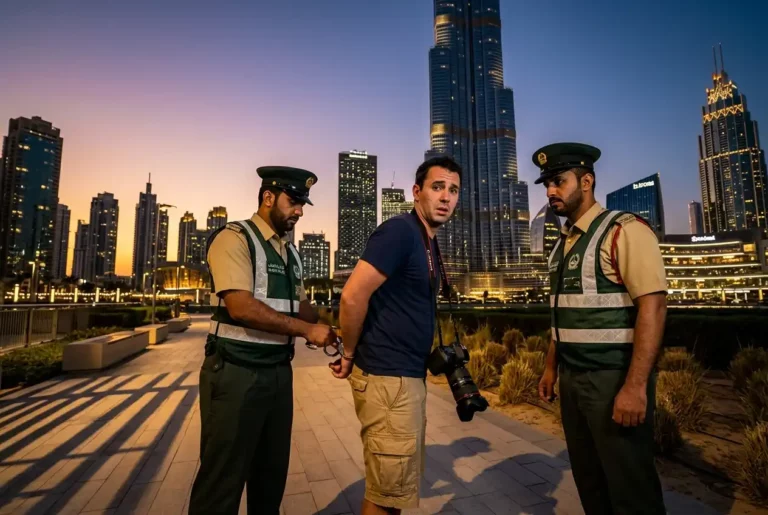
You take a photo of the city skyline and end up facing 2 years in prison. You text a friend using language you’d use at home and get charged with cybercrime. You raise your voice at an employee and spend months in detention. These aren’t hypothetical scenarios. People are being arrested in Dubai for activities that would never result in prosecution in Western countries. This is the reality of living or traveling in a jurisdiction where the law operates on a completely different playbook than what you’re accustomed to.
If you’re considering a move to the UAE, thinking about a business trip, or already living there (see our deep dive into Dubai’s hidden risks for expats), you need to understand something critical: Dubai’s legal system doesn’t function like Western legal systems. The same freedoms you take for granted—freedom of speech, the right to criticism, even casual gestures—can land you in serious legal trouble. And that trouble comes with real consequences: lengthy prison sentences, massive fines, travel bans, and deportations.
The March 2026 Iranian missile attacks on the UAE exposed just how quickly these laws get enforced. Over 66 people were arrested across Dubai and Abu Dhabi for something as simple as taking or sharing photos and videos. A 60-year-old British tourist deleted his video immediately when authorities asked, but he was still charged under cybercrime laws and faced years in prison. This wasn’t a fringe incident. This is how enforcement actually works on the ground.
Here’s what you need to know before you get arrested in Dubai.
The March 2026 Missile Crisis and the Mass Arrests in Dubai
In March 2026, Iran launched 398 ballistic missiles, 1,872 drone attacks, and 15 cruise missiles at the United Arab Emirates. The strikes hit critical infrastructure: Dubai International Airport multiple times, the Jebel Ali Port, AWS data centers, and the Ruwais refinery, which shut down 922,000 barrels of daily production. Eleven people died. Expats panicked. Private jets cost $250,000. Schools closed. People abandoned pets in the rush to leave. The city descended into chaos.
In the aftermath, authorities made a decisive move. They arrested 21 people in Dubai and 45 in Abu Dhabi for one crime: taking photos and videos of the missile strikes.
That’s it. That was the entire offense. Not terrorism. Not sabotage. Photography.
A 60-year-old British tourist filmed Iranian missiles in the sky. When authorities discovered the video, he deleted it immediately. He complied. He cooperated. And he was still charged under Article 14 of the UAE’s Cybercrime Law, which carries a minimum sentence of 2 years imprisonment and a fine of 200,000 AED (approximately $54,000). A Filipina domestic worker was detained near the Burj Al Arab after taking a photograph while waiting for work. A Vietnamese sailor in Fujairah shared a video of missile activity filmed outside UAE territory and ended up detained.
This wasn’t selective enforcement against troublemakers or foreign agitators. This was the state defending its narrative through criminalization. The government doesn’t want images of missile impacts circulating. Photos of chaos undermine the myth of UAE invulnerability. So they arrested people who took them.
And here’s the kicker: most people didn’t even know they were breaking the law. Everyone around them was sharing these photos. The confusion was understandable. But the law doesn’t care about confusion. As Radha Stirling, CEO of Detained in Dubai, explained, “Authorities have given these warnings, but when you’re there and everyone else seems to be sharing these photos, a lot of people are just going to forget or get caught up in everything.”
This is what being arrested in Dubai actually looks like. It’s not a consequence of intentional lawbreaking. It’s a consequence of living in a jurisdiction where the rules operate completely differently from what your instincts tell you.
Put your assets beyond reach in 57 jurisdictions.
Pick where you want your company. We handle the filing, the registered agent, and the bank introduction. From US$1,290, done in days, not months.
- Charging-order protection in jurisdictions courts can't pierce
- Zero tax on foreign income in 30+ territories
- Banking options available
- Fixed price. No surprise fees at closing
Arrested in Dubai for Photography: Not Documenting, Just Breaking the Law
Let’s be direct: photographing or filming in Dubai without explicit consent is illegal in ways that will surprise you. The penalties are severe. Under Article 14 of the UAE Cybercrime Law, unauthorized photography or recording of “critical infrastructure” can result in up to 2 years in prison and fines of 200,000 AED. But that’s just the starting point.
Article 373 of the UAE Penal Code criminalizes taking a photograph of someone without their consent. The maximum penalty is 500,000 AED in fines and imprisonment. That’s roughly $136,000. For a photo. That you probably thought was innocent.
The vagueness of the law is the real weapon. What counts as “critical infrastructure”? The government decides. What counts as photographing “without consent”? The government decides. What counts as using a photo in a way that “damages reputation” or “threatens security”? The government decides. You’re not operating under a system of clear, predictable rules. You’re operating under the government’s discretion.
This discretion gets exercised aggressively. People get arrested in Dubai for tourist photos. People get detained for documenting property conditions. Business owners get harassed for taking pictures of their own facilities. The common thread: the state decides what counts as acceptable documentation, and most of your instincts about what’s okay are wrong.
If you’re thinking, “But I saw hundreds of tourists taking photos,” you’re right. They did. Many of them also take the risk that eventually, they’ll be the one the authorities decide to make an example of. That’s not a strategy. That’s gambling.
Arrested in Dubai for a Text Message: WhatsApp and Cybercrime Laws
A 31-year-old British HR manager texted “f*** you” to a flatmate on WhatsApp. Not in person. Not on social media. Private message. She faced 2 years in prison under Article 373 of the UAE Penal Code, which criminalizes insults and abusive language, even in private messages. She eventually left the country after media coverage brought pressure on the authorities. The cost: a 600-pound fine and the loss of her life in Dubai.
An Italian pilot, Achraf Arjaouy, was detained for 3 months after WhatsApp messages to an ex-girlfriend. His ex demanded 10,000 dirhams to drop the case. He paid. He was released.
This is how being arrested in Dubai happens for average people doing average things. You send a text message. Someone decides to weaponize it. The government enforces the law aggressively. You’re in prison, and your best hope is that media coverage or a bribe gets you released.
The specific law is unforgiving. Swearing in public carries up to 1 year imprisonment and 10,000 dirhams in fines. Swearing on WhatsApp, social media, or through any electronic communication carries up to 2 years imprisonment or fines up to 250,000 AED (~$68,000). That’s roughly the cost of a car. For texting like you normally text.
And here’s what makes this especially dangerous: the law is enforced inconsistently and retroactively. People aren’t always arrested immediately. Someone screenshots your message, reports it weeks later, and suddenly authorities contact you. You don’t get the benefit of knowing the rules in advance. You get the benefit of learning them from a jail cell.
Raising Your Voice: The Tierra Allen Case
Tierra Allen is a TikTok creator from Texas known as the “Sassy Trucker.” In 2023, she visited Dubai. At a rental car agency, she had a disagreement with an employee. She raised her voice. She was animated. She was being herself.
The employee filed a complaint accusing her of “shouting.” She was arrested. She spent months in detention, from May to August 2023. The charges: public harassment and verbal abuse. The outcome: she eventually paid $1,300 to lift a travel ban and was allowed to leave.
Think about what happened here. A woman had a heated conversation. She wasn’t violent. She didn’t threaten anyone. She raised her voice during a disagreement. And that behavior was treated as a criminal offense serious enough to warrant months of detention.
The lesson is stark: your personality might be illegal in Dubai. Your expressiveness, your directness, your tendency to get animated in conversation, your American (or European or Australian) directness about problems, might all be classified as criminal conduct. Being arrested in Dubai for “shouting” is a real risk, not a hypothetical one.
This is what happens when a government decides that maintaining order and respect for authority takes absolute priority over personal expression. Your freedom to be yourself becomes a criminal liability.
Physical Contact: The Elizabeth Polanco Case
Elizabeth Polanco De Los Santos was a 21-year-old college student from New York studying at Lehman College. She was transiting through Dubai International Airport. During a layover, she had a medical condition that caused her to move in ways that weren’t entirely voluntary. While interacting with airport security, she gently touched the arm of a security officer.
That touch was classified as assault. She was arrested. She was detained for 5 months. She was sentenced to 1 year in prison. The total cost to her family: $50,000. She was eventually freed and deported, but her year was destroyed, her education was disrupted, and her life was marked by a criminal conviction in a foreign country.
She gently touched someone’s arm. That’s the offense. That’s what resulted in arrest, detention, conviction, and deportation.
This illustrates a critical principle of the UAE legal system: the state has absolute authority to define what constitutes a crime, and that definition prioritizes state authority and security over reasonable expectations. A fleeting, gentle touch becomes assault. A raised voice becomes harassment. A photograph becomes sabotage. The definitions are written in ways that give authorities maximum discretion.
Other Behaviors That Get You Arrested in Dubai
The categories of criminalized behavior extend far beyond what we’ve covered. Here’s a partial list of activities that can result in arrest:
Public displays of affection. Kissing, hugging, or holding hands in public. The penalty varies depending on circumstances, but it can include arrest, detention, and deportation. The rule technically applies equally to heterosexual and same-sex couples, but enforcement is selective.
Drinking in public. Consuming alcohol on streets, beaches, parks, or anywhere outside designated venues. Penalty: up to 6 months imprisonment and/or fines. This is a Muslim-majority country with strict religious laws, even though some of the hotels serve alcohol freely. Know the difference between what’s permitted for tourists inside resorts and what’s legal in public spaces.
Photography without explicit consent. We covered this, but the scope is worth repeating. You can’t photograph people, property, government buildings, or infrastructure without permission. Compare that to the country guides we publish for jurisdictions with actual rule of law. Penalties up to 500,000 AED.
Making a middle finger gesture. This counts as an “indecent gesture.” It results in immediate deportation and bans on re-entry. You won’t get a trial. You won’t get an appeal. You’ll be on the next plane home.
Bounced checks. This was historically treated as a criminal offense, though it was partially decriminalized in 2022. Check writing in the UAE comes with criminal liability in ways that many Western countries have abandoned entirely.
Promoting foreign charities on social media. Posting about international nonprofits or asking for donations to non-UAE registered organizations can result in criminal charges for unauthorized fundraising.
Eating or drinking in public during Ramadan. If you eat, drink, smoke, or apply makeup in public during fasting hours, you can be fined or arrested. The enforcement is sporadic but real.
Possessing CBD products or poppy seeds. Even though these are legal in many countries, they’re classified as drug offenses in the UAE. A tiny amount can result in severe penalties including lengthy prison sentences. The rules are absolute.
Posting negative reviews online. Writing a critical review of a business or service on social media or review sites can result in defamation charges, fines, imprisonment, and travel bans. The business owner doesn’t need to prove the review was false. They just need to file a complaint.
This is the operating environment. It’s not a list of extreme edge cases. These are real penalties for activities that people engage in constantly without a second thought in other countries.
The Legal System: How Being Arrested in Dubai Actually Works
Understanding the mechanics of arrest and prosecution in the UAE is critical. This isn’t like getting arrested in the US or UK or Australia. The legal system operates on completely different principles.
First, there’s limited access to legal counsel. You have the right to a lawyer, but that lawyer operates in an environment where the government has enormous discretion. Your lawyer can’t rely on precedent the way they could in a common law jurisdiction. Judges have broad latitude to interpret laws and determine sentences. The balance of power between state and individual is utterly asymmetrical.
Second, there’s no meaningful bail system or preliminary hearing process. You can be detained for extended periods while the government investigates. Months pass. You’re away from your family. Your business falls apart. Your legal bills accumulate. Eventually, you’re either convicted or released, but either way, you’ve lost months of your life and tens of thousands of dollars.
Third, there’s the weaponization of complaints. A business rival, a disgruntled employee, a person you had a conflict with, can file a complaint that triggers an arrest. You’re not arrested because you’ve committed a crime that actually harmed anyone. You’re arrested because someone made an accusation, and the government chose to enforce it aggressively.
Fourth, there are travel bans. Even if you’re eventually released, the government can impose a travel ban that prevents you from leaving the country. You’re stuck. Your family can’t visit. You can’t conduct business abroad. Your life is frozen.
Being arrested in Dubai isn’t a process where the system presumes your innocence and requires the government to prove guilt beyond a reasonable doubt. It’s a process where you’re presumed to have violated the law, you need to prove otherwise, and the government has almost unlimited resources and discretion to make your life difficult.
The Underlying Problem: Low Taxes, High Control
Dubai is marketed as a tax haven. Zero income tax. Free zones with minimal regulation. Business-friendly policies. It’s attractive. And for accountants who care only about tax rates, it looks perfect.
But here’s the reality that most people miss: a low tax rate means almost nothing if the government can cage you for taking a photograph, sending a text message, or raising your voice. The two things are completely connected. A government that respects your property rights enough to let you keep your income is usually the same government that respects your personal rights enough to let you speak freely, move freely, and live your life without fear of arbitrary prosecution.
The inverse is also true. A government that exercises absolute control over personal behavior and speech is unlikely to respect your property rights in any meaningful way. You’re one political shift away from increased taxation, asset seizures, or capital controls. You’re one relationship away from having your assets frozen because you upset a connected government official.
The Dubai model is essentially this: we’ll let you make money, but you’ll accept that we have the right to control everything else. Your words. Your images. Your movements. Your associations. Your expressions. In exchange, you get low taxes. It’s a devil’s bargain. And it’s particularly dangerous because the low tax rate blinds people to the absence of real freedom.
The math should be obvious: a jurisdiction that offers zero income tax but where you can be imprisoned for sending a text message is worse for your long-term asset protection than a jurisdiction with 20% income tax and rule of law. Because the 20% is predictable and the imprisonment risk is not.
We’ve created detailed guides to jurisdictions that offer real advantages without hidden costs. Explore the best tax residency programs, understand your options for geographic diversification, and learn what to actually look for in a jurisdiction. Get the complete picture.
Explore Residency Programs That Respect FreedomDubai vs. Actual Alternatives: Where You Can Have Both Economic AND Personal Freedom
The conversation shouldn’t be “Dubai or nowhere.” The conversation should be “What are the jurisdictions that offer genuine advantages without trapping you in a state surveillance apparatus?”
Monaco. No income tax on foreign-source income for residents. Rule of law. European legal protections. Stable government with a constitution and rule of law protecting residents. Yes, it’s expensive. Yes, you need real money to move there. But you get genuine economic freedom plus personal freedom. Your words are protected. Your privacy is protected. You can raise your voice without going to prison.
Panama. Territorial tax system, meaning you only pay tax on Panamanian-source income. Reasonable costs of living. Strong business infrastructure. Personal freedom. You can speak your mind. You can take photographs. You can criticize the government. You’re not risking years in prison for sending a text message. Panama isn’t a tax haven like the UAE, but it’s much closer to true freedom than Dubai.
Cyprus. Non-dom regime that’s attractive for expats. EU membership, which means rule of law and legal protections. Common law heritage. English is widely spoken. Reasonable cost of living. Mediterranean lifestyle. And you can actually live your life without fear of arbitrary arrest for ordinary behaviors.
Ireland. Non-dom regime. English speaking. EU membership. Common law tradition. Your words are protected. Your personal freedom is protected. The tax burden is higher, but the stability is real. The rule of law is real. It’s not a tax haven, but it’s a jurisdiction where you’re treated as a free person rather than a subject.
The common thread in these alternatives: they offer meaningful economic advantages while treating residents as free individuals rather than subjects of state control. That’s the actual standard you should be evaluating. Not just “What’s the tax rate?” but “Can I speak freely? Can I criticize the government? Can I take a picture without going to prison? Is my private communication actually private?”
The point is simple: you do not have to compromise. You can live completely tax free, or close to it, in jurisdictions that also respect your personal freedom. Panama charges zero tax on foreign income. Monaco charges zero income tax. Period. You keep 100% of your money AND you keep your right to speak, photograph, text, and live like a free human being. The idea that Dubai is the only option for tax-free living is a marketing myth, and a dangerous one. There are places where no overreaching government is watching your WhatsApp messages, scanning your camera roll, or throwing you in a cell for raising your voice at a car rental desk.
Dubai isn’t a trade-off. It’s a trap dressed up as a tax haven.
Before You Move: What You Actually Need to Know
If you’re still considering Dubai despite everything you’ve read, at minimum, understand what you’re accepting:
Understand the laws. Genuinely understand them. Not the version the tourism board tells you. Read the actual UAE Penal Code. Read the Cybercrime Law. Read articles by people like Radha Stirling who document arrests and enforcement patterns. Understand what behaviors get criminalized.
Understand that “everyone does it” is not a legal defense. Just because hundreds of tourists take photographs doesn’t mean you won’t be the one arrested. Selective enforcement is a feature of the system, not a bug.
Understand that your personal freedom is actually at risk. This isn’t theoretical. We’ve documented real people: a 60-year-old British tourist, a 21-year-old American college student, an Italian pilot, a Filipina domestic worker, a Texas TikTok creator. These are ordinary people who did ordinary things and got arrested.
Understand that legal defense is expensive and time-consuming. Even if you eventually win your case, you’ve already lost months or years and tens of thousands of dollars.
Understand that travel bans can trap you. You can be unable to leave the country for months or years while disputes are resolved.
Understand that the legal system doesn’t assume your innocence in the way Western legal systems do. The burden is on you to prove you didn’t commit an offense, not on the government to prove that you did.
If you understand all of that and you still want to move to Dubai, do it with open eyes. But if you’re moving to Dubai under the assumption that you’ll get Western-style legal protections plus tax benefits, you’re being naive about what you’re accepting.
Comparison: Dubai vs. Alternative Jurisdictions
| Factor | Dubai/UAE | Monaco | Panama | Cyprus | Ireland |
|---|---|---|---|---|---|
| Top Income Tax Rate | 0% (foreign income) | 0% (foreign income) | Territorial (0% foreign) | 0% (non-dom, 10 years) | 0% (non-dom, 9 years) |
| Rule of Law | Weak / Discretionary | Strong / Constitutional | Strong / Common Law | Strong / EU Law | Strong / Common Law |
| Speech Protection | Severely Limited | Protected | Protected | Protected (EU) | Protected |
| Photography Laws | Highly Restrictive | Standard Laws | Standard Laws | Standard Laws | Standard Laws |
| Privacy Protection | Limited / Monitored | Strong | Strong | Strong (EU GDPR) | Strong (EU GDPR) |
| Criminal Penalties for Speech | Yes (severe) | No | No | No | No |
| Arbitrary Arrest Risk | High | Very Low | Very Low | Very Low | Very Low |
| Cost of Living | Moderate-High | Very High | Moderate | Moderate | Moderate-High |
| English Prevalence | High | High | High | High | High |
Frequently Asked Questions: Getting Arrested in Dubai
What is the most common reason people get arrested in Dubai?
Based on reported cases, the most common arrests involve photography and filming, cybercrime charges for online behavior, and alleged insults or harassment over messaging apps. The March 2026 missile attacks resulted in 66+ arrests for photography alone. People get arrested in Dubai not for violent crime or theft, but for ordinary behavior that violates the state’s control preferences.
Can you be arrested in Dubai for something you did not know was illegal?
Yes. The law is not always clearly publicized, enforcement is inconsistent and discretionary, and many behaviors that are legal elsewhere are criminalized without clear warning. The 60-year-old British tourist who deleted his video immediately was still charged. Ignorance does not protect you from being arrested in Dubai.
What happens if you are arrested in Dubai as a foreigner?
You will be detained, interrogated, potentially denied access to legal counsel, and held while the government investigates. You can face travel bans that prevent you from leaving the country. Your family may not be able to visit. You will need an expensive local lawyer. You may spend weeks or months in detention before being convicted, imprisoned, or eventually deported with a criminal record.
How much does it cost to defend yourself if arrested in Dubai?
Realistic legal fees for a serious case start at $10,000 to $15,000 and easily reach $50,000 or more. On top of that, you lose income while detained or fighting charges. The Elizabeth Polanco case cost her family $50,000, and that was in 2023. Current costs are likely higher.
Can the US or UK government help if you are arrested in Dubai?
Help is limited. Your embassy can verify your detention, ensure you have legal representation, and provide some support, but they cannot override UAE law or force your release. You are subject to UAE legal jurisdiction. International pressure can sometimes help (as it did with the British HR manager), but it is not guaranteed.
Is it true that you can be imprisoned for WhatsApp messages in Dubai?
Yes, absolutely. Article 373 of the UAE Penal Code criminalizes insults over electronic communication. The British HR manager faced 2 years for a single swear word to a flatmate. The Italian pilot was detained for 3 months over messages to an ex-girlfriend. Being arrested in Dubai for a text message is documented law with documented prosecutions.
What should you do if you are traveling to Dubai?
Understand the real legal environment, including photography restrictions, speech restrictions, and behavioral laws. Assume that ordinary behavior might be illegal. Do not take photographs of infrastructure, government buildings, or people without explicit permission. Do not post criticism online. Brief your family on these risks and consider comprehensive travel insurance that covers legal defense abroad.
Is Dubai getting safer legally or more restrictive?
The trend over the past decade has been increasing enforcement of existing laws, broader definitions of crimes (especially cybercrime and “insults”), and greater use of arrests for ordinary behavior. The March 2026 photography arrests show that the government actively uses the legal system to enforce information control. Things are not improving for people worried about being arrested in Dubai.
What are realistic alternatives to Dubai if you want low taxes and freedom?
Consider Monaco (zero foreign income tax, full rule of law), Panama (territorial tax, personal freedom, strong legal system), Cyprus (non-dom regime, EU protections), or Ireland (non-dom regime, common law, English speaking). None offer the same tax advantages as Dubai, but they offer real freedom without the risk of being arrested in Dubai for ordinary behavior.
Can you negotiate with authorities if arrested in Dubai?
Sometimes. Some cases have been resolved with payments or political pressure. But you cannot count on it. The Italian pilot paid off his ex-girlfriend to drop charges. The British HR manager got media coverage that pressured authorities. For every successful negotiation, there are people who spent months in prison or years under travel bans. Negotiation is not a reliable defense strategy.
Does travel insurance cover arrest and legal defense in Dubai?
Some travel insurance policies include coverage for legal defense and bail, but most exclude coverage for criminal charges or arrests related to local law violations. Check your policy carefully. Comprehensive travel insurance that includes legal support is rare and expensive. It is not a substitute for understanding the laws before you travel.
Why does the UAE government arrest people for taking photographs?
Control. Information control. A government that arrests people for photographing missile damage is controlling the narrative about what happens in the country. Images of chaos, damage, and military vulnerability undermine the government’s preferred image. Suppressing photography through criminalization is an information control strategy. It is not about actual security. It is about narrative dominance.
The Bottom Line: You’re Trading Freedom for Tax Optimization
Let’s be blunt. Every person arrested in Dubai had a choice. They could have lived somewhere else. They could have accepted a higher tax burden in exchange for genuine personal freedom. A 60-year-old British tourist could have retired in Portugal or Italy instead of Dubai. A 21-year-old college student could have transited through a different airport. A Texas TikTok creator could have traveled elsewhere.
They chose Dubai. Most chose it because of the image of easy money, tax-free living, and luxurious lifestyle. They didn’t choose it because they carefully analyzed the legal system and decided the trade-off was worth it. They chose it because they weren’t thinking about the legal system at all. They were thinking about the beaches, the buildings, the parties, and the tax-free income.
And then they collided with a legal system that operated on completely different principles than they expected.
The real lesson isn’t about Dubai specifically. It’s about the fundamental error of jurisdictional decision-making. You cannot optimize for one variable (tax rate) and ignore the others (legal freedom, rule of law, respect for property rights, respect for personal liberty). They’re connected. The government that respects your property rights enough to tax you at zero also tends to respect your personal freedom. And the government that controls your personal behavior absolutely will eventually control your property.
A 15% tax rate in a jurisdiction with rule of law beats zero tax in a jurisdiction where you can be imprisoned for taking a photograph. The math isn’t complicated. But people get seduced by the low tax number and ignore everything else.
The right way to approach jurisdictional arbitrage and asset protection is to start with freedom and rule of law as your baseline requirements, then optimize for tax efficiency within those constraints. Not the other way around. Not “What’s the lowest tax number I can find?” but “What’s the jurisdiction with the strongest legal protections where I can also optimize my tax burden?”
Dubai fails that test. It fails catastrophically. And the people paying the price are sitting in detention centers right now, wondering why they didn’t think about this before they took that photograph or sent that text message.
Don’t be one of them. Choose your jurisdiction carefully. Choose it because it offers both economic advantage AND genuine personal freedom. And if you’re looking at Dubai, look harder at alternatives. Because the beach view and the tax rate aren’t worth the risk of years in prison for behavior you didn’t even know was illegal.
We’ve compiled detailed comparisons of the best tax residency programs around the world, analyzing not just tax benefits but legal protections, rule of law, and genuine personal freedom. Get the complete picture of your realistic alternatives, including costs, requirements, and actual benefits.
Explore the Best Tax Jurisdictions With Rule of LawFinal Thoughts: The Real Price of Jurisdictional Arbitrage
Jurisdictional arbitrage is real. Geographic diversification is smart. Choosing the right country matters. These are legitimate strategies for protecting your wealth and your freedom. But they only work if you’re optimizing correctly. And optimization means including freedom and rule of law as primary variables, not afterthoughts.
Dubai is a masterclass in how to get this wrong. It’s a jurisdiction that looks perfect on the surface (zero tax, modern infrastructure, business-friendly policies) but is actually a trap if you value personal freedom. The government will take your income tax rate down to zero, but it will take your personal freedom down to less than zero. You’ll be free to make money but not free to speak, photograph, move, or communicate without fear of arbitrary state enforcement.
There are better options. Options where you can have both economic advantage and personal freedom. Not as much of a tax advantage as Dubai, but genuine advantages combined with genuine freedom. That’s the actual goal. That’s what jurisdictional arbitrage should mean.
Make your decision with open eyes. Understand what you’re getting and what you’re trading away. Don’t move to Dubai because the tax rate is low. If you need a second passport as your escape route, get one now. Don’t stay in Dubai because you’re afraid of uprooting. And don’t assume that “everyone does it” means it’s safe. The people being arrested in Dubai right now probably thought the same thing.
Your freedom is worth more than the tax savings. Act like it.
Sources and References
- Detained in Dubai, Detained in Dubai: UAE Legal Experts and Case Database
- UK Government, United Arab Emirates: Safety and Security Travel Advice
- US Department of State, United Arab Emirates: Country Report on Human Rights Practices
- CBS News, Tourists, Expats and Influencers Detained in UAE Over Digital Content
- CNN, British Man Charged With Cybercrimes in Dubai for Filming Missile Strikes
- ABC News, NYC College Student Sentenced to 1 Year in Dubai Prison Over Airport Altercation
- Government of Canada, An Overview of the Criminal Law System in the United Arab Emirates
- Wikipedia, 2026 Iranian Strikes on the United Arab Emirates