Albania citizenship just stopped being a curiosity and became a strategy. When former New York mayor Eric Adams walked out of a Tirana ceremony on 10 April 2026 holding an Albanian passport, he didn’t collect a souvenir. He planted a flag in one of the most interesting European accession stories of the decade.
Adams received honorary Albanian citizenship by presidential decree from Bajram Begaj, granted “at his request” under Albania’s citizenship-by-exception provisions. The story flashed across US media for a news cycle, then disappeared. Americans who follow second-passport strategy did not let it disappear. They saw what Adams saw: a merit-based path into a future EU member state, available now, without the price tags attached to Austria or the closed door that Malta just slammed shut.
The timing is the thing. Albania opened its final EU accession cluster in November 2025 and is pushing to close negotiations by the end of 2027, with full membership targeted for 2030. The European Commission calls that timeline “ambitious but on track.” Every Albanian passport issued today is, on a long enough horizon, a future EU passport. That’s the play. That’s why Adams moved. And that’s why the queue of quiet, qualified Americans making the same move is getting longer.
Let’s be blunt: this is not a golden visa. Albania doesn’t sell passports. Albania grants citizenship to individuals who bring documented, substantial value to the country. Nail the contribution and the dossier, and you land an Article 9 decree. Miss, and no amount of money closes the gap. This guide covers how Albania citizenship by exception actually works, what Eric Adams’s case teaches every applicant who isn’t a former mayor, and how Americans should weigh Albania against the Caribbean, Serbia, Montenegro, and what’s left of Malta.
Put your assets beyond reach in 57 jurisdictions.
Pick where you want your company. We handle the filing, the registered agent, and the bank introduction. From US$1,290, done in days, not months.
- Charging-order protection in jurisdictions courts can't pierce
- Zero tax on foreign income in 30+ territories
- Banking options available
- Fixed price. No surprise fees at closing
Why Americans Are Suddenly Asking About Albania Citizenship
For years Americans shopping for a second passport had a short mental list: Saint Kitts, Dominica, Grenada, Antigua, Saint Lucia, Malta, Portugal, maybe Turkey. Albania wasn’t on it. Most Americans couldn’t place Albania on a map beyond “somewhere near Greece.” That has changed fast.
Three things changed it. First, Malta. The Court of Justice of the European Union ruled on 29 April 2025 that Malta’s citizenship-by-investment program violated EU law, striking down the only direct-investment route to an EU passport available to non-EU nationals. Malta still operates a narrow “exceptional services” residency program, but the sell-a-passport era in the EU is over. Second, Cyprus shut its own golden passport program years earlier. Americans used to solving problems with money suddenly discovered the door is closed.
Third, Adams. When a high-profile American former mayor publicly accepted an Albanian passport by presidential decree, it put the program on the front page of every US tabloid for forty-eight hours. That was enough to flip it from obscure to obvious. Immigration lawyers in Tirana report a visible spike in English-language inquiries in the weeks that followed.
US citizens already enjoy visa-free stays of up to one year in Albania, the longest tourist allowance of any country for American passport holders. That year lets you actually live in the country, build a business, make introductions, and scout real estate without any visa paperwork. By the time you apply for albania citizenship under Article 9, you can credibly claim a genuine connection. That matters. It’s also a lifestyle test in disguise: spend six months in Tirana and on the Albanian Riviera and you’ll know whether this fits.
How Albania Citizenship by Exception Actually Works
The legal hook is Article 9 of Law No. 8389 on Albanian Citizenship, Albania’s nationality law. The text is short. A foreign citizen aged 18 or over may be granted Albanian citizenship, even without meeting standard naturalization requirements, if the Republic of Albania has a scientific, economic, cultural, or national interest in granting it. That’s the entire statutory basis. Everything else is policy, precedent, and practice.
No price list exists. No fixed investment threshold. No clause saying if you donate X euros you automatically qualify. That is by design. Albania does not want to be Malta. The country wants contributors, not check writers, and the Ministry of Interior evaluates each dossier on its merits. This is what makes the program both attractive and demanding. Done right, albania citizenship is cheaper and more durable than any commercial CBI. Done wrong, you can spend years assembling evidence and still get nothing.
The categories the Albanian government considers for citizenship by exception include:
- Economic contribution: Business investment that creates Albanian jobs, significant real estate development, foreign direct investment in strategic sectors (energy, tech, tourism, manufacturing), or demonstrable capital inflow that benefits the national economy.
- Cultural contribution: Artists, musicians, filmmakers, writers, or designers whose work advances Albania’s international cultural profile. Adams’s honorary decree cited cultural and diplomatic connection to the New York Albanian diaspora.
- Scientific contribution: Researchers, academics, or engineers bringing advanced knowledge, collaborations, or innovation to Albanian institutions.
- Sport: Athletes and coaches who can represent Albania internationally or raise Albanian sport to a higher level.
- Humanitarian grounds: Stateless persons, persons at risk, or individuals whose protection is in Albania’s humanitarian interest.
- National interest: A catch-all for people whose presence serves Albania’s political, diplomatic, or strategic position.
Here’s the kicker on the process: no language test, no residence requirement, no minimum number of days in country, no integration exam. The exception route waives all of those standard naturalization prerequisites. What it doesn’t waive is substance. You need a dossier that makes the minister say, quite simply, Albania wants this person as a citizen.
The Strategic Play: Albania Citizenship Before EU Accession
Why does this matter if Albania isn’t in the EU? Because Albania is about to be. In November 2025 the Commission opened the final negotiation cluster. All six negotiation clusters are now open. Prime Minister Edi Rama has set a target of closing accession talks by the end of 2027 and joining the EU by 2030. The European Commission called that timeline “ambitious but on track.” Independent analysts at DGAP and the European Council on Foreign Relations treat 2030 to 2032 as realistic.
The numbers don’t lie. Albania has moved faster through the accession process in the last three years than any other Western Balkan candidate. Montenegro has stalled on rule-of-law benchmarks. Serbia has foreign policy headaches with Kosovo and Russia. North Macedonia is still blocked by bilateral disputes. Albania has run ahead of the pack, and the EU has noticed.
What does EU accession mean for a current Albanian passport holder? On the day Albania joins, every Albanian passport becomes an EU passport. That unlocks the right to live, work, and run a business in any of 27 EU member states, plus Iceland, Norway, Liechtenstein, and Switzerland. It’s the same right German, French, and Irish citizens currently enjoy. You get it without ever having lived a single day in the EU.
Put another way: an Albanian passport acquired in 2026 is an option on EU citizenship in 2030. If Albania accedes on schedule, you paid for a Balkan passport and you received a European one. If accession slips to 2032 or 2034, you still have a passport that opens 123 countries visa-free today, including the entire Schengen Area, Turkey, Russia, China, Indonesia, and most of Latin America. That’s not a bad consolation prize.
One more thing. Austria maintains its own honorary citizenship program. Austrian citizenship is immediately EU, but the unwritten contribution bar typically exceeds 5 million euros and the program is far more political. Albania sits in the middle. More accessible than Austria. More prestigious and durable than Caribbean CBI. And unlike Malta, once you have it, nobody can take it back because you closed your business.
Eric Adams: A Case Study in Article 9 Citizenship
Adams is the public data point, so let’s use him. What did he actually demonstrate to qualify?
He had served as mayor of New York City, home to roughly 200,000 people of Albanian descent, one of the largest Albanian diaspora communities outside Kosovo. During his mayoral term he visited Albania, spoke at Albanian American community events, and built political ties with Albanian officials. His son lived in Albania while competing on the country’s version of “American Idol.” In October 2025 he made a four-day working trip to Albania focused on tourism, investment, and NYC economic ties. President Begaj’s decree cited the strength of the Albanian American community and Adams’s role in strengthening that bond.
That’s a lot of what Article 9 calls “national interest.” It’s also something you can’t fake. Adams didn’t wake up one morning, write a check, and get a passport. He built years of verifiable connection first. The decree ratified what the record already showed.
The lesson for Americans without a political profile is simple: you need a story, and the story needs documents. Investment alone won’t do it. You need the investment plus the jobs, plus the local partnership, plus the documented economic impact, plus the photos with the ministers, plus the press coverage in Albanian media. Build the record, then apply.
Albania Citizenship vs. Caribbean CBI vs. Malta vs. Austria
Most Americans weighing albania citizenship are also looking at Caribbean programs, Turkey, and residual European options. Here’s how the realistic set compares in early 2026:
| Program | Structure | Typical Cost | Timeline | Passport Rank (Henley 2026) | Visa-Free EU? | Current Status |
|---|---|---|---|---|---|---|
| Albania citizenship by exception | Merit-based, Article 9 decree | No fixed price; substantial contribution | 6 to 24 months | 48 (123 destinations) | Yes, Schengen visa-free | Open |
| Saint Kitts and Nevis CBI | Donation or real estate | From $250,000 donation | 3 to 6 months | 23 | Yes | Open |
| Dominica CBI | Donation or real estate | From $200,000 donation | 4 to 9 months | 36 | Yes | Open |
| Antigua and Barbuda CBI | Donation, real estate, or business | From $230,000 donation | 4 to 8 months | 29 | Yes | Open |
| Grenada CBI | Donation or real estate | From $235,000 donation | 4 to 8 months | 37 | Yes, plus E-2 US access | Open |
| Turkey CBI | Real estate or deposit | From $400,000 real estate | 4 to 8 months | 49 | No | Open |
| Malta CBI | Closed by CJEU ruling | Not applicable | Not applicable | N/A | N/A | Closed April 2025 |
| Austrian honorary citizenship | Article 10(6) exceptional services | Typically €5M+ contribution | 18 to 36 months | 1 | Yes, EU citizen | Open but rare |
The comparison surfaces an uncomfortable question for Caribbean CBI buyers: why pay $200,000 to $400,000 for a passport that will never be an EU passport, when a similar or smaller sum directed into a real Albanian business can produce an Albanian passport that converts to EU citizenship in four to six years? The Caribbean is faster. Albania is deeper. Pick your trade.
Also note what’s not in the table: Malta’s new “exceptional services” regime, which replaced the CBI. It technically exists but is vanishingly narrow, not bankable as a strategy, and burdened by the same scrutiny that killed the old program. Treat it as closed until further notice.
Practical Guide: Building an Application That Lands
Here’s the honest part. Most Article 9 applications that fail don’t fail because the applicant is unqualified. They fail because the applicant submitted a thin dossier, misunderstood what Albanian officials want to see, or tried to backdoor a commercial purchase into a merit-based framework. Avoid those three mistakes and your odds rise sharply.
A credible dossier has the following layers.
Substantive contribution. This is the foundation. It needs to be specific, documented, and verifiable. Acceptable forms include:
- A capital investment of at least several hundred thousand euros into an operating Albanian business, with local hires on payroll and books audited locally.
- Real estate development that delivers measurable tourism or housing benefit, especially on the coast, where infrastructure demand is highest.
- Technology transfer or IP licensing into Albania that boosts local capacity (software companies, medtech, fintech, agri-tech).
- Cultural production filmed, composed, or authored in Albania, or significantly featuring Albanian themes or personnel.
- Scientific research conducted in partnership with University of Tirana, Polytechnic University of Tirana, or another recognized institution.
- Documented charitable contribution or humanitarian work of scale, with Albanian beneficiary organizations as partners.
Local partnerships and endorsements. Albanian institutional support is non-optional. Chamber of Commerce letters, ministerial endorsements, partnerships with Albanian universities or NGOs, and relationships with Albanian business owners all weigh heavily. A dossier with no Albanian signatories at all reads as a foreigner trying to buy a passport, which is exactly what the government is trying to avoid.
Media and public record. Coverage in Albanian press, industry press, or diaspora outlets showing your presence and impact. This is the Adams lesson. His decree rested partly on a long public record of Albanian-American engagement. Build your own version.
Clean background. The Ministry of Interior runs checks. FBI background report, Interpol clearance, anti-money-laundering compliance, source-of-funds documentation. Anyone with criminal history, sanctions exposure, or PEP issues should expect friction or rejection.
Legal representation. Albanian counsel experienced in citizenship files is essential. Processing times reported range from six months to two years, and local attorneys know which ministerial offices to chase, which documents need apostilles, and which informal signals indicate where a file is stuck.
How to Apply for Albania Citizenship: Step by Step
Step 1: Scope your contribution and test the concept in-country. Before any paperwork, spend time in Albania. Use the one-year visa-free stay Americans get. Meet officials, Albanian lawyers, and local business partners. Pressure-test your contribution concept against what Albanian institutions actually value. Many applicants skip this and build a dossier that looks great in New York and flat in Tirana.
Step 2: Retain Albanian counsel and a citizenship adviser. Local legal representation is non-negotiable. Liberty Mundo partners with Albanian firms that handle Article 9 files directly. Your adviser maps the strongest application path, opens institutional conversations, and identifies which ministerial desk your file should cross first.
Step 3: Execute the contribution with full documentation. Register your Albanian company, fund it, hire local staff, file audited accounts, or deliver your cultural, scientific, or humanitarian project. Every step gets documented. Every euro gets traced. Every hire shows on Albanian payroll with tax IDs. A dossier with thin evidence is a dossier that stalls.
Step 4: Build the endorsement file. Collect letters from Albanian partners, chambers of commerce, ministries relevant to your sector, universities, or NGOs. Press coverage of your work in Albanian outlets. Photos of events, ceremonies, and public-facing activity. The endorsement file is often what tips a borderline application to approval.
Step 5: Compile supporting personal documents. Apostilled birth certificate, marriage certificate if applicable, FBI background check, source-of-funds documents, bank references, tax returns, current passport, proof of Albanian residence or business registration. All foreign documents translated into Albanian and notarized.
Step 6: Submit through the Ministry of Interior. Your counsel files the complete dossier with the Ministry of Interior in Tirana. Background checks and inter-ministerial review begin. Expect follow-up requests for additional evidence. Response time to each request is typically tight; a good Albanian counsel keeps the file moving.
Step 7: Presidential decree and passport issuance. If the file is recommended, the dossier moves to the President of Albania for signature. Once the decree is issued, you take the oath, register your new citizenship, and apply for your Albanian passport and national ID. Most applicants complete this final stage within 60 to 120 days of decree. From start to passport, plan on 12 to 24 months total.
Common Mistakes That Sink Applications
Absolute lunacy is watching applicants repeat the same four mistakes month after month. Skip these.
Treating it like a CBI. People arrive expecting a brochure and a price sheet. There isn’t one. The government will not tell you “pay X, get Y.” Anyone on Instagram promising a fixed price sheet for this program is either lying or running a scam. Plan for a merit-based evaluation. Price the contribution around what your sector and capacity can credibly deliver, not around some invented threshold.
Passive investment. Buying a beachfront apartment in Vlorë and sitting on it does not create eligibility. Ownership of a holiday flat is not a contribution. Active, operating businesses with employees, tax filings, and measurable economic output are the baseline.
No Albanian partnerships. Some applicants build their entire case around foreign money with no local integration. That signals extraction, not contribution. Partner with Albanian businesses, institutions, or cultural organizations. Use Albanian counsel, Albanian accountants, Albanian directors, Albanian staff. Your dossier should read Albanian, not American with an Albanian address.
Assuming speed. Applicants who push for a decision in three months tend to flag themselves as impatient money movers. Albanian bureaucracy moves at Albanian speed. Plan the timeline at 18 months, not six. Adams’s own connection to Albania was built over years.
Ignoring source-of-funds rigor. Albania is applying to join the EU. It cannot afford to grant citizenship to anyone whose funds won’t survive scrutiny. Clean provenance, audited records, and transparent transfers are minimum table stakes.
Skipping the lifestyle test. Too many people apply for a passport they will never use because they never actually visited the country. Spend real time in Tirana, on the Albanian Riviera, in the mountains around Theth, before committing. If it fits, you’ll know. If it doesn’t, that ship has sailed and you just saved yourself a decade of regret.
Albania vs. Serbia, Montenegro, and North Macedonia
Albania isn’t the only Balkan country with a citizenship-by-exception mechanism. Here’s the regional comparison for Americans weighing the Western Balkans as a whole.
| Country | Citizenship Route | Typical Requirement | EU Accession Status | Passport Rank (Henley 2026) | Visa-Free Schengen |
|---|---|---|---|---|---|
| Albania | Citizenship by exception (Article 9) | Substantial contribution, no price list | All clusters open, target 2030 | 48 | Yes |
| Serbia | Naturalization in national interest | Discretionary, case-by-case | Slower accession, Kosovo issues | 34 | Yes |
| Montenegro | Former CBI ended; discretionary naturalization remains | Discretionary, case-by-case | Negotiations stalled on rule of law | 44 | Yes |
| North Macedonia | Naturalization in national interest | Investment or special contribution | Blocked by bilateral disputes | 42 | Yes |
| Kosovo | Limited discretionary naturalization | Not realistically available to non-connected foreigners | Candidate, no clear timeline | 86 | Since 2024 |
Serbia passes the passport test on paper but not the EU test. Belgrade’s foreign policy posture, its Russia relationship, and unresolved Kosovo recognition have put Serbian accession in deep freeze. Montenegro has a more Euro-aligned posture but has stalled on rule-of-law benchmarks that the Commission keeps flagging. North Macedonia is blocked by bilateral issues with Bulgaria.
Albania’s comparative advantage is simple. It’s moving fastest. Its government has put accession at the center of national strategy. It has no structural foreign policy problem equivalent to Serbia’s. And its citizenship-by-exception framework is being used, not dormant. Adams’s decree proved the program functions in real time.

Taxes, Banking, and the Long-Term Cost of an Albanian Passport
Holding an Albanian passport doesn’t automatically make you an Albanian tax resident. Tax residency is separate. You become an Albanian tax resident if you spend more than 183 days in Albania in a tax year, or if Albania is your center of vital interests. Holders who live abroad and spend less than 183 days in country are not Albanian tax residents.
Albanian personal income tax is progressive, topping out at 23 percent for employment income above roughly ALL 200,000 per month, with lower bands for smaller amounts. Corporate income tax is 15 percent (with a reduced 5 percent rate for small businesses with turnover up to ALL 14 million and for software production and automotive industries). Capital gains on the sale of shares or property are generally taxed at 15 percent. There is no wealth tax. Real estate transfer tax applies on property sales.
Here’s the one every American reader needs to hear and absorb: getting an Albanian passport does not remove you from US tax. The United States taxes its citizens on worldwide income regardless of where they live or what other passports they hold. Readers weighing a full US expatriation strategy should separate the passport question from the tax question cleanly; the two are different decisions. The Foreign Earned Income Exclusion (FEIE) covers earned employment or self-employment income up to an annual cap, but it does not cover pensions, Social Security, 401(k) withdrawals, dividends, interest, or capital gains. Anyone telling you an Albanian passport makes US retirement income tax-free is selling you smoke. The only way a US citizen escapes US tax is by renouncing US citizenship, which is a separate and serious decision with exit-tax and reporting consequences. Speak to a qualified US tax professional before making any moves.
Banking is functional. Albanian banks open accounts for new citizens with the usual KYC paperwork. For readers planning larger balances or multi-currency needs, layering an Albanian account on top of a broader offshore banking setup tends to work better than relying on any single jurisdiction. International transfers clear through standard correspondent relationships. The lek is stable but not widely held outside Albania; most high-balance residents keep euro accounts. Real estate ownership by foreigners is permitted in most categories, though agricultural land has restrictions and coastal zones require specific procedures.
Ground-Level Realities of Life in Albania
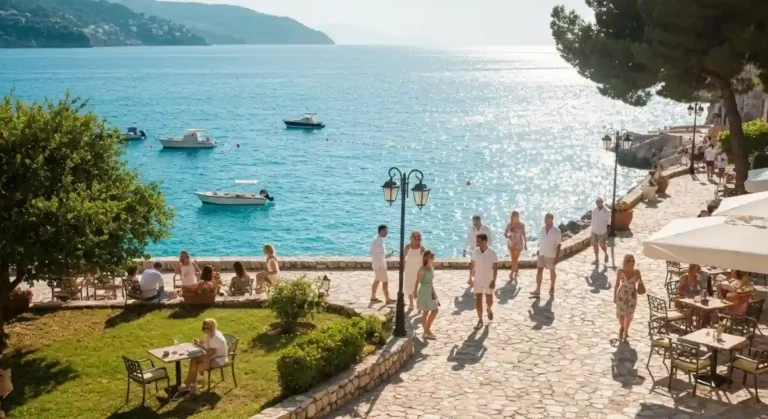
Let’s cut through the Balkan stereotypes. Western media leans hard on organized-crime narratives about Albania. The reality on the ground in Tirana, Durrës, Vlorë, Sarandë, and Theth looks like any ordinary Mediterranean-adjacent country. Tirana is a busy, increasingly modern capital with a young English-speaking professional class, decent restaurants, and a startup scene. The Albanian Riviera between Himarë and Ksamil is among the most underrated coastlines in Europe, with prices still roughly a third of Croatian equivalents for comparable beachfront.
Infrastructure is improving but uneven. Roads outside major corridors can be rough. Healthcare is better in private clinics in Tirana than in the public system. Internet is fine in cities and patchy in mountain towns. Electricity is stable. Water is drinkable in most urban areas.
English penetration among Albanians under 40 is high, especially in service industries and any professional context. Older Albanians often speak Italian or Greek before English. Daily life as an English-speaking resident is workable without any Albanian, though learning basic phrases opens doors socially.
The historical backdrop matters. Albania endured one of the harshest communist dictatorships in Europe under Enver Hoxha from 1944 to 1991. Hoxha built over 170,000 concrete bunkers across the country; many still dot the landscape. The isolation of that era produced a specific Albanian character, pragmatic, family-oriented, deeply pro-American, and strongly Western-leaning today. Religious life is moderate; the population is roughly 45 to 51 percent Muslim (Sunni and Bektashi), with significant Orthodox and Catholic Christian minorities. Religion rarely features in business or social interactions.
Investment Landscape: Where a Qualifying Contribution Makes Sense
The highest-probability contribution categories for a credible Article 9 application in 2026 are the sectors where Albanian government priorities and market gaps overlap.
Coastal tourism and hospitality. The Albanian Riviera is actively being developed. Boutique hotels, villa developments, and mixed-use resorts in Himarë, Dhermi, Ksamil, and Sarandë attract foreign capital and match national tourism strategy. Done at scale with Albanian contractors and staff, this is a textbook Article 9 contribution.
Technology and software. Tirana has a growing tech scene. The 5 percent corporate tax rate on software production companies is a direct policy incentive. Establishing a software operation with local engineering hires, especially if tied to training programs or university partnerships, hits multiple contribution categories at once.
Renewable energy. Albania’s grid is heavily hydroelectric and increasingly integrating solar. Mid-scale solar and wind projects in partnership with Albanian energy companies are a strategic priority.
Manufacturing and light industry. EU accession will open tariff-free access to the EU single market. Manufacturing capacity in Albania looks increasingly attractive as a near-shoring play. Early entrants who create meaningful Albanian employment now, often through a paired offshore company formation structure for the parent entity, will be well positioned both for citizenship and for the economic upswing.
Education and healthcare. Private international schools and modern private clinics serve real domestic demand and a growing expat base. Both sectors generate high-quality jobs and visible social benefit, which plays well in an Article 9 dossier.
Frequently Asked Questions
Does Albania sell citizenship?
How much does albania citizenship cost?
Does Albania allow dual citizenship?
How long does the Albania citizenship process take?
Is there a language requirement for the Article 9 route?
When will Albania join the EU?
What countries can I visit visa-free with an Albanian passport?
Can albania citizenship be revoked?
Will Albania citizenship affect my US taxes?
Can my spouse and children become Albanian citizens too?
Is the Albanian route safer than Caribbean CBI?
Can I apply without living in Albania?
Final Thoughts on Albania Citizenship
Albania citizenship is not for everyone. If you want a three-month Caribbean closing, take the Caribbean. If you want an immediate EU passport and you have 10 million euros, look at Austrian second passports options. If you want something else entirely, the Liberty Mundo coverage of residency programs covers the wider menu.
But if you want a merit-based, discretionary, durable path into a future EU passport, held at prices that make sense for entrepreneurs and investors rather than only for oligarchs, albania citizenship is the strongest option left on the board. Malta is closed. Cyprus is closed. Portugal’s golden visa has narrowed. Greece has moved upmarket. The honorary and exceptional-contribution routes in the Balkans and Austria are what remain, and of those, Albania is moving fastest toward the European prize.
The Adams case confirmed what knowledgeable advisors already knew: the Article 9 route functions, the government is willing to use it, and the passport is real. The queue is forming. Early movers who build legitimate Albanian operations now will have albania citizenship decreed before the EU accession calendar forces global attention and tightens the criteria.
For readers looking at this alongside other strategies, Liberty Mundo’s coverage of asset protection structures, offshore company formation, and offshore banking pairs naturally with a European citizenship play. The passport is one pillar. The structure, banking, and tax position around it is the rest. A Balkan passport without a plan for where your company sits, where your money flows, and how your family is protected is a passport without a strategy.
Visit Albania. Spend time there. Test the fit. Build the contribution. Then apply. That’s the order. Reverse it and you’re reading this guide again in a year wondering why the file is still open. Do it right and you’re holding the decree while everyone else is still arguing about whether Malta will reopen.
Travel power is only half the story. Visa-free access tells you where Albania’s passport can take you, not how free the country behind it leaves you. The Liberty Mundo Passport Freedom Index re-ranks 197 passports on tax, extradition protection, conscription and civil liberties, not just visa-free travel, so you can see where Albania really lands once freedom is in the mix.
Sources and References
- Republic of Albania, Law No. 8389 on Albanian Citizenship (Article 9)
- Court of Justice of the European Union, Judgment Case C-181/23: The Maltese Investor Citizenship Scheme Is Contrary to EU Law (29 April 2025)
- Euronews, Brussels Opens Final Negotiations Cluster in Albania’s EU Accession (November 2025)
- European Council on Foreign Relations, Accelerate the Accessions: Why Faster Is Better in EU Enlargement Policy
- Henley & Partners, Henley Passport Index 2026 Official Ranking
- Transparency International EU, EU Court of Justice Puts an End to Harmful Citizenship-by-Investment Schemes
- European University Institute, GLOBALCIT Report on Citizenship Law: Albania
- CBS News, Former NYC Mayor Eric Adams Becomes Honorary Albanian Citizen (April 2026)