
The best passport in Latin America is not Mexican. It is not Brazilian. It is not Argentine. It is Chilean, and it is not even close.
Chile’s passport ranks 13th globally on the 2026 Henley Passport Index with visa-free or visa-on-arrival access to 174 destinations. That puts Chile in the global top 15, alongside several EU member states, and miles ahead of every other country on the continent. The kicker? Chile is the only Latin American nation whose citizens can walk into both the United States and Canada without a visa. Most people looking for a second passport in this region grab Paraguay or Uruguay because they are easier. They are also weaker travel documents. If you actually want the strongest paper in the region, you go for Chile.
Travel power is only half the story. Visa-free access tells you where Latin America’s passport can take you, not how free the country behind it leaves you. The Liberty Mundo Passport Freedom Index re-ranks 197 passports on tax, extradition protection, conscription and civil liberties, not just visa-free travel, so you can see where Latin America really lands once freedom is in the mix.
This guide walks you through exactly how to get the chile passport, from your first day of residency to the day you swear allegiance and walk out with a Chilean ID. It also covers the angle most articles miss: the six-year tax holiday on foreign income that makes Chile a serious option for high earners, not just retirees.
Put your assets beyond reach in 57 jurisdictions.
Pick where you want your company. We handle the filing, the registered agent, and the bank introduction. From US$1,290, done in days, not months.
- Charging-order protection in jurisdictions courts can't pierce
- Zero tax on foreign income in 30+ territories
- Banking options available
- Fixed price. No surprise fees at closing
Why Chile Holds the Best Passport in Latin America
Let’s be blunt. There are 33 countries in Latin America and the Caribbean, and most of their passports are mediocre travel documents. The Chile passport is the exception. According to the 2026 Henley Passport Index, Chilean citizens have visa-free or visa-on-arrival access to 174 countries and territories. That puts Chile inside the global top 15, in the same bracket as several EU member states, and ahead of Brazil and Argentina (the next strongest in the region) which sit at ranks 14 and 15 with 169 destinations each. Chile is not as mobile as the strongest tier (Singapore at 192, Australia at 182, the United States at 179), but it is the only Latin American passport that comes anywhere near them, and it is the only one in the region with both US visa-waiver access and Canadian visa-free entry.
What does that actually mean for your life? It means you board flights to Tokyo, London, Paris, New York, Toronto, Dubai, and Seoul without ever filling out a visa form. It means business trips to the EU need an ETIAS travel authorisation (a three-minute online form), not a six-week consular nightmare. It means your kids inherit one of the most useful citizenships on earth.
Chile is one of only four passports in the world (Chile, South Korea, Israel, Brunei) that grants visa-free access to every G8 country. The others on the list are Asian and Middle Eastern. The fact that a South American country sits in that club at all should tell you something about the diplomatic capital Chile has built over the last 30 years.
The US and Canada Visa Waiver Edge
Chile is the only Latin American country with both a US visa waiver and visa-free Canadian access. Not Mexico. Not Brazil. Not even Argentina. Chile entered the US Visa Waiver Program in 2014 and has stayed in it since. That single fact makes the chile passport the most valuable Latin American travel document for anyone whose business or family ties run north.
The numbers don’t lie. A Mexican citizen needs a B1/B2 visa to enter the United States, with embassy waits running 12 to 18 months in some consulates. A Chilean citizen books a flight, fills out an ESTA online for $40.27, and lands. That is the difference between paperwork and freedom.
Chile Passport vs. Other Latin American Passports: 2026 Rankings
The regional pecking order looks like this, sourced from the 2026 Henley Passport Index. If you are weighing the best passport in Latin America against alternatives like Mexican or Uruguayan citizenship, this table puts the gap in plain numbers.
| Country | Henley 2026 Rank | Visa-Free Destinations | US Visa Waiver? | Schengen Visa-Free? |
|---|---|---|---|---|
| Chile | 13th | 174 | Yes (ESTA) | Yes (ETIAS) |
| Brazil | 14th | 169 | No | Yes (ETIAS) |
| Argentina | 15th | 169 | No | Yes (ETIAS) |
| Uruguay | 20th | 156 | No | Yes (ETIAS) |
| Mexico | 21st | 157 | No | Yes (ETIAS) |
| Costa Rica | 26th | 148 | No | Yes (ETIAS) |
| Paraguay | 27th | ~145 | No | Yes (ETIAS) |
| Panama | 28th | 148 | No | Yes (ETIAS) |
Notice the column nobody else fills. Chile is the only entry with a Yes under US Visa Waiver. That single column is the reason wealthy Latin Americans, expats, and second-passport hunters target Chile despite the longer naturalisation timeline. A weaker passport you get in two years is still a weaker passport. The chile passport takes five years, but you walk out with the Cadillac.

What Makes the Best Passport in Latin America So Powerful
Three things drive Chile’s ranking. None are accidents.
Diplomatic relationships built over decades. Chile signed bilateral visa-waiver agreements long before most of its neighbours bothered. The country runs a professional foreign service, settles its international disputes through arbitration rather than rhetoric, and shows up to OECD meetings. Chile joined the OECD in 2010 as the first South American member, and that membership signals to other governments that Chilean travellers are vetted, low-risk, and worth granting visa-free access.
A clean immigration track record. Visa waivers depend on overstay rates. Chilean citizens have one of the lowest overstay rates of any visa-waiver country in the United States, which is why Washington keeps renewing the agreement. Compare that to Mexico, which has applied for the US Visa Waiver Program multiple times and been rejected every round.
Economic stability. Chile has one of the highest GDP per capita figures in South America (consistently top three on a PPP basis), a stable currency, and an investment-grade sovereign credit rating. Foreign governments grant visa-free access to citizens of countries whose people are unlikely to work illegally or claim asylum. Chile checks every box.
What the Chile Passport Actually Gets You
Beyond the headline number of 174 destinations, this is what the document opens up in practice:
- United States: ESTA-based entry, 90 days, no consulate visit required
- Canada: Visa-free entry with eTA online authorisation
- Schengen Area (29 countries): 90 days within any 180-day period, ETIAS required from 2026
- United Kingdom: Six months visa-free, ETA online authorisation required
- Japan: 90 days visa-free, no ETA required
- South Korea: 90 days visa-free with K-ETA
- UAE and most of the Middle East: Visa-on-arrival or visa-free
- Russia: 90 days visa-free
- Most of Asia: Visa-free or visa-on-arrival across Southeast Asia and the Indian subcontinent
- Latin America: Visa-free across every Mercosur country and most of the Caribbean
That is the best passport in Latin America by raw mobility. There is no second place that even comes close.
Tax Angle: Why the Best Passport in Latin America Comes With a 6-Year Tax Holiday
Here’s the kicker most articles skip. Chile’s tax system has a quirk that makes it surprisingly attractive for new residents, even though the headline rate looks high.
Chilean tax residents are taxed on worldwide income at progressive rates from 0% to 40%. Read that and you might think Chile is a high-tax disaster. It is not, because the country grants every new foreign resident a three-year exemption from taxation on foreign-source income, extendable to six years upon application to the Servicio de Impuestos Internos (Chile’s tax authority).
What that means in practice: if you move to Chile in 2026 with rental income from US properties, dividends from a Singapore brokerage account, or consulting fees billed through a Cayman LLC, Chile does not touch any of it. None. Zero. For up to six years. You only pay Chilean tax on income earned inside Chile during this window. After the exemption expires, you become subject to worldwide income tax like any other Chilean resident, at which point most expats restructure or relocate.
That six-year window is enough time to qualify for permanent residency, hit the citizenship clock, and walk out with the best passport in Latin America while paying near-zero local tax on your offshore income. Compare this to Uruguay, which gives you 11 years on foreign capital income but at 12% IRPF after the holiday, or to Argentina, which taxes worldwide income immediately with no grace period at all.
How the 3-Year Exemption Becomes 6 Years
The default exemption is three years from the date you arrive in Chile and establish domicile. Before the three-year mark expires, you file a request with Servicio de Impuestos Internos asking for an additional three-year extension. The request must be filed before the original period ends, and it requires demonstrating that your foreign income remains genuinely foreign-sourced. In practice, most KPMG and PwC country guides note that the extension is approved for cases with clear documentation, although it has historically been described as “uncommon” in some legal commentary. File early, file clean, and use a Chilean tax lawyer.
The combination of an OECD-grade chile passport at the end of the road and six years of foreign income exemption along the way is what makes this jurisdiction stand alone in the region.

Chile Residency Visas: Your Five Routes In
Chile rebuilt its immigration system in 2022 under Ley 21.325. The new law killed the old “show up as a tourist and apply for a visa later” trick. Now you apply from abroad before you set foot in the country, and the visa categories are tighter. These five practical routes work for foreigners chasing the best passport in Latin America:
| Visa Type | Who It’s For | Income / Investment Required | Initial Validity |
|---|---|---|---|
| Work Contract Visa (Sujeta a Contrato) | Hired by a Chilean company | Signed contract with Chilean employer | Up to 2 years |
| Rentista / Jubilado Visa | Retirees, passive-income earners | ~USD 1,500-2,000/month passive income (informal benchmark) | Up to 2 years |
| Investor Visa (Inversionista) | Foreign investors, business founders | USD 500,000+ investment, or business setup with InvestChile sponsorship | Up to 1 year initially |
| Mercosur Visa | Argentinians, Bolivians, Brazilians, Paraguayans, Uruguayans | Citizenship of a Mercosur country, clean record | Up to 2 years |
| Family Reunification | Spouses, parents, children of Chilean citizens or residents | Proof of family tie, sponsorship from Chilean relative | Up to 2 years |
The two most common routes for Liberty Mundo readers are the Rentista visa (passive-income retirees and remote workers) and the Investor visa (founders and high-net-worth individuals). Each has its quirks.
The Rentista Visa: Most Popular for Liberty Mundo Readers
The Rentista (income-based) visa is the standard route for anyone with passive income who wants to live in Chile without a local job. SERMIG, Chile’s immigration service, does not publish an official minimum income figure. In practice, single applicants who can show roughly USD 1,500 to 2,000 per month of stable passive income (rental, pension, dividend, or annuity) get approved. Add 25% to 40% per dependent. Submit documentation well above the floor and the rejection risk drops dramatically.
The visa is initially granted for one or two years, renewable, and after 24 months of continuous residency you can apply for permanent residency.
The Investor Visa: Fastest Route for Founders
If you have capital, the Investor visa is the fastest visa category in Chile. Processing runs one to three months, compared to four to nine months for the Rentista. The traditional Investor visa requires USD 500,000+ invested in productive economic activity (not personal real estate), with a sponsorship letter from InvestChile. Smaller business setups starting around USD 60,000 to USD 75,000 can also qualify if structured correctly with a Chilean SpA company and clean documentation.
The investor route earns you the same clock toward citizenship as the Rentista. The difference is speed and signal: an Investor visa marks you as a higher-priority applicant, which translates into faster permanent residency upgrades and fewer hassles at renewal.
How to Get Residency in Chile: Step-by-Step (2026)
Step 1: Pick the right visa category. The choice between Rentista, Investor, and Work Contract drives everything else. If you have $1,500+ per month in passive income, Rentista is dead simple. If you have capital and want speed, go Investor. If a Chilean company is hiring you, Work Contract handles itself. Pick wrong and you waste six to nine months on a refused application.
Step 2: Gather your documents. Every visa requires a valid passport (six months of remaining validity), apostilled FBI background check (or equivalent from your home country), birth certificate, marriage certificate (if applying with a spouse), and proof of income or investment. Every foreign document needs apostille and certified Spanish translation. Budget two months for document gathering alone. The new immigration law tolerates zero gaps; one missing apostille and your file goes to the bottom of the queue.
Step 3: File the application from abroad. Since Ley 21.325 took effect in 2022, you cannot enter Chile as a tourist and apply for a visa from inside the country (with rare exceptions for family reunification and pregnancy cases). You apply through the Chilean consulate in your country of residence using SERMIG’s online portal. Pay the consular fee, submit documents, wait for review.
Step 4: Receive the visa stamp and travel to Chile. Approval typically takes four to nine months for Rentista applications and one to three months for Investor visas. Once approved, you receive a visa stamp in your passport. You then travel to Chile and have 90 days to register your visa with the Policía de Investigaciones (PDI) and apply for your Cédula de Identidad (RUN, the Chilean national ID).
Step 5: Get the Estampado Electrónico (citizenship clock starts). When you register your visa with the PDI, you receive the Estampado Electrónico, the electronic stamp that officially marks your first day of legal Chilean residence. This date matters more than any other on your timeline because the five-year clock to citizenship starts here, not from your permanent residency. Save this date in three places.
Step 6: Live in Chile for 24 months and apply for permanent residency. After 24 months of continuous Residencia Temporal, you become eligible for Residencia Definitiva (permanent residency). The application proves continuous physical presence, clean criminal record, and ongoing income or investment. Permanent residency removes the renewal hassle and locks in your status for indefinite stay, with re-entry rights.
Step 7: Apply for citizenship after 5 years. Once you have hit five years of continuous residence (counted from the Estampado Electrónico, including your time on temporary residency) and you currently hold Permanent Residency, you file your naturalisation application with SERMIG. You also need to demonstrate basic Spanish, knowledge of Chilean civic principles, financial stability, and a clean record. Final approval typically takes two to three years from filing. When approved, you swear allegiance and walk out with the chile passport, the best passport in Latin America.
From Residency to the Chilean Passport: The 5-Year Timeline
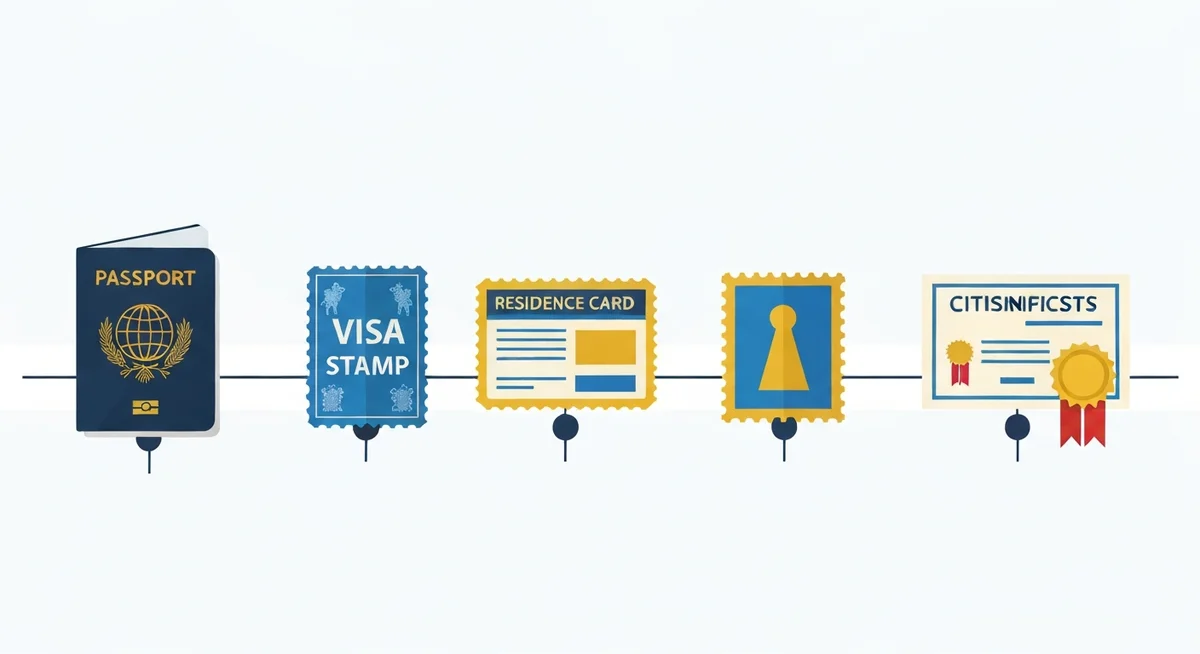
The full timeline from “I want a Chilean passport” to “I have a Chilean passport” looks like this:
| Year | Status | Action |
|---|---|---|
| Year 0 (months 1-2) | Document gathering | Apostille FBI check, birth certificates, translations |
| Year 0 (months 3-9) | Visa processing | File at consulate, await approval |
| Year 1 | Temporary residency (Estampado Electrónico) | Travel to Chile, register with PDI, get RUN |
| Years 1-2 | Temporary residency continues | Renew if needed, build presence |
| Year 2 | Apply for permanent residency | Residencia Definitiva application |
| Years 3-5 | Permanent residency | Continuous physical presence, build civic record |
| Year 5 | Citizenship application filed | Naturalisation, Spanish test, civic principles |
| Years 5-7 | Naturalisation processing | Background verification, interviews |
| Year 7 | Swearing-in ceremony | Receive Chilean ID, apply for Chilean passport |
That seven-year total wall-clock might sound long. But remember: from year one through year six you are running on a tax holiday for foreign income while your residency clock counts. Few jurisdictions stack a six-year tax exemption with a path to a top-15 passport. That is the real proposition behind the best passport in Latin America.
The Accelerated Two-Year Spouse Path
One legitimate shortcut exists. If you marry a Chilean citizen, register the marriage in Chile, live in the same household for at least two years, and accumulate two years of continuous residence, you can apply for citizenship at the two-year mark instead of five. This is not a marriage-of-convenience scheme; SERMIG investigates these cases hard. But for couples who already have a genuine relationship with a Chilean partner, the path is real and well-documented.
What Chile Residency and Citizenship Actually Cost
Marketing sites quote wildly different numbers for Chile residency. Some claim “free.” Others claim “$15,000.” The honest answer sits in the middle, and it depends on which visa you pick and whether you DIY the paperwork or hire counsel.
| Cost Category | DIY Estimate | With Local Counsel |
|---|---|---|
| Document apostilles + translations | $300-500 | $300-500 |
| Consular fees (varies by nationality) | $0-500 | $0-500 |
| Rentista visa application | $0-200 official fees | $1,500-3,500 legal fees |
| Investor visa application | $500-1,000 official fees | $5,000-15,000 legal + structuring |
| Permanent residency upgrade | $50-200 | $1,000-2,000 legal |
| Naturalisation application | ~$200 | $1,500-3,000 legal |
| Ongoing cost of living (Santiago, single) | $2,000-2,700/month | $2,000-2,700/month |
Total all-in cost for a Rentista applicant going DIY with a single legal review at each stage: roughly $5,000 to $8,000 in fees over the seven-year journey, plus living costs. The Investor route runs $15,000 to $30,000 in fees but compresses the early visa stage and signals priority status.
Compare that to a CBI passport from Saint Kitts at $250,000+ or Antigua at $230,000+ (donation routes; real estate routes run higher) and the math is obvious. You are buying a stronger document for a fraction of the cash, in exchange for a multi-year residency commitment.
Common Mistakes That Kill Chile Citizenship Applications
The path is well-defined, but applications get rejected every month for predictable reasons. Avoid these.
Mistake 1: Counting from permanent residency, not the Estampado Electrónico. The five-year citizenship clock starts on the day you registered your first temporary residency with the PDI, not the day you got Residencia Definitiva. Many applicants delay their citizenship filing by years because they thought the clock started later. It started earlier. Pull out your Estampado Electrónico paperwork and count from there.
Mistake 2: Long absences from Chile. Continuous residence does not mean “stays through the year on paper.” SERMIG looks at your actual physical presence. Travelling out of Chile for more than 180 days in any single year, or accumulating long absences, can break the continuity and reset your clock. Track your days. Keep flight records. If your work requires extended absences, talk to a Chilean immigration lawyer before you book a six-month overseas project.
Mistake 3: Filing for the visa after entering Chile as a tourist. The 2022 immigration law killed this. With narrow exceptions (family reunification, pregnancy), you cannot enter Chile on a tourist stamp and apply for a residency visa from inside the country. Try it and you get deported with a re-entry ban. Apply from abroad, period.
Mistake 4: Weak or incomplete passive-income documentation. Rentista applications die when applicants submit one bank statement and call it proof of income. SERMIG wants 12 months of bank statements, the source of every recurring deposit, tax returns showing the income, and ideally a notarised statement from your employer or pension administrator. Submit thin and you get refused. Submit thick and you get approved.
Mistake 5: Skipping the Spanish test prep. Chilean naturalisation requires basic Spanish proficiency. Most applicants who have lived in Chile for five years pass without effort, but applicants who hid in expat bubbles in Las Condes and never learned the language fail. The bar is not high; you need to hold a basic conversation about Chilean history, civics, and your own life. But “basic” still means Spanish.
Mistake 6: Ignoring tax residency planning. Spending more than six months per year in Chile makes you a tax resident. If you cross that threshold without planning, you can lose your foreign income exemption (or trigger your home country’s exit tax rules) by accident. Map out your physical days each calendar year, and structure your offshore companies and brokerage accounts before you trigger Chilean tax residence.
How to Earn the Best Passport in Latin America: Chile vs. Paraguay vs. Uruguay
If you have done any homework on Latin American residency, you have heard pitches for Paraguay (cheap and fast) and Uruguay (calm and English-friendly). Both are real options. Neither earns you the best passport in Latin America at the end. The head-to-head looks like this.
| Factor | Chile | Paraguay | Uruguay |
|---|---|---|---|
| Henley 2026 passport rank | 13th | 28th | 22nd |
| Visa-free destinations | 174 | ~144 | 156 |
| US visa waiver | Yes | No | No |
| Years to citizenship | 5 (Estampado Electrónico) | 3 (proposed; actual 8+ historically) | 3-5 (married/single) |
| Tax on foreign income (residents) | Exempt years 1-6, then worldwide 0-40% | Territorial (foreign income exempt) | 12% IRPF on foreign capital after holiday (Ley 20.446) |
| Cost of living (capital, single, monthly) | $2,000-2,700 | $1,000-1,500 | $2,500-3,500 |
| Dual citizenship allowed | Yes | Yes | Yes (with caveats) |
| Spanish required for citizenship | Yes (basic) | Yes (basic) | Yes (basic) |
Paraguay wins on cheap and fast. Uruguay wins on lifestyle. Chile wins on the only thing that actually matters when you take possession of the document: passport power and the ability to walk into the United States. If you want a backup passport you will probably never use, Paraguay is fine. If you want a primary passport that replaces or upgrades a weaker home passport, you go for the chile passport.
Dual Citizenship and the Chilean Passport: What You Keep
Chile permits dual citizenship without restriction. When you naturalise, the country does not require you to renounce your original nationality, and Chilean-born citizens do not lose Chilean nationality by acquiring a foreign one. Whether you keep your original passport depends on your home country’s rules, not Chile’s.
For Americans, dual citizenship with Chile is straightforward; the United States permits it. For Brits, the same. For Indians, citizenship of Chile would require renouncing Indian citizenship under India’s nationality law (no dual citizenship), so the calculation changes. Anyone considering Chile naturalisation should check their original country’s rules before swearing allegiance, because that is where the catch typically sits, not on the Chilean side.
Frequently Asked Questions
Is the chile passport really the best passport in Latin America?
How long does it take to get the best passport in Latin America?
Can I apply for Chilean residency from inside Chile as a tourist?
What income do I need for the Chile Rentista visa?
Does Chile tax my foreign income while I work toward citizenship?
Does Chile allow dual citizenship?
Can I buy citizenship in Chile?
How does the chile passport compare to Saint Kitts or Antigua CBI passports?
Do I need to speak Spanish to get Chilean citizenship?
How many days a year do I need to spend in Chile to keep my residency?
What is the cost of living in Chile for a single expat?
Is the chile passport worth the five-year wait?
Final Thoughts: Why Chile Is the Quiet Winner
Most articles about second passports point you toward CBI programs or Paraguay’s three-year shortcut. Both have their place. Neither delivers the best passport in Latin America. Chile does, and it does it for less money than any CBI route, with a tax holiday baked into the deal. The catch is time. You need to live in Chile, learn the basics of Spanish, and run the residency clock for five years before the document is yours.
For anyone playing the long game on second citizenship, asset protection, and global mobility, Chile is one of the clearest wins on the board. Combine a Chilean passport with a US LLC for offshore banking, a foreign trust for asset protection, and a tax-residency strategy that uses Chile’s six-year exemption window, and you have something most wealth-protection consultants cannot put together for any price.
If you want help mapping out the full sequence (visa selection, document gathering, structuring your offshore income to qualify for the foreign income exemption, and timing the citizenship filing), Liberty Mundo handles the entire process for clients. Read more on residency strategies, browse our passport guides, or look at our broader work on asset protection structures and global tax strategies. Chile pairs naturally with a US LLC structure for foreign founders, and we cover the offshore banking side in depth elsewhere on the site.
The chile passport is not the easiest path. It is the strongest. That ship has sailed for anyone who waited until 2026 to start, but the clock is ticking faster than ever for the next five-year window. Start now and you walk out a Chilean citizen by 2031, holding the best passport in Latin America. Wait, and you watch the door narrow as global mobility tightens. The numbers don’t lie. Chile wins.
For a broader look at the region’s options, see our guides on country-by-country residency and citizenship-by-investment programs. If you would prefer a one-on-one walkthrough, you can request a strategy call with our team.
Sources and References
- Henley & Partners, 2026 Henley Passport Index Ranking
- Servicio Nacional de Migraciones (SERMIG), Chilean Citizenship
- Servicio Nacional de Migraciones (SERMIG), Residencia Temporal Permit
- Servicio Nacional de Migraciones (SERMIG), Residencia Definitiva Permit
- PwC Worldwide Tax Summaries, Chile Individual Taxes on Personal Income
- KPMG, Taxation of International Executives: Chile
- Wikipedia, Visa Requirements for Chilean Citizens
- OECD, OECD Chile Country Page