
Planning residency in Japan in 2026 means navigating a system that was rewritten twice in the last 18 months. October 2025 brought new Business Manager visa rules. April 2026 tightened naturalization practice to roughly ten years. April 2027 will add a maximum-period-of-stay requirement for permanent residency applicants. Anyone who studied this topic two years ago needs a fresh read.
The good news: Japan still offers multiple paths to long-term residency with clear numerical thresholds and (for most paths) no Japanese language requirement. The Highly Skilled Professional (HSP) visa still grants permanent residency in as little as one year for 80-point applicants. The Business Manager visa path still works if you can fund the new JPY 30 million capital threshold. The long-term stay visa still accepts self-funded retirees on savings or passive income.
This guide maps every viable residency in Japan route in 2026, the exact requirements under current rules, the cost to execute, the time to permanent residency, and the US tax traps that trip up American expats. Every number here is sourced from the Immigration Services Agency, the Ministry of Justice, the National Tax Agency, and Big 4 country reports.
Why Foreigners Pursue Residency in Japan
Residency in Japan buys you access to one of the most functional societies on earth. Universal healthcare at costs that would make an American cry. A crime rate so low that local police struggle to find things to do. A transport system that makes Manhattan feel third-world. Food that is cheaper, fresher, and safer than almost anywhere in the developed world.
The trade-off is the immigration bar. Japan does not recruit. The system is built for compliant long-stayers who fit into one of a narrow set of officially sanctioned categories. There is no lottery, no amnesty, and no investor golden-visa-for-a-check route. You earn your way in through a specific visa that matches what you actually do, and you maintain that status through clean paperwork every renewal.
For high-net-worth individuals, the appeal is permanent residency. Once you clear 10 years (or 1-3 years on HSP) of continuous lawful residence, you get an unrestricted right to live, work, and invest in Japan without renewals. You can buy property, open banks freely, and run companies without the Business Manager visa’s capitalization requirements. For many, PR is the practical destination, not citizenship.

Every Visa Route to Residency in Japan in 2026
Here’s the full map of practical residency visas for foreign nationals as of April 2026. Skip the niche categories (Entertainer, Religious Activities, Intra-company Transferee) since those apply to narrow professional situations and rarely lead to independent residency planning.
| Visa | Duration | Main Requirement | Path to Permanent Residency |
|---|---|---|---|
| Highly Skilled Professional (HSP) i-a, i-b, i-c | 5 years | 70+ points on HSP scoresheet | 1 year (80 points), 3 years (70 points) |
| Business Manager | 1, 3, or 5 years | JPY 30M capital + 1 Japanese employee | 10 years (or 1-3 via HSP score) |
| Work visa (Engineer, Humanities, Specified Skilled Worker) | 1, 3, or 5 years | Japanese employer sponsorship | 10 years |
| Long-Term Stay (Designated Activities) | 6 months to 3 years | JPY 30M savings or JPY 250K/month income | 10 years |
| Spouse of Japanese National | 1, 3, or 5 years | Genuine marriage to Japanese citizen | 3 years (if married 3+ years) |
| Spouse of Permanent Resident | 1, 3, or 5 years | Marriage to PR holder | 3-5 years depending on prior residence |
| Digital Nomad Visa | 6 months, non-renewable | JPY 10M annual income, tax treaty country | Not a PR path (trial only) |
| Student | 1-2 years | Accredited Japanese school enrollment | Upgrade to work or HSP after graduation |
For HNWI expats with capital or high-earning skills, the two fastest routes are HSP and spouse. Every other category defaults to the 10-year continuous residence rule for permanent residency eligibility. That is a long time to wait for unconditional residency in a country that rewrote its naturalization rules twice in the last two years.
The Highly Skilled Professional Fast Track
The HSP visa is the Japanese government’s explicit priority channel for attracting foreign talent. Applicants earn points across age, education, salary, Japanese proficiency, and specialized experience categories. Score 70 points and you qualify for the HSP visa with a 5-year initial grant and a path to permanent residency in 3 years. Score 80 points and you accelerate that PR timeline to just 1 year.
| Category | Max Points | Practical Strategy |
|---|---|---|
| Academic credentials | 30 (PhD) | Master’s = 20 pts, PhD = 30 pts |
| Professional experience | 25 (10+ years) | Each year of relevant experience: 5-25 pts in bands |
| Annual salary | 40 (age-graduated) | Younger + higher salary = more points |
| Age (younger = more) | 15 (under 30) | Under 30: 15, 30-34: 10, 35-39: 5 |
| Japanese language (JLPT) | 15 (N1) | N2: 10 pts, N1: 15 pts |
| Graduate of Japanese university | 10 | Bonus for domestic education |
| Listed Japanese research area | 10-25 | AI, biotech, green tech get bonus |
To hit 80 points and qualify for the 1-year PR track, applicants typically need a combination of a master’s or PhD, 5+ years of senior experience, an annual salary above JPY 15 million, and either Japanese language credentials or a Japanese university degree. It is a high bar, but clearing it collapses your permanent residency timeline by nine years compared to standard routes.
The HSP visa also confers ancillary benefits: multiple activities permitted under one status (no need to switch visas for consulting side gigs), parents and domestic helpers can accompany you under certain conditions, spouse employment is freely allowed, and priority processing at immigration. For qualifying applicants, it is the gold standard.
Put your assets beyond reach in 57 jurisdictions.
Pick where you want your company. We handle the filing, the registered agent, and the bank introduction. From US$1,290, done in days, not months.
- Charging-order protection in jurisdictions courts can't pierce
- Zero tax on foreign income in 30+ territories
- Banking options available
- Fixed price. No surprise fees at closing
The Business Manager Visa Post-October 2025
Entrepreneurs who want residency in Japan through their own business need the Business Manager visa. Since October 16, 2025, the baseline requirements tightened substantially.
The new rules require a paid-in capital of JPY 30 million (approximately $200,000 USD), at least one full-time Japanese national, permanent resident, long-term resident, or spouse/child of such on the payroll, a B2 / JLPT N2 Japanese speaker (either the applicant or a designated employee), three years of management experience or a master’s degree in business, and a business plan certified by a Japanese CPA or SME Management Consultant.
The Immigration Services Agency also now suggests a minimum founder remuneration of JPY 20 million per year (about $135,000 USD) to demonstrate genuine operations. Visas are granted for 1, 3, or 5 years depending on how established the business appears at initial application and renewal. Existing Business Manager visa holders as of October 2025 have until October 16, 2028 to transition to the new standard.
For founders considering this route in tandem with incorporation, the practical playbook is to set up a GK or KK (see our incorporate in Japan guide), fully fund the JPY 30 million, hire at least one qualifying Japanese employee, build out a proper commercial lease, and engage a Japanese CPA for the business plan certification. Budget JPY 50 million to JPY 80 million total to run this play safely.
The Digital Nomad Visa: Good Trial, Bad Long-Term
Japan’s digital nomad visa launched in 2024 and remains a six-month, non-renewable stay for remote workers earning over JPY 10 million per year who are tax residents of one of approximately 49 countries with a Japanese tax treaty. The visa accepts family members (spouse, children) as dependents and does not require Japanese language proficiency.
The big advantage: nomads staying under one year do not become Japanese tax residents and owe no Japanese income tax on their foreign-source earnings. The big disadvantage: the visa expires, is not renewable, and does not count toward the 10-year permanent residency clock. Nomads who love Japan have to pivot to a different visa route before the six-month window closes or leave the country.
The practical use case: trial a Japanese life without committing to a full relocation, then apply for HSP, Business Manager, or Long-Term Stay during the nomad visa’s six-month window. The nomad status is a bridge, not a destination.
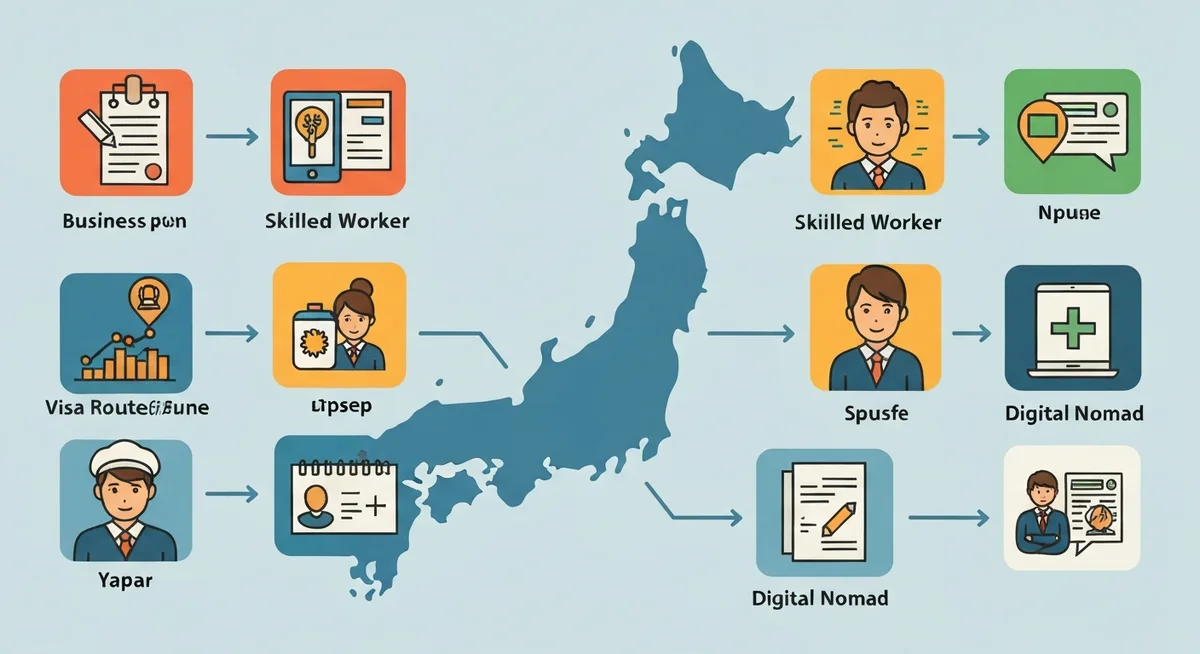
Step by Step: Applying for Residency in Japan
Step 1: Identify the best-fit visa route. Evaluate your profile against every option: HSP scoresheet (if skilled professional), Business Manager (if entrepreneur with JPY 30M capital), Long-Term Stay (if retiree with savings or pension), Spouse (if married to a Japanese national), or Work visa (if you have a Japanese employer). The wrong visa typically costs 2+ years to correct.
Step 2: File a Certificate of Eligibility application. Submit the COE to the regional Immigration Services Agency office along with the required financial documents, company registration (if Business Manager), HSP scoresheet (if HSP), and supporting evidence. Processing takes 1 to 3 months depending on route and case complexity.
Step 3: Convert the COE to a visa at a Japanese consulate. Submit the COE at a Japanese embassy or consulate in your home country. Visa issuance typically takes 5 to 10 business days. Visa fees are modest: JPY 3,000 single entry, JPY 6,000 multiple entry.
Step 4: Enter Japan and complete landing registration. On arrival, immigration issues your residence card at the airport. Within 14 days, register your address at the local municipal office and enroll in National Health Insurance and the National Pension system (mandatory for residents aged 20-59).
Step 5: Maintain compliance through the residency period. File annual tax returns (February to March). Pay inhabitant tax and social insurance contributions on time. Notify Immigration Services Agency of any address changes within 14 days. Avoid extended absences from Japan (more than 90 consecutive days requires re-entry permit planning).
Step 6: Apply for permanent residency at eligibility. Standard route applicants apply after 10 years of continuous lawful residence. HSP 70-point applicants apply after 3 years, HSP 80-point applicants after 1 year. Spouse-of-Japanese-national applicants apply after 3 years of residence if married 3+ years. Submit the PR application to the Immigration Services Agency with all supporting financial, tax, and compliance records.
Japanese Tax Rules for Residents
Japanese tax residency triggers at the point you establish a domicile (jusho) in Japan or physically reside for one year or more. Once a tax resident, you fall into one of three categories, and the category determines what is taxable.
| Category | Definition | Taxable Income |
|---|---|---|
| Permanent Resident Taxpayer | Japanese national, OR foreign national domiciled 5+ years in past 10 | Worldwide income |
| Non-Permanent Resident Taxpayer | Foreign national domiciled 5 or fewer years in past 10 | Japan-source + foreign income remitted to Japan |
| Non-Resident Taxpayer | Physically in Japan less than 1 year without domicile | Japan-source income only |
New arrivals benefit from the non-permanent resident window for the first five of any ten-year period. During that window, foreign pensions, dividends, capital gains, and rental income are only taxed by Japan to the extent remitted into Japan. This is a major planning opportunity for high-net-worth new residents. Structure your cash flow so foreign income accumulates offshore, remit only what you need for Japanese living expenses, and you defer Japanese tax on the rest.
Japanese progressive income tax runs from 5% to 45% nationally, plus 10% local inhabitant tax and a 2.1% reconstruction surtax. Top combined marginal rate: approximately 55.945% on income above JPY 40 million. Capital gains are typically 20.315% on listed securities and up to 39% on real estate held under 5 years.
The practical US tax playbook: file US taxes every year, use the US-Japan tax treaty to claim a foreign tax credit (Form 1116) for Japanese taxes paid on the same income, file FBAR annually if aggregate Japanese bank balances exceed $10,000, and file Form 8938 if specified foreign financial assets exceed thresholds ($200,000 for married filing jointly residing abroad, $400,000 at year-end).

The Path from Residency to Permanent Residency
Permanent residency in Japan (eijuken) gives you unrestricted right to stay, work, and run businesses without visa renewals. You can buy property without restrictions, access standard mortgages, and (importantly) keep your original citizenship. You are not a Japanese national. You still hold your original passport. But you have a Japanese residence card with “Permanent Resident” status and no expiry on your stay.
| Your Current Visa | Minimum Residence for PR | Additional Requirements |
|---|---|---|
| HSP 80 points | 1 year | Maintain 80 points throughout |
| HSP 70 points | 3 years | Maintain 70 points throughout |
| Spouse of Japanese national | 3 years | Married 3+ years, OR 1 year residence after 3 years marriage |
| Spouse of Permanent Resident | 3-5 years | Depends on prior continuous residence |
| Any other status (Business Manager, Work, Long-Term Stay) | 10 years | Minimum 5 years in work-related status |
Beyond the years-resident test, PR applicants must clear a solvency test (stable income or assets), a good-conduct test (no significant criminal or tax issues), and a public-charge test (not on welfare). From April 2027, applicants must also hold the maximum period of stay (typically 5 years) on their current visa at the time of PR application. This April 2027 change is a meaningful tightening: anyone currently on a 1-year Business Manager visa must secure a renewal to 5-year status before applying for PR from 2027 onward.
Processing time for PR applications runs 4 to 8 months. Government filing fee is JPY 8,000. Approval rate is roughly 50-60% for standard applicants (higher for HSP and spouse routes), so applicants should not assume automatic success.
Japan vs Other Asian Residency Options
| Country | Primary Investor/Skilled Visa | Minimum Investment / Income | Time to Permanent Residency | Worldwide Taxation? |
|---|---|---|---|---|
| Japan (HSP 80 pts) | Highly Skilled Professional | ~JPY 15M salary + credentials | 1 year | Yes (after 5-year non-permanent window) |
| Japan (Business Manager) | Business Manager Visa | JPY 30M capital + 1 employee | 10 years (or HSP score route) | Yes (same 5-year window) |
| Singapore | Global Investor Programme (GIP) | SGD 10M-25M business investment | Direct PR upon approval | No, territorial |
| Thailand | Long-Term Resident Visa | $80K passive income OR $500K investment + $80K income | LTR is 10-year renewable, no PR track | Territorial, worldwide from 2024 if remitted |
| Malaysia | MM2H (Silver Premium) | MYR 1.5M fixed deposit (50+) | No PR path (pass is renewable) | Territorial |
| South Korea | F-5 Permanent Residency | KRW 500M investment or F-2 residency | 5 years after F-2 | Yes, worldwide |
Japan stacks up differently than most Asia-Pacific alternatives. It is the only developed East Asian country with a sub-1-year path to permanent residency (HSP 80 points). It offers universal healthcare that outperforms any of its neighbors. And it taxes worldwide income once the 5-year non-permanent resident window closes, putting it in the higher-tax bucket compared to Singapore (territorial) or Malaysia (territorial with 0% on foreign-source pensions).
Common Mistakes Pursuing Residency in Japan
First mistake: choosing the long-term stay visa when HSP would work. Applicants who qualify for HSP but default to the easier long-term stay path lock themselves into the 10-year PR timeline instead of the 1-3 year HSP timeline. Always run the HSP scoresheet first.
Second mistake: underestimating Japanese tax compliance burden. Expats new to Japan routinely miss the February-March tax filing deadline, fail to file inhabitant tax returns, or skip social insurance enrollment. Each of these creates a bad-record event that will surface during PR or naturalization review 5-10 years later. Get a Japanese tax accountant from year one.
Third mistake: treating the digital nomad visa as a permanent solution. The visa is a 6-month trial only. Nomads who love Japan and try to extend by re-entering create a pattern of short-stay visits that is flagged by immigration and jeopardizes future longer-term applications.
Fourth mistake: extended absences abroad. Immigration Services Agency treats trips outside Japan of more than 90 consecutive days, or more than 150 days per year in total, as potentially breaking continuous residence. The clock can reset and cost you years of progress toward permanent residency.
Fifth mistake for US citizens: remitting too much foreign income into Japan during the non-permanent resident window. Every dollar you move into a Japanese account during years 1 to 5 becomes Japanese-taxable. Structure your remittances to cover living expenses only and keep investment income offshore until year 6 or later.
Residency in Japan FAQ
What’s the fastest way to get residency in Japan?
Can I get residency in Japan without a job offer?
Does Japan have an investor visa or golden visa program?
How long does residency in Japan take to approve?
Can my family come with me on residency in Japan?
How much does it cost to get residency in Japan?
Can US citizens avoid taxation by getting residency in Japan?
Does residency in Japan lead to citizenship automatically?
Can I work in Japan on the Long-Term Stay visa?
What changes for residency in Japan from April 2027?
Can I get residency in Japan without speaking Japanese?
Final Thoughts: Is Residency in Japan Right for You?
For skilled professionals, entrepreneurs with capital, self-funded retirees, and spouses of Japanese nationals, residency in Japan delivers an exceptional quality of life at a long-term tax cost that is higher than some Asian alternatives but lower than most of Western Europe. The 1-year HSP path to permanent residency remains one of the fastest developed-country PR routes anywhere in the world.
For anyone who cannot clear JPY 30 million savings or capital, who does not score 70+ on the HSP scoresheet, who is not married to a Japanese national, and who lacks a Japanese employer sponsor, the realistic paths narrow to the 6-month digital nomad trial or the Long-Term Stay visa with 10-year PR timeline. For those profiles, residency in another Asia-Pacific jurisdiction (Thailand LTR, Malaysia MM2H, Singapore GIP for very wealthy) may be a better fit.
Put your assets beyond reach in 57 jurisdictions.
Pick where you want your company. We handle the filing, the registered agent, and the bank introduction. From US$1,290, done in days, not months.
- Charging-order protection in jurisdictions courts can't pierce
- Zero tax on foreign income in 30+ territories
- Banking options available
- Fixed price. No surprise fees at closing
For specific route deep-dives, see our Japan second passport guide on naturalization after residency, our retire in Japan guide focused on the Long-Term Stay visa, and our incorporate in Japan guide covering the KK vs GK decision for Business Manager visa applicants. Global readers comparing Japan to alternatives should read our residency program roundup.
Sources and References
- Immigration Services Agency of Japan, Official Residence Status and Permanent Residency Application Guide
- Ministry of Justice Japan, Ministry of Justice Immigration and Naturalization Portal
- National Tax Agency Japan, Income Tax Guide for Foreign Residents
- Ministry of Foreign Affairs of Japan, Visa Application Procedures and Requirements
- PwC Worldwide Tax Summaries, Japan Tax Residency and Worldwide Income
- US Internal Revenue Service, US Citizens and Resident Aliens Abroad
- OECD, US-Japan Income Tax Treaty Text and Updates
- Baker McKenzie, Japan Business Manager Visa 2025 Reform