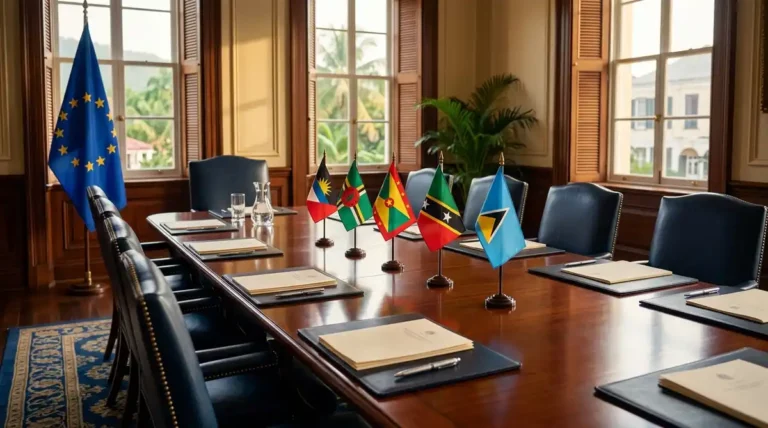
The Caribbean CBI response to Brussels is now on paper. The five Eastern Caribbean states selling citizenship by investment met in Roseau on 10 July 2026 and answered the EU’s shutdown demand with a joint statement, a planned mission to Brussels, and one condition: replacement money first.
ROSEAU, Dominica – 11 July 2026
Three days after Antigua and Barbuda disclosed the EU’s phase-out ultimatum, the leaders of all five CBI states gathered under Roosevelt Skerrit’s chairmanship. Even St Vincent’s Godwin Friday showed up, the man planning to launch a brand-new programme into the teeth of this storm.
Put your assets beyond reach in 57 jurisdictions.
Pick where you want your company. We handle the filing, the registered agent, and the bank introduction. From US$1,290, done in days, not months.
- Charging-order protection in jurisdictions courts can't pierce
- Zero tax on foreign income in 30+ territories
- Banking options available
- Fixed price. No surprise fees at closing
What Did the Five CBI States Agree in Roseau?
The five heads of government agreed on 10 July 2026 to dispatch a high-level mission to Brussels to meet the presidents of the European Commission and the European Council plus the EU’s foreign policy chief, backed by coordinated outreach to key European capitals. Ministers and ambassadors were told to present a unified regional position in every engagement.
The statement, published through Dominica’s Office of the Prime Minister, calls the programmes “an important pillar of economic resilience and development financing for small island developing states.” Anyone comparing citizenship by investment options should note the core demand buried in the diplomatic language: any transition “must be accompanied by a comprehensive framework that safeguards economic stability” and creates “sustainable alternative sources of financing.”
Translation: you want the programmes gone, you replace the revenue. In writing.
What Does the Caribbean CBI Response Not Say?
The joint statement never mentions the June 2028 deadline, the Schengen area, the September 2026 interim vetting requirements, or any refusal to comply. Its firmest language concerns the terms of “any transition,” which quietly concedes a transition is on the table. The Caribbean CBI response reads as a negotiating document, not a declaration of war.
That tone shift matters. A week ago Gaston Browne was vowing Antigua “will not be pressured into a unilateral phase-out.” The collective text drops all of that, instead welcoming the Commission’s “continued engagement and technical dialogue” and expressing confidence that “balanced and durable solutions can be achieved.”
Let’s be blunt about why. Under the revised visa suspension mechanism, in force since late December 2025, merely operating a CBI programme is a standalone ground for suspending Schengen access. Fighting that in public gains nothing, so the five went from defiance to choreography in six days, echoing the crackdown that became law in all five nations earlier this year. Schengen access is the single biggest driver of these passports’ standing on our Passport Freedom Index, and everyone at that table knows it.
What Happened When These Islands Sold Bank Licenses in the 1990s?
The same governments spent the 1990s selling offshore banking licenses, and nearly all of those banks were wiped out within a decade. St Vincent and the Grenadines had 28 registered offshore banks by 1999, according to the IMF. The FATF blacklist of June 2000 named Dominica, St Kitts and Nevis, and St Vincent as non-cooperative, Grenada joined in 2001, correspondent banks cut ties, and by 2015 St Vincent’s offshore sector was down to four banks.
I have been making this comparison for years. Nobody in Washington or Paris ever “banned” a Caribbean offshore bank. The IMF’s 2002 review records how it went: blacklists, then US and UK advisories warning banks away from Antigua and its neighbours, then the slow strangulation of correspondent relationships until a license that once printed money became worthless paper. The islands reformed and delicensed the worst actors themselves. The sector died anyway, as US State Department reporting on St Vincent confirmed. Here’s the kicker: the Caribbean CBI response now landing in Brussels tracks that script beat for beat.
| Stage | Offshore banking, 1990s to 2000s | Citizenship by investment, 2010s to today |
|---|---|---|
| The boom | Dozens of licenses per island; St Vincent had 28 offshore banks by 1999 | Five programmes, tens of thousands of passports, core state revenue |
| The trigger | FATF blacklist, June 2000: Dominica, St Kitts and Nevis, St Vincent listed; Grenada added 2001 | Revised EU visa suspension mechanism, in force late December 2025: a CBI programme is itself a suspension ground |
| The pressure tool | US and UK advisories; correspondent banks cut ties | Schengen held hostage; Brunner letters of 25 June 2026 demand phase-out by June 2028 |
| The compliance response | New laws, tighter supervision, self-delicensing | Joint MoU, higher prices, mandatory interviews, the ECCIRA regulator |
| The outcome | Sector gutted within a decade; a handful of banks survive | Requested end by June 2028. My view: same ending, longer timeline |
Will Every CBI Passport Eventually Be Cancelled?
No CBI passport is being cancelled today, and existing citizenships remain legally valid. My long-term view is that this will not hold: I expect every passport sold through Caribbean citizenship by investment to eventually be cancelled, the way the region’s offshore banking licenses became worthless after 2000. The timing is unknowable. The direction is not.
Mind you, “cancelled” may never mean a decree voiding your document. The bank licenses were rarely revoked in one dramatic stroke either. They just became impossible to renew or use: correspondent accounts closed, renewals sat unprocessed, and a licensed bank that could not move a dollar was dead on its feet. Expect the passport version of that. Renewals quietly refused or endlessly delayed for CBI citizens, visa-free treaties carved up so the document stops opening borders, banks declining it as identification. Vanuatu already lost EU visa-free access, and Canberra is pushing differentiated passports for Vanuatu’s CBI citizens. Once passports are differentiated, strangling them is an administrative step, no announcement required.
We hear the counterargument weekly from clients who bought Caribbean passports between 2017 and 2023: the programmes reformed, vetting is tight, the regulator is real. All true, and all beside the point. The banks reformed too. What killed them was a larger power deciding the product should not exist. The clock is ticking, and that is why we increasingly pair citizenship files with asset protection trusts and a fallback base, rather than treating a passport as a plan on its own.
What did the Caribbean CBI response to the EU actually say?
Did the Caribbean states refuse the EU’s June 2028 phase-out demand?
Will existing CBI passports be cancelled?
What happens next in the EU and Caribbean CBI standoff?
Bottom line: the Caribbean CBI response is polite, unified, and quietly resigned. The five states are no longer arguing about whether the passport business ends. They are negotiating the invoice. What the FATF did to the region’s bank licenses, Brussels is doing to its passports, and ultimately, on a date nobody can name, I expect every single passport sold as citizenship by investment to be cancelled, or left to expire with no renewal on offer, which amounts to the same thing. Plan on that assumption and let events prove you pleasantly wrong.
Sources and References
- Government of the Commonwealth of Dominica, Office of the Prime Minister, Statement by the Heads of Government of the Participating Eastern Caribbean States on Citizenship by Investment Programmes and Engagement with the European Union
- Caribbean Media Corporation via Jamaica Observer, EU calls on Antigua to phase out Citizenship by Investment programme
- European Parliament, More flexible visa suspension mechanism
- International Monetary Fund, Caribbean Offshore Financial Centers (Working Paper 02/88)
- US Department of State, International Narcotics Control Strategy Report: St Vincent and the Grenadines