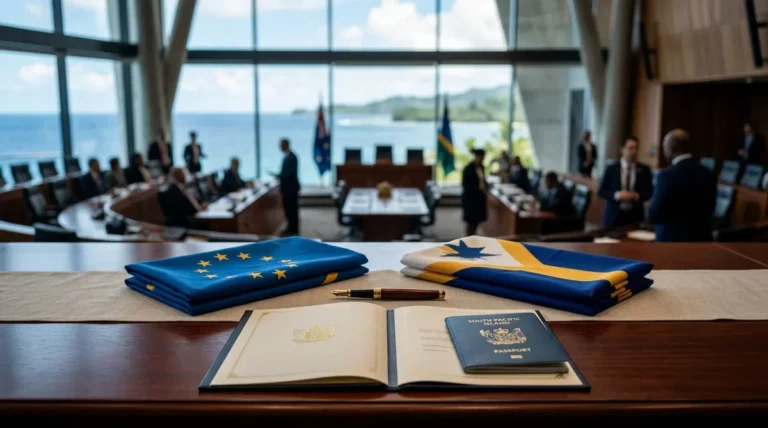
The Vanuatu Australia agreement is finally signed, and anyone who bought a Vanuatu passport should read the fine print. After nearly a year of tense, on-again-off-again negotiations, Prime Ministers Jotham Napat of Vanuatu and Anthony Albanese of Australia put their names to the Nakamal Agreement in Canberra this week, a sweeping ten-year security and development pact worth roughly 500 million Australian dollars.
CANBERRA, Australia — 1 July 2026
Most of the coverage has focused on the security headline: Vanuatu agrees not to host any foreign military base, a clause aimed squarely at China’s growing footprint in the Pacific. Fair enough, that is the big geopolitical prize for Canberra. But buried in the text sits a clause that matters far more to the investment migration world than to defence hawks.
Article 6 asks Vanuatu to build systems that tell its citizenship-by-investment passport holders apart from everyone else. In return, Australia offers “enhanced mobility arrangements” for Vanuatu visitors. Here’s the kicker: nobody has defined what that phrase actually delivers.
Put your assets beyond reach in 57 jurisdictions.
Pick where you want your company. We handle the filing, the registered agent, and the bank introduction. From US$1,290, done in days, not months.
- Charging-order protection in jurisdictions courts can't pierce
- Zero tax on foreign income in 30+ territories
- Banking options available
- Fixed price. No surprise fees at closing
What the Vanuatu Australia agreement actually says
Strip away the ceremony and the pact does two things for citizenship buyers. Australia commits to “enhanced mobility arrangements for Vanuatu visitors to Australia.” Vanuatu commits to “develop effective mechanisms to differentiate citizenship by investment from other forms of citizenship.” A third clause tells both governments to review the mobility side every year.
Notice what is missing. There is no visa waiver. No specific visa class. No numbers, no timeline, no promise that a Vanuatu passport gets you through Australian immigration any faster than it does today. Vanuatu’s own Daily Post reported bluntly that the deal did not deliver the visa-free travel status that Napat had chased. He had walked away from an earlier signing ceremony in Port Vila over exactly this, and the version he eventually signed is watered down from the grand agreement first blessed atop Mount Yasur in 2025.
Outside the treaty text, Canberra threw in a sweetener. Australia will bring Vanuatu back into the 2026-27 Pacific Engagement Visa ballot with 150 permanent-residence places, after quietly dropping the country from the list earlier in the month. That ballot opens on 1 July. Useful, sure, but a lottery for 150 spots is a long way from the open door Napat wanted.
Why “differentiate” is the word that matters
For a citizenship-by-investment audience, the mobility fog is a sideshow. The real story is that clause asking Vanuatu to sort its own citizens into categories. And the industry is genuinely split on what it means.
One camp reads it as harmless plumbing. On this view, Vanuatu simply keeps better internal records, separating indigenous, naturalised, and investor citizens inside its own database so it can answer security queries fast. Australia gets the comfort it wants, well-vetted applicants sail through, and nobody is treated differently at the border. A record-keeping upgrade, not an exclusion.
The other camp calls it a dangerous precedent. Tiering citizens by how they got their status chips away at a bedrock principle: citizenship is supposed to be absolute and indivisible. Once a government formally labels who “bought in,” the door swings open to treating those people differently later, whether at a border, a bank, or a visa desk. That is not a small technical footnote. That is the state building the exact filing cabinet a future policy could weaponise.
Both readings can be true at once, which is what makes this worth watching. The text commits Vanuatu to build the mechanism. It says nothing about how Australia, or anyone else, will use the output.
The mobility backdrop nobody should ignore
This did not come out of nowhere. Vanuatu’s golden passport has been losing travel power for two years. Brussels stripped the country of visa-free Schengen access in December 2024, the first time the EU had ever pulled a third country off its visa-exempt list, citing security and screening concerns tied to the investor program. Britain slapped a visa requirement on all Vanuatu citizens back in July 2023 on the same logic. We covered the wider squeeze when Vanuatu passports started getting blocked across major destinations.
Check the numbers on any independent ranking and the trend is obvious. Vanuatu’s passport has slid down the tables as visa-free doors closed, and you can see where it sits today on the Passport Freedom Index. Even so, the program is not dead. The minimum contribution still sits around US$130,000 for a single applicant, all three of Vanuatu’s programs still process in weeks, and the passport still opens plenty of doors, just fewer than it did in 2022.
None of this means dumping Vanuatu off your shortlist. It means being honest about what you are buying. A fast, low-cost second citizenship with a decent tax setup? Yes. A guaranteed golden ticket through every airport on earth? Not anymore, and not for a while. The smart buyers already treat citizenship, residency, and asset protection as three separate layers, so that when one country tightens the screws, the whole plan does not wobble. Compare Vanuatu honestly against the Caribbean CBI programs and pick on fundamentals, not on a mobility promise that can evaporate overnight.
What is the Nakamal Agreement between Vanuatu and Australia?
Does the Vanuatu Australia agreement give visa-free travel to Australia?
What does “differentiate citizenship by investment” mean for Vanuatu passport holders?
Is the Vanuatu Australia agreement in force yet?
How much does Vanuatu citizenship by investment cost in 2026?
Sources and References
- Australian Minister for Foreign Affairs, Vanuatu and Australia sign Nakamal Agreement
- Australian Department of Foreign Affairs and Trade, Vanuatu-Australia Nakamal Agreement
- National Indigenous Times, Foreign bases ruled out as Vanuatu signs security deal
- Vanuatu Daily Post, Vanuatu, Australia to sign Nakamal Agreement