
Picture this. You retire in Vanuatu, draw your pension, your dividends, your rental income, and the government takes none of it. Zero. No income tax, no capital gains tax, no inheritance tax. You sip your morning coffee on a deck above a turquoise lagoon, and the only tax you really notice is the 15% VAT on your groceries. For a retiree who has spent decades feeding a high-tax system, that sounds like a fantasy. It is real, but it comes with trade-offs you need to understand first.
This guide covers the honest version of retiring in this South Pacific nation: the visa that lets you stay, what your money actually buys, the healthcare gap that catches people out, and who this lifestyle truly suits. No sugar-coating, because picking your retirement home off a glossy brochure is how people end up stranded.
Put your assets beyond reach in 57 jurisdictions.
Pick where you want your company. We handle the filing, the registered agent, and the bank introduction. From US$1,290, done in days, not months.
- Charging-order protection in jurisdictions courts can't pierce
- Zero tax on foreign income in 30+ territories
- Banking options available
- Fixed price. No surprise fees at closing
Why Retire in Vanuatu at All
Vanuatu is a string of 80-plus islands in the South Pacific, a couple of hours by plane from Australia. The pace is slow, the climate is tropical year-round, and the islands routinely top happiness surveys. But the headline draw for financially-minded retirees is the tax system, which is close to unique.
Most retirement havens promise low tax. Vanuatu offers no tax at all on the income that matters to a retiree. Your pension, your 401(k) draws, your dividends, your rental yield from back home, none of it is taxed locally. There is also no annual property tax on the home you buy or lease. For someone living off investments, that is a genuine wake-up call about how much a tax system quietly skims every year.
If a zero-tax base is what draws you, it helps to see how Vanuatu fits the wider map. Our guide to tax-free countries with zero income tax shows the short list of nations that pull this off, and Vanuatu is one of the few that pairs it with an easy residence route.
The Tax Picture When You Retire in Vanuatu
Let’s put real numbers to it. A retiree faces these main tax categories.
| Tax Type | Vanuatu Rate | What It Means for a Retiree |
|---|---|---|
| Personal income tax | 0% | Pension and salary income untouched |
| Capital gains tax | 0% | Sell investments with no local CGT |
| Tax on foreign income | 0% | Overseas dividends and rent untaxed |
| Inheritance / estate tax | 0% | Pass wealth on cleanly |
| Annual property tax | None | No yearly bill on your home |
| VAT | 15% | Applies to most goods and services |
The only meaningful tax you feel day to day is the 15% VAT baked into prices. Everything else a retiree usually worries about simply is not levied. That said, your home country may still have a claim on you. Americans, for instance, owe US tax on worldwide income wherever they live, and the Foreign Earned Income Exclusion does not cover pensions or investment gains. The way to genuinely benefit is to establish real tax residency in Vanuatu and break ties with your old jurisdiction, which is where residency in Vanuatu becomes the practical foundation of the whole plan. Entrepreneurs often add a Vanuatu International Company to hold business income at a zero corporate rate alongside it.

The Visa to Retire in Vanuatu
Vanuatu does not market a dedicated pensioner visa the way Panama or Malaysia do. Instead, most retirees use the Self-Funded Residence Visa. The logic is simple: prove you can support yourself from outside income, and you are welcome to stay.
The core requirement is certified income of at least 250,000 vatu per month for a single applicant, which works out to roughly $2,080 USD. For a couple, the threshold rises to 500,000 vatu per month, around $4,160. The visa can be granted for one, three, five, or ten years, and it renews as long as you keep meeting the income test. There is a modest annual maintenance fee of about 20,000 vatu.
That income bar is comfortably met by most Western pensions and investment portfolios. If you would rather skip the income test entirely, the fast-track option is citizenship by donation, which we cover in the second passport in Vanuatu guide. Either route gets you the right to live there. The visa is cheaper. The passport is faster and permanent.
What It Costs to Retire in Vanuatu
Vanuatu is not Southeast Asia cheap. Almost everything is imported, so groceries and electronics carry a premium. But housing and the absence of tax balance the ledger, and the lifestyle you get for the money is hard to price.
A single retiree can live comfortably on roughly $1,500 to $2,500 a month. A couple should budget $3,000 to $5,000 depending on lifestyle and whether they rent in central Port Vila or further out. A modern one-bedroom apartment in the capital runs around $1,200 to $1,900 a month. Utilities, internet, and a phone plan add a few hundred dollars more, with broadband being surprisingly pricey on the islands.
- Single retiree comfortable budget: $1,500 to $2,500 per month
- Couple comfortable budget: $3,000 to $5,000 per month
- One-bedroom rent, Port Vila: $1,200 to $1,900 per month
- International health insurance, couple aged 65: $300 to $600 per month
- Annual income tax bill: $0
The Healthcare Reality Nobody Mentions
This is where honesty matters most. Vanuatu’s healthcare is fine for routine needs. There are clinics and a main hospital in Port Vila, doctors for everyday issues, and pharmacies for common medications. For a broken wrist or a chest infection, you are covered.
For anything serious, the picture changes fast. Complex surgery, cancer treatment, and advanced cardiac care are not available locally. Retirees who need that level of care are evacuated to Australia, New Zealand, or Fiji. That is why a standard international health policy with medical-evacuation cover is not optional here, it is the price of admission. Expect a couple in their mid-sixties to pay $300 to $600 a month for a policy from a major global insurer that covers treatment in Australia and New Zealand.
Skip this, and a single emergency can wipe out years of tax savings. Plan for it from day one and the math still works comfortably in your favor.
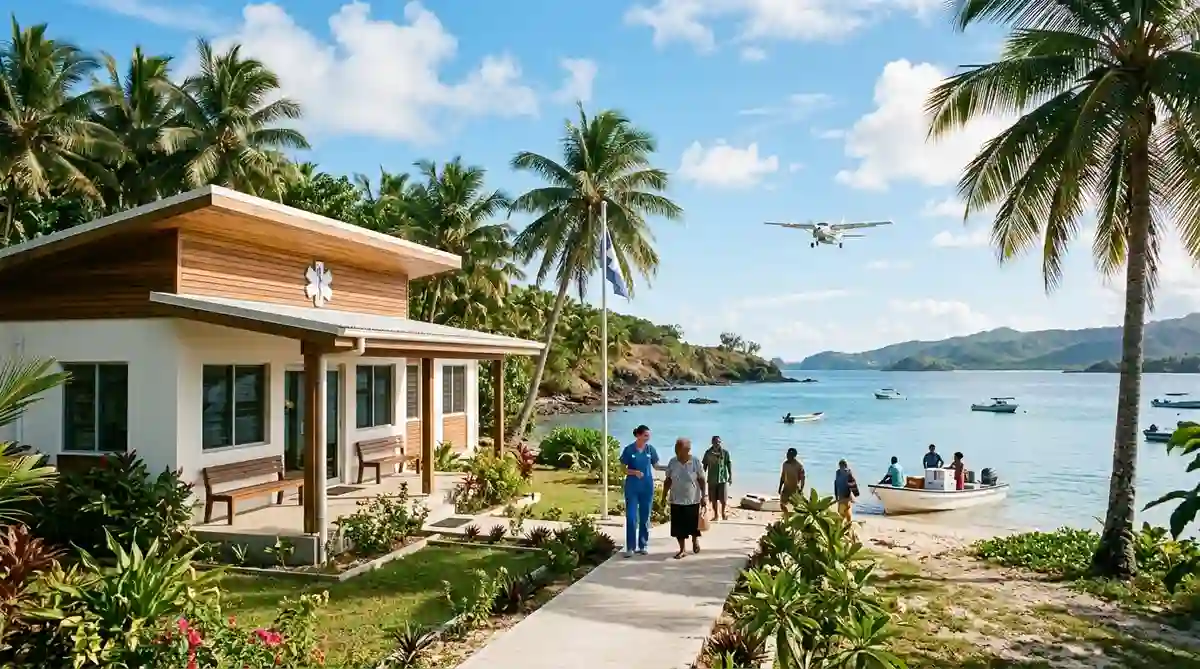
How to Retire in Vanuatu: Step by Step
Step 1: Scout before you commit. Spend a few weeks on the ground, ideally across two seasons. Test the internet, the healthcare access, the cost of your actual shopping basket, and the rhythm of island life before you uproot.
Step 2: Confirm your income qualifies. Gather certified proof that you draw at least 250,000 vatu a month, or 500,000 for a couple, from pensions, investments, or other passive sources. Bank statements and pension letters are the standard evidence.
Step 3: Apply for the self-funded residence visa. Submit your application to the Department of Immigration with your income proof, police clearance, passport, and health cover. Choose the visa term that fits your plans, up to ten years.
Step 4: Lock in medical-evacuation insurance. Before you move, secure an international health policy that covers treatment and evacuation to Australia, New Zealand, or Fiji. This is the single most important practical step for an older retiree.
Step 5: Establish genuine tax residency. To capture the zero-tax benefit, make Vanuatu your real home base and formally break ties with your previous high-tax country. Get cross-border tax advice so the exit is clean and defensible.
Common Mistakes Retirees Make
The number one error is underestimating healthcare. People fall for the tax story and the views, then realize too late that serious treatment means a flight to Brisbane. Sort the insurance first.
The second is assuming the islands are cheap across the board. Rent and tax are low, but imported goods are not. Build your budget from real Port Vila prices, not a generic Pacific average. The third mistake is moving without establishing tax residency properly, which leaves you still tethered to your old tax office. The fourth is ignoring the logistics of distance, since Vanuatu is remote and visiting family back home is a long, costly trip.
Retire in Vanuatu vs Other Pacific and Tropical Options
How does it compare to other warm, low-tax retirement spots? A quick honest look tells you most of what you need.
| Destination | Tax on Foreign Pension | Healthcare for Majors | Single Monthly Budget |
|---|---|---|---|
| Vanuatu | 0% | Evacuation needed | $1,500 to $2,500 |
| Belize | 0% (Qualified Retired Persons) | Often US/Mexico travel | $1,500 to $2,500 |
| Indonesia (Bali) | Generally not taxed on remitted foreign pension | Better private hospitals | $1,200 to $2,000 |
| Mauritius | Low, around 15% with exemptions | Decent private care | $1,800 to $2,800 |
Vanuatu wins on tax and lifestyle simplicity. It loses on healthcare depth and remoteness. If those matter more to you, our guides to retiring in Indonesia, residency in Belize, and residency in Mauritius walk through the trade-offs in detail. The bottom line is that no single haven is perfect, and the right call depends on your health, your budget, and how far from family you can comfortably live.
Frequently Asked Questions
Is it really tax-free to retire in Vanuatu?
What visa do you need to retire in Vanuatu?
How much does it cost to retire in Vanuatu each month?
What is healthcare like for retirees in Vanuatu?
Can you own property in Vanuatu as a foreigner?
Do you have to live in Vanuatu full-time to keep the visa?
Is Vanuatu safe for retirees?
Can I get permanent residency or citizenship if I retire in Vanuatu?
What is the biggest downside of retiring in Vanuatu?
Final Thoughts
The chance to retire in Vanuatu and keep every cent of your pension and investment income is rare and real. The lifestyle is peaceful, the tax is genuinely zero, and the entry requirements are reasonable. Just go in with your eyes open about healthcare and distance, sort your insurance and tax residency before you move, and the islands reward you handsomely. If you want to map out the legal foundation first, start with our full residency in Vanuatu guide.
Sources and References
- Vanuatu Foreign Investment Promotion Agency, Low Tax Jurisdiction
- Department of Immigration and Passport Services, Vanuatu, Residence Visa
- Department of Immigration and Passport Services, Vanuatu, Live in Vanuatu
- Numbeo, Cost of Living in Vanuatu
- Wise, Cost of Living in Vanuatu 2026