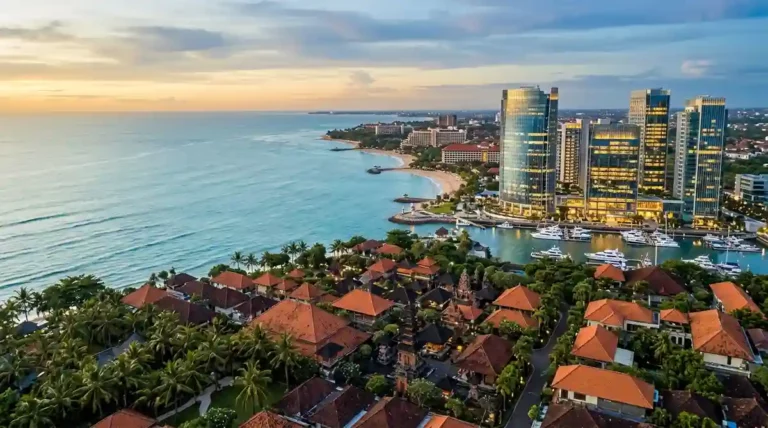
Indonesia’s parliament just passed the Indonesia International Financial Center law, and the tax numbers are startling. Zero corporate income tax for qualifying firms. Zero personal income tax for foreign finance professionals. Non-resident tax treatment for golden visa holders tied to the zone. All of it approved unanimously, in a single afternoon.
JAKARTA, Indonesia — 23 July 2026
The House of Representatives waved the bill through by acclamation on Tuesday, 21 July, according to Indonesia’s state news agency ANTARA. The law runs to 10 chapters and 73 articles and went from first committee meeting to final vote in roughly three weeks. Governments do not usually move that fast unless they want something badly.
What Jakarta wants is capital. The finance ministry projects the hub could pull in up to 500 trillion rupiah, about US$28 billion, as Southeast Asia’s largest economy chases 8% growth by 2029.
Put your assets beyond reach in 57 jurisdictions.
Pick where you want your company. We handle the filing, the registered agent, and the bank introduction. From US$1,290, done in days, not months.
- Charging-order protection in jurisdictions courts can't pierce
- Zero tax on foreign income in 30+ territories
- Banking options available
- Fixed price. No surprise fees at closing
What Does the Indonesia International Financial Center Law Actually Do?
The Indonesia International Financial Center law creates a ring-fenced special jurisdiction with a 100% corporate income tax reduction for qualifying businesses, zero personal income tax for foreign financial-sector professionals, withholding tax exemptions on dividends paid to overseas investors, and waivers of VAT, luxury goods tax, and import duties. The zone gets its own governor, council, special court, and arbitration body.
Permitted activities read like a private banker’s wish list: banking, insurance, pensions, capital markets, bullion, family offices, plus supporting lawyers and accountants. Here’s the kicker. Firms inside the zone cannot raise money from the Indonesian public or sell to domestic consumers outside it. This is an offshore enclave in the classic sense, walled off from the onshore market.
The contrast with standard Indonesian taxation is stark. We help clients with tax residency planning across dozens of jurisdictions, and full exemptions of this breadth are rare outside the Gulf.
| Levy | Inside the PFII zone | Standard Indonesia |
|---|---|---|
| Corporate income tax | 0% for qualifying firms | 22% |
| Personal income tax (foreign finance professionals) | 0% | Progressive, up to 35% |
| Foreign income of zone-linked golden visa holders | Exempt via non-resident status | Worldwide taxation once tax resident |
| Dividends to overseas investors | Withholding tax exemption available | 20% withholding for non-residents (treaty rates vary) |
| VAT and luxury goods sales tax | Waived | 12% headline VAT |
| Import duties | Waived | Varies by product |
Standard rates are drawn from PwC’s Indonesia tax summaries. The government can also layer on further incentives by regulation.

How Do Golden Visa Holders Get the 0% Tax Deal?
Under the new law, foreigners holding an Indonesia golden visa tied to the zone receive non-resident tax status, meaning Indonesia would not tax their foreign-source income while living in the country. The golden visa requires US$350,000 in government bonds, deposits, or listed shares for a five-year permit, or US$700,000 for ten years.
That flips Indonesia’s usual rule on its head. Spend 183 days in the archipelago today and you become a tax resident taxed on worldwide income at rates up to 35%. The Indonesia golden visa tax exemption would remove that trap for zone-linked investors, at least on paper.
Let’s be blunt about the reporting side. CRS follows tax residency, not nationality. Become a genuine Indonesian tax resident and banks report your accounts to Jakarta, not to the country you left. The wrinkle: zone-linked golden visa holders get non-resident tax status, so if Indonesia does not class you as a tax resident, banks may keep reporting you to the country that still does. Read the fine print on the CRS 2.0 crackdown before assuming you have slipped the net.
Where Will the Bali Financial Center Be Built?
Nobody knows yet. The law leaves the location open: the finance minister proposes candidate sites, and the president designates them by regulation. Bali is the clear frontrunner, with the Kura Kura special economic zone floated since President Prabowo Subianto first raised a Bali financial center in April. Two or three sites are reportedly under review.
Finance Minister Purbaya Yudhi Sadewa told lawmakers the hub will complement the domestic financial system rather than compete with it, drawing long-term foreign capital to cushion Indonesia against sudden outflows, as reported by Nikkei Asia.
The enforcement question is the one to watch. Indonesia has no internal borders, so policing who genuinely lives and works “in the zone” versus who simply registers there will be the difference between a credible hub and a paper one. In our experience, incentive regimes with fuzzy substance rules get tightened within a few years, and the early movers who structured carelessly are the ones who get burned. The clock is ticking on implementing regulations, and until they land, nobody can apply for anything.
Can Indonesia Really Compete With Singapore?
Not overnight. Singapore offers deep capital markets, common-law courts, 85+ tax treaties, and four decades of institutional trust. Indonesia is offering a bigger tax break and a beach. That is a real pitch for family offices chasing yield in a growing G20 economy, but most clients who ask us about Southeast Asian bases still end up choosing to incorporate in Singapore once legal certainty and the wave of bank account closures elsewhere enter the conversation.
The smarter read: Jakarta is not trying to beat Singapore at its own game. It is bidding for the capital that finds Singapore expensive and Dubai crowded. Whether a special court and a presidential governor can manufacture trust by decree is the multi-billion-dollar question.
What is the Indonesia International Financial Center?
Do Indonesia golden visa holders pay tax under the new law?
Where will the Bali financial center be located?
When does the Indonesia zero tax zone open?
Does the Indonesia International Financial Center help US citizens avoid tax?
Bottom line: Indonesia just wrote the most aggressive tax offer in Southeast Asia into law in under three weeks. Execution, not legislation, will decide whether it matters. Watch the implementing regulations and the site designation.
Sources and References
- ANTARA News, DPR Plenary Session Approves PFII Bill Into Law
- Nikkei Asia, Indonesia Parliament Passes Bill to Set Up Financial Centers
- Bloomberg Tax, Indonesia Parliament Passes Law on Financial Center
- PwC Worldwide Tax Summaries, Indonesia: Taxes on Corporate Income
- Kompas, DPR Passes PFII Law, Indonesia to Get International Financial Center