
If you want to know how to protect your freedom, start by admitting something uncomfortable. The country you were born in is not the safe harbour it used to be. Freedom is not being seized in one dramatic night. It is being nibbled away, one tax, one mandate, one reporting requirement at a time, and most people never notice until the cage is already built around them.
Freedom House just recorded the 20th straight year of declining global freedom. Twenty years. That is not a blip. That is a trend with momentum, and the West is no longer the exception it once pretended to be.
Below are seven signs of rising totalitarianism creeping through the developed world, and next to each one, the concrete move that puts distance between you and the state. This is not a doom piece with no exit. It is a map. The danger is real. So is the escape route.
Put your assets beyond reach in 57 jurisdictions.
Pick where you want your company. We handle the filing, the registered agent, and the bank introduction. From US$1,290, done in days, not months.
- Charging-order protection in jurisdictions courts can't pierce
- Zero tax on foreign income in 30+ territories
- Banking options available
- Fixed price. No surprise fees at closing
Why “How to Protect Your Freedom” Is Suddenly a Mainstream Question
A decade ago, worrying about government overreach got you labelled a crank. Not anymore. Ordinary people who have never read a word of political theory are now asking the same thing: how to protect your freedom when the institutions that were supposed to guard it have started turning against the individual.
The numbers don’t lie. According to Freedom House, just 21 percent of the world’s population now lives in countries rated “Free,” down from 46 percent two decades ago. Fifty-four countries got less free in the most recent year measured. Only 35 improved. The direction of travel is obvious, and the countries sliding backwards include names that used to top the freedom rankings.
One client came to us last year genuinely rattled after his bank froze a routine transfer for “review” and asked him to explain, in writing, what a payment to a relative was for. He had done nothing wrong. He just wanted to know he could never be cornered like that again. That instinct, that quiet screaming at me to act, is exactly the right one. Let’s walk through what is driving it.
1. Taxation Now Reaches Into Every Corner of Your Life
Income tax, capital gains tax, property tax, estate tax, sales tax, and a growing menu of wealth and exit taxes now stack on top of each other until the state is a silent partner in almost everything you earn, own, or pass on. In many Western countries the combined lifetime tax take on a productive person exceeds half of everything they ever produce. That is the first sign of rising totalitarianism: the assumption that your money is the government’s first, and yours second.
Here’s the kicker. The taxes never get simpler and they never go down for long. Politicians of every stripe discover new “temporary” levies that somehow become permanent. When a state believes it has a prior claim on your wealth, freedom is already conditional.
The freedom move: legally lower the state’s claim on you. Territorial-tax countries like Panama and Paraguay only tax income earned inside their borders. Relocating your tax residency to a saner jurisdiction, or routing international income through an offshore company in a favourable place, is how you stop feeding a machine that resents you. Explore the current low-tax jurisdictions before you assume your home country is your only option.
2. Money Itself Is Becoming a Tool of Control
Central Bank Digital Currencies turn money from something you hold into something the state permits you to use. A programmable currency can be dated to expire, blocked from certain purchases, or switched off for a flagged account, all without a court order. That is the second sign, and it is no longer theoretical.
According to the Atlantic Council’s tracker, 146 countries and currency unions, representing roughly 98 percent of global GDP, are now exploring a CBDC. Three have fully launched, several more are live in pilot, and China’s digital yuan is the largest rollout on earth. Add legal tender laws that force you to accept a currency the central bank is quietly debasing, and you have a system where the money in your pocket answers to someone other than you.
The freedom move: own assets no government can reprogram. Physical gold and Bitcoin sit outside the banking rails and outside any single state’s control. Holding a slice of your wealth in inherently international, non-confiscatable assets is the single cleanest hedge against a programmable-money future. Pair it with offshore banking so not every dollar you own lives inside one country’s system.
3. Financial Surveillance Is Now Effectively Total
Global reporting regimes like the Common Reporting Standard and FATCA mean your financial life is automatically visible to your home tax authority no matter where the account sits. Layer on domestic transaction monitoring and the rise of “de-banking,” where a bank quietly closes your account over a political donation or an offhand opinion, and financial privacy in the West is close to dead. That ship has sailed for anyone who thinks a domestic bank is a private space.
Let’s be blunt about what de-banking really is. It is punishment without trial. No charge, no judge, no appeal, just an account closure and a form letter. When your ability to transact depends on staying in favour, you are not free. You are licensed.
The freedom move: spread your financial life across borders and legal systems. A properly structured US LLC paired with a compliant offshore bank account, or an account in a jurisdiction that does not recognise foreign judgments, means no single bank or agency can flip a switch and cut you off. Diversification is not about hiding. It is about never being at the mercy of one counterparty.
4. Your Freedom of Movement Is Being Quietly Fenced In
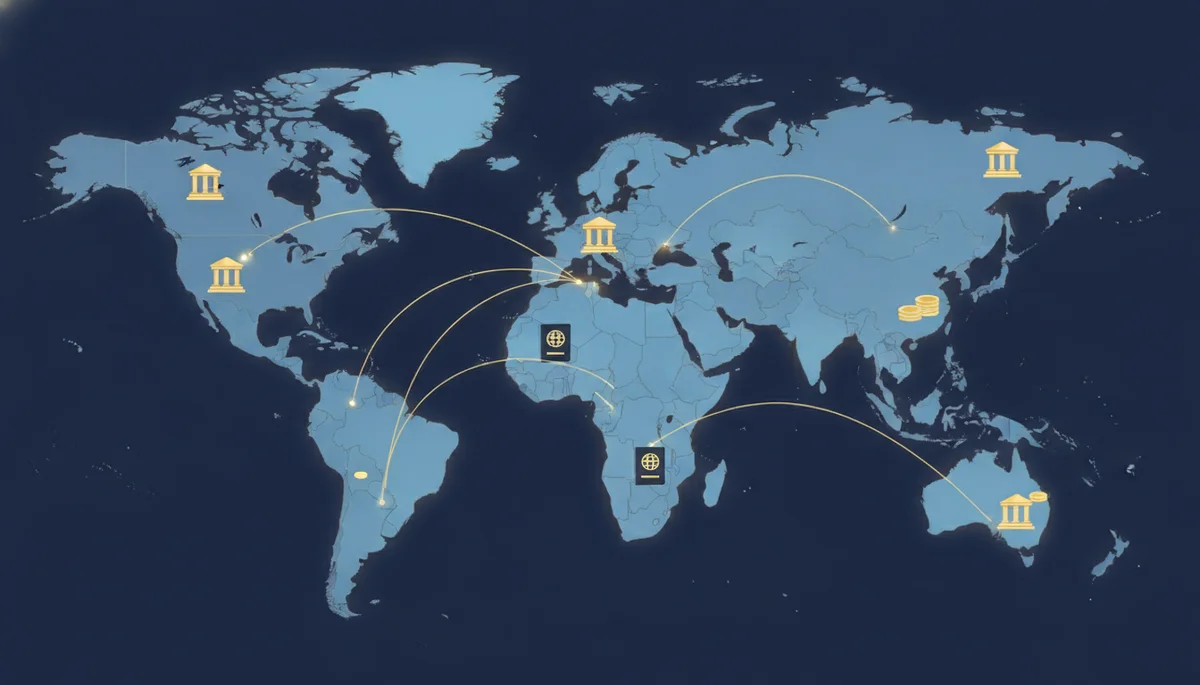
Rising totalitarianism shows up at the border before it shows up anywhere else. Travel restrictions, health-status gates, exit taxes on people who leave, and passport revocation for tax debts all turn a passport from a key into a leash. During the last global health scare, entire populations discovered their governments could confine them to the country overnight, and most had no second door to walk through.
A single passport is a single point of failure. If the government that issued it decides you cannot leave, or the world decides that document is unwelcome, you are stuck. Options are freedom, and one passport is not options.
The freedom move: get a second passport. A second citizenship is the ultimate insurance policy against being trapped by a single state. Many people qualify by descent through an Italian, Irish, Polish, or Hungarian grandparent and never realise it. Others use citizenship-by-investment or a residency program that leads to naturalisation. Before you assume your passport is strong, check where it really ranks on the Passport Freedom Index, which scores 197 passports on actual freedom, not just visa-free travel.
5. Social Credit and ESG Scoring Are Creeping Into the West
Scoring systems that rank people by behaviour are no longer a China-only story. In the West they arrive dressed as ESG metrics, “trust and safety” scores, and reputation flags shared between platforms and payment processors. The mechanism is the same: your access to services becomes conditional on approved conduct. That is the fifth sign, and it is the one people underestimate most.
The danger of a soft social credit system is that no one ever voted for it. It emerges from a hundred private policies that quietly align, until a wrong opinion costs you a payment processor, a platform, or a loan. Absolute lunacy, and almost invisible while it happens.
The freedom move: reduce your dependence on any single country’s institutions and infrastructure. Multiple banking relationships, income from more than one jurisdiction, and a digital presence hosted in privacy-respecting countries all mean no one scoring authority holds your whole life. When your livelihood is spread across borders, a bad score in one place is an inconvenience, not a catastrophe.
6. The Rule of Law Is Bending Toward the State
When the justice system becomes a political weapon, when regulators write binding rules no legislature ever passed, and when long-standing rights get “reinterpreted” out of existence, the law stops protecting you and starts managing you. That is the sixth sign of rising totalitarianism, and it is the most corrosive because the law is supposed to be the last line of defence.
An overreaching state does not need to jail you to control you. It only needs to make the process itself the punishment. Endless regulation, arbitrary enforcement, and the ever-present threat of a lawsuit or seizure keep productive people cautious, compliant, and quiet.
The freedom move: put your assets somewhere the reach is genuinely limited. Strong offshore asset protection structures, an international trust or a foundation in a jurisdiction that ignores foreign court orders, make you a hard target for opportunistic litigation and administrative seizure. We often see people wait until a threat is already at the door. By then the best structures are off the table, because moving assets under a live claim is fraud. Build the wall while the sky is clear.
7. It Doesn’t Matter Who Wins the Election
One pattern ties the other six together. Whichever party takes power, the state keeps growing and personal freedom keeps shrinking. Different speeds, same direction. Spending rises, agencies expand, and the ratchet only ever turns one way. Anyone still waiting for an election to reverse the trend is going to be waiting a long time.
This is why learning how to protect your freedom cannot depend on politics. If your entire plan B is “the right people get elected next time,” you do not have a plan B. You have a hope. Hope is not a strategy, and it is certainly not insurance.
The freedom move: stop betting your liberty on a single government behaving well. International diversification takes the outcome out of any one country’s hands. The billionaires already do this, quietly and completely. Look at how the ultra-wealthy build their plan B escape routes, then build a right-sized version of the same thing for yourself.

How to Protect Your Freedom: The Freedom Insurance Framework
Freedom Insurance is international diversification treated as a real insurance policy. You hope you never need it, you build it anyway, and it protects you and your family if the worst arrives. Most people already carry medical, fire, and car insurance without a second thought. A policy against an out-of-control government is the one that matters most, and almost no one has it.
Wealthy families have used these exact tools for centuries. Modern technology means you no longer need to be a billionaire, and in many cases you never have to leave home to start. The step-by-step below is the practical answer to how to protect your freedom, in the order that usually makes sense.
How to Protect Your Freedom Step by Step
Step 1: Own assets outside the system. Move a slice of your wealth into physical gold and Bitcoin. Both are inherently international and sit outside any single government’s control, which makes them your first and easiest hedge against currency debasement and programmable money.
Step 2: Bank across borders. Open an offshore bank account so not every dollar you own lives inside one country’s reach. This alone ends the single-point-of-failure problem that de-banking exploits.
Step 3: Diversify your income. Route international cash flows through an offshore company in a favourable jurisdiction. Multiple income sources across multiple countries mean no single state controls your ability to earn.
Step 4: Build the wall. Place core assets inside an international trust or foundation in a jurisdiction that does not recognise foreign judgments. This is offshore asset protection, and it must be done before any threat exists.
Step 5: Get a second door. Secure a second passport by descent, naturalisation, or investment. A second citizenship is your guarantee against ever being trapped by a single government.
Step 6: Plant a residency flag. Establish legal residency in a jurisdiction you would actually want to live in. Options range from a passive income visa to direct routes like the Paraguay investor pass. This gives you a real place to go, not just a document.
Freedom Insurance vs. Doing Nothing
The gap between having Freedom Insurance and hoping for the best is not subtle. One column is a person with options. The other is a person waiting to find out what their government decides next.
| Situation | No Freedom Insurance | Freedom Insurance in place |
|---|---|---|
| Your money | All in one banking system, freezable overnight | Spread across borders, gold and Bitcoin outside the rails |
| Your ability to leave | One passport, one exit, revocable | Second passport, a residency abroad, real options |
| Your assets in a lawsuit | Exposed to domestic courts and seizure | Held offshore where foreign judgments do not reach |
| Your income | Tied to one country and its rules | Multiple sources across multiple jurisdictions |
| Political risk | Bet entirely on the next election | Diversified away from any single state |

Common Mistakes People Make
Most people who try this on their own make the same handful of errors, and they are all avoidable. The biggest one is waiting too long. Freedom Insurance is like every other kind of insurance. You cannot buy it after the accident.
- Waiting for a crisis. Moving assets under a live legal threat is fraud, not protection. Build structures while the sky is clear.
- Assuming it is only for the ultra-rich. Not even close. A second passport by descent or a modest offshore account is within reach of ordinary people.
- Confusing privacy with hiding. Everything here is legal and reported where required. This is diversification, not evasion.
- Doing one thing and stopping. A single move is a start, not a plan. The pillars work together, which is the whole point.
- Ignoring home-country rules. US citizens especially must comply with worldwide tax and reporting until they formally sever ties. Get proper advice.
Frequently Asked Questions
How do I protect my freedom from an overreaching government legally?
Is the West really becoming more totalitarian?
What is the fastest way to start protecting my freedom?
Do I need to be wealthy to get a second passport?
What is a CBDC and why does it threaten freedom?
Will moving abroad lower my taxes?
What is Freedom Insurance?
Is offshore asset protection legal?
Which countries are best for a freedom-focused residency?
Final Thoughts
The seven signs are real and the trend is not reversing on its own. But knowing how to protect your freedom turns a frightening picture into a to-do list. You do not need permission, you do not need to be a billionaire, and in most cases you can start this week from your living room. Setting up your own Freedom Insurance is how you declare a personal independence that no election can grant and no government can quietly revoke. If you want to see where you stand today, start with our guide to the best countries for overseas residency and the complete second passport blueprint. And if you would rather map this out with a person than piece it together alone, you can book a strategy call with me directly and we will build your Freedom Insurance plan around your situation. The clock is ticking, and the people who move first always have the most options.
Sources and References
- Freedom House, Freedom in the World 2026: The Growing Shadow of Autocracy
- Freedom House, Global Freedom Declined for the 20th Consecutive Year
- Atlantic Council, Central Bank Digital Currency Tracker
- OECD, Common Reporting Standard (Automatic Exchange of Information)
- Liberty Mundo, Passport Freedom Index