Second passport privacy is not a style preference. It is a survival rule, and on August 10, 2026, the US Department of Justice filed a 38-page brief in Miami federal court that proves it. The filing opposes bail for Andrew and Tristan Tate pending their extradition to the United Kingdom, and it is built, page after page, on one thing: years of the brothers publicly bragging about how many passports they hold. Every tweet, every podcast clip, every “I have 5 passports” boast was archived, exhibited, stamped TATE_0001 through TATE_0034, and handed to a federal judge as proof they can never be trusted on bond.
Whatever you think of the Tates, and whatever a court eventually decides about the charges they deny, the passport lesson here is universal. They did the one thing we tell every client never to do. They told the world.
Put your assets beyond reach in 57 jurisdictions.
Pick where you want your company. We handle the filing, the registered agent, and the bank introduction. From US$1,290, done in days, not months.
- Charging-order protection in jurisdictions courts can't pierce
- Zero tax on foreign income in 30+ territories
- Banking options available
- Fixed price. No surprise fees at closing
The Court Filing That Should Terrify Every Passport Collector
Quick background before we get into the passports. Andrew and Tristan Tate were arrested in Miami on July 18, 2026, on a provisional arrest request from the United Kingdom. Andrew Tate now faces 42 charges in England and Tristan 17, including rape, trafficking and assault allegations that both men firmly deny. Nothing has been proven, and under both US and UK law they are presumed innocent. This article takes no position on any of that. Our interest is narrower and, for readers building an international life legally, far more practical: what the case file reveals about disclosure.
Their lawyers asked the court for release on bond while the extradition plays out. On August 10, prosecutors from the US Attorney’s Office and the DOJ Office of International Affairs filed their response in case 1:26-mj-03259-LFL, and the UK Crown Prosecution Service backed it with its own letter and 34 pages of exhibits. Extradition bail is already brutally hard to get. As the government reminds the court, there is “a presumption against bond” and a fugitive must prove he is neither a flight risk nor a danger, plus show special circumstances. So what did prosecutors reach for first to paint the brothers as flight risks?
Their own words about passports. The government’s framing, on page 2 of the brief, sets the tone:
“That the TATES also claim to maintain multiple passports and identities, have access to excessive wealth and influence in numerous countries, and are stridently unwilling to voluntarily return to face prosecution in the United Kingdom, collectively demonstrate a heightened risk of flight that no amount of bond could overcome.”
Read that again. Not “the defendants secretly obtained travel documents.” The word is claim. The government’s flight-risk case is anchored to things the Tates said about themselves, in public, for years. That is the whole ballgame, and it is why second passport privacy sits at the top of every serious offshore checklist we write.
How Many Passports Does Andrew Tate Have?
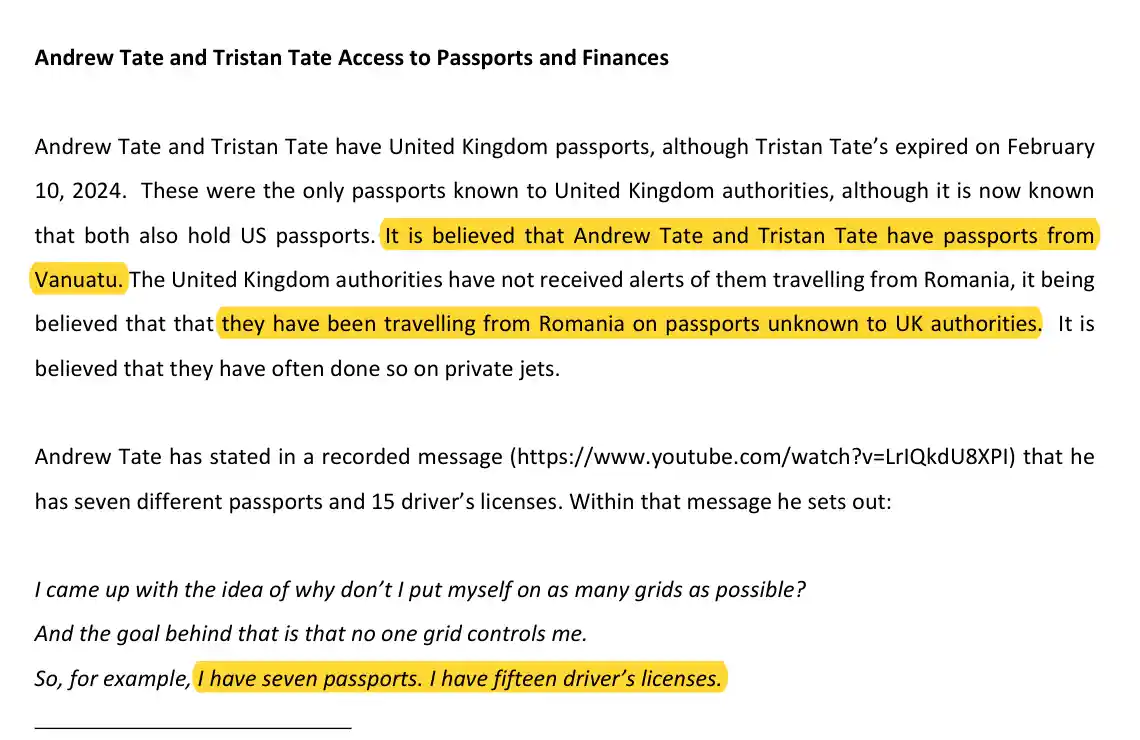
According to the extradition filings, Andrew Tate has publicly claimed between 4 and 8 passports at different times, and UK authorities believe the true number is at least seven, including UK, US and suspected Vanuatu citizenship, with four more he says he has never disclosed. No agency claims to know the full count. That uncertainty is exactly what prosecutors used against him.
The paper trail is remarkable because it is all self-inflicted. Every figure below comes from the government’s Exhibit 1, which is simply a collection of Andrew Tate’s own posts and interviews:
| Date | Public claim | Where it ended up |
|---|---|---|
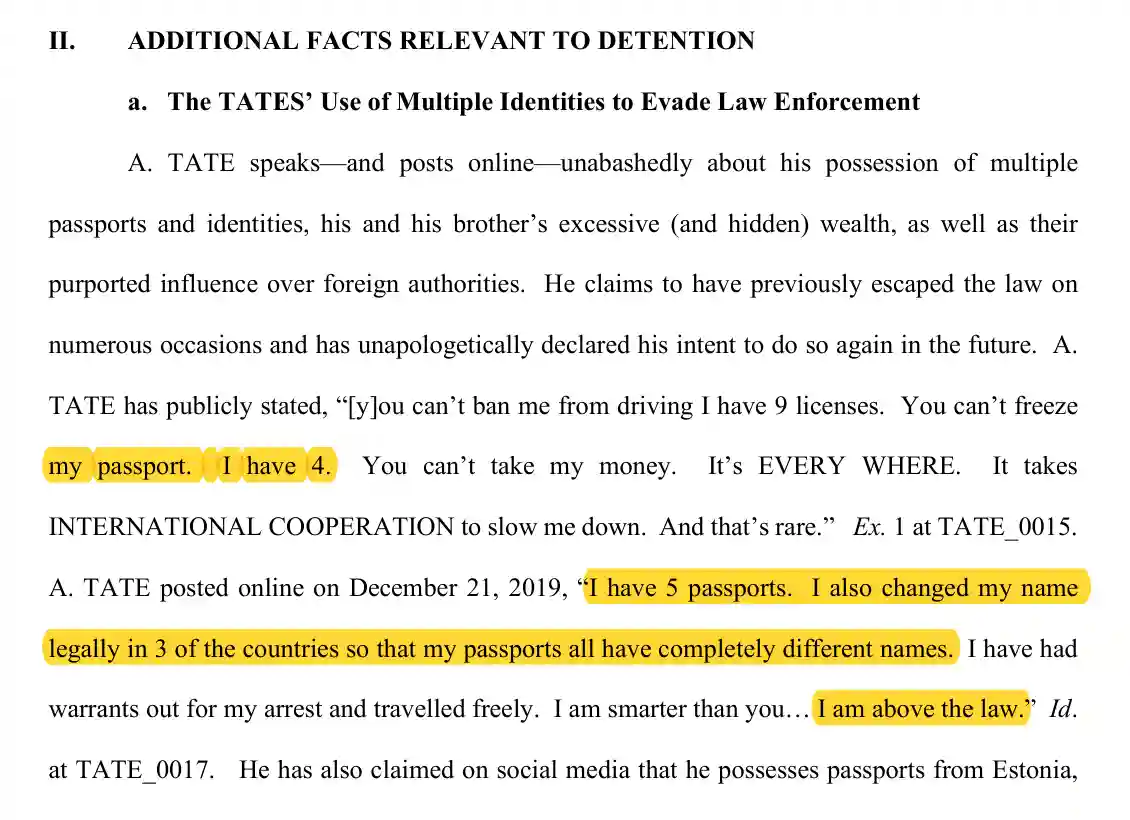
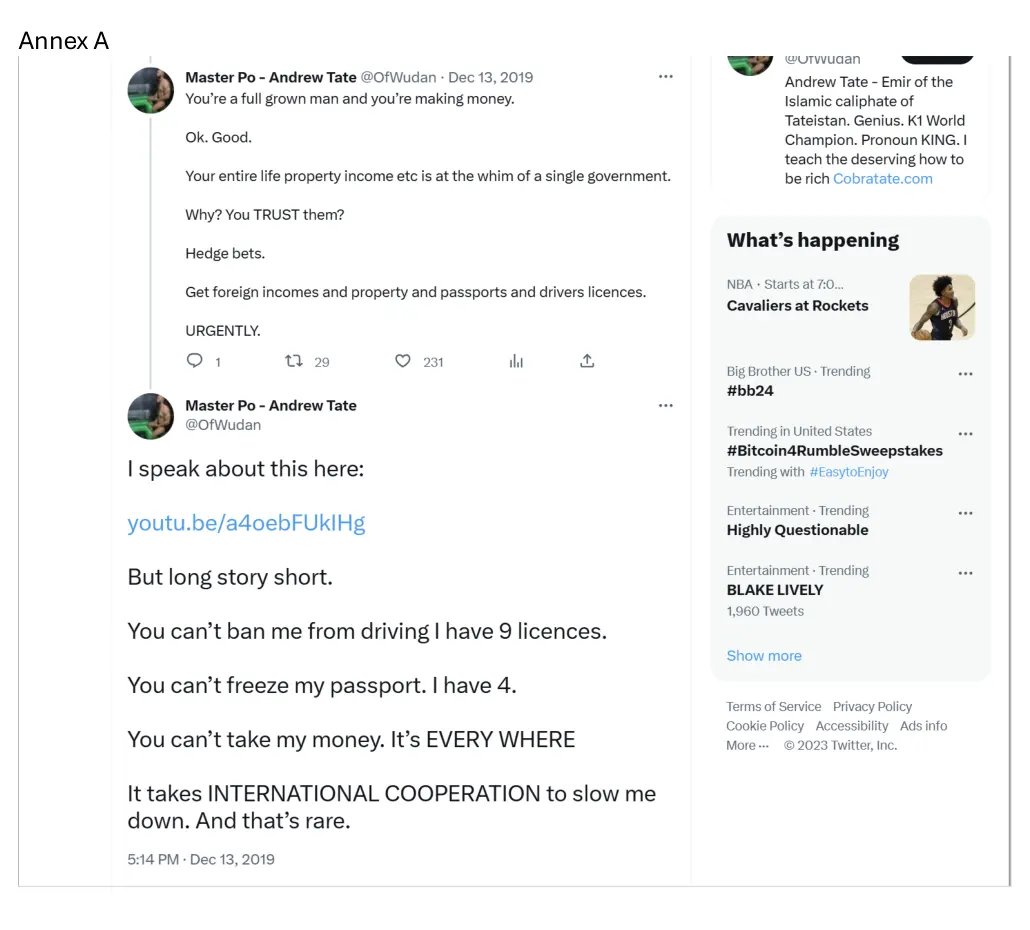
| Dec 13, 2019 | “You can’t freeze my passport. I have 4.” | Exhibit 1, TATE_0015 |
| Dec 21, 2019 | “I have 5 passports. I also changed my name legally in 3 of the countries so that my passports all have completely different names.” | Exhibit 1, TATE_0017; quoted on page 9 of the DOJ brief |
| May 3, 2020 | “I have 7 passports.” Plus: “I want AS MANY PASSPORTS as possible.” | Exhibit 1, TATE_0018 to 0019 |
| Aug 29, 2021 | “There’s 8 different Andrews. (THE WAR ROOM). I got 8 lives. 8 licenses and passports.” | Exhibit 1, TATE_0029 |
| Recorded video | “I have seven passports. I have fifteen driver’s licenses.” | Quoted in the CPS letter, TATE_0007, and page 18 of the DOJ brief |
| Social media | Passports from Estonia, Nigeria, Poland, the UK and the US, “and four more that he has never publicly disclosed” | DOJ brief, pages 9 to 10, citing Exhibit 8 |
The UK adds its own intelligence on top. Per the CPS letter, both brothers hold UK and US passports, both are believed to hold Vanuatu passports, and the UK has been “largely unsuccessful” tracing their movements because, it believes, “they have been travelling from Romania on passports unknown to UK authorities.” Vanuatu ran one of the fastest citizenship by investment programs on earth, so that detail surprised nobody in this industry.
Notice something? The number kept growing, 4, then 5, then 7, then 8, because the disclosures were about status, not strategy. Each boast bought a day of engagement and now buys extra weeks in a federal detention cell. The government literally told the court that the brothers’ fame argument fails because their posts prove “their ability to avoid detection by using false identity documents in different names.”
The Government Was Listening the Whole Time
Here’s the kicker. Andrew Tate deleted the @OfWudan account where most of these posts lived. Didn’t matter. Not even close. The CPS letter states the account “is no longer accessible via X, but is available via internet archiving,” and then reproduces the tweets as full-color screenshots in Annex A. Deletion does not un-ring the bell. Archive services, subpoenas to platforms, and simple screenshots by strangers mean every public disclosure about your documents is permanent. Second passport privacy has no undo button: you either kept the information off the internet or you did not.
And the archived material is devastating in its specificity. A few samples now sitting in the federal record:
“You need a bug out spot and a second passport and a bank nobody knows about.” (Dec 13, 2019, TATE_0014)
“Get 5 passports. 5 drivers licenses. Then change your name in a few counties, so you have legit passports with new names. DON’T BE LAZY ITS ESSENTIAL.” (Aug 8, 2020, TATE_0020)
“FUCK. Woke up in Munich. Running from the German police wasn’t a good idea… They’ve also got everyone’s IDs from hotel reception. Thank fuck I used a dummy passport. Second time this trip it saved me.” (Aug 12, 2020, TATE_0021)
“You need at least 2 passports. If you’ve just got 1 passport, you’re fucked. I’ve been in situations where they deny my UK passport. So I simply switch to another one and they let me through.” (Apr 24, 2021, TATE_0026)
Strip out the bravado and half of this is advice we would half agree with. A bolthole, a second citizenship, banking diversification: that is standard Plan B material, and the benefits of having a second passport are real and legal. The difference between a client and a cautionary tale is that a client’s plan is boring, documented, lawful and quiet. Tate’s version was broadcast to millions with “I am above the law” stapled to it. Prosecutors did not have to build a flight-risk narrative. They copy-pasted one.
One more archived line deserves its own frame, because it is the thesis of the government’s whole detention argument, written by the defendant himself in April 2021: “I’m untouchable because I’ve spent a decade spreading myself into MANY grids. I can be in another country under a different name, with a penthouse, and $300k if things go bad.” The DOJ quoted it in a footnote as evidence of an “escape plan.”
The Vladimir Scorpius Passport: Where Legal Ends and Alleged Fraud Begins
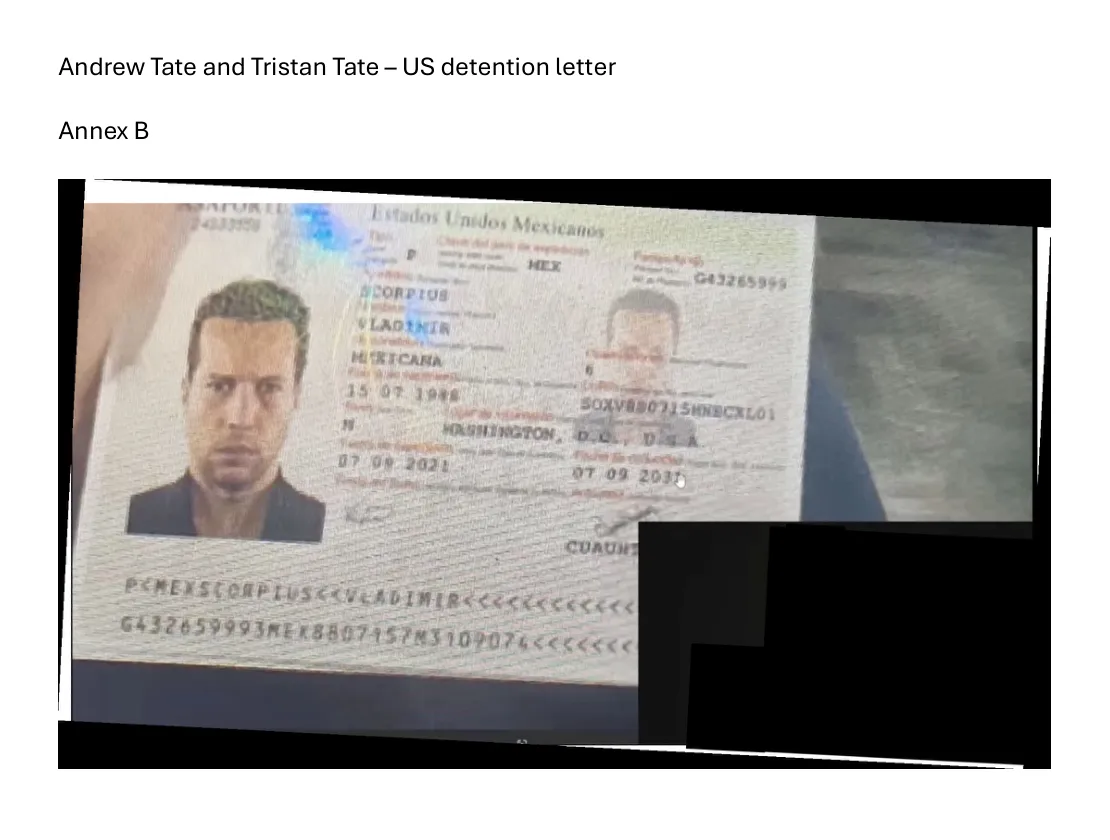
The single most damaging exhibit in the file is a photograph of a Mexican passport. It carries Tristan Tate’s photo and date of birth, but the name on it reads “Vladimir Scorpius.” UK authorities note the name belongs to an arms dealer in a 1998 James Bond novel, that Tristan declared “I’m Captain Vladimir Scorpius” in an online video, and that he was appointed director of a UK company called “Scorpius Ltd” in 2022. Mexican officials told US law enforcement they have no record of ever issuing a passport in that name. If that document is what prosecutors imply it is, that is not citizenship planning. That is an alleged fraudulent identity document, a different universe from anything lawful, and the Tates have not been charged over it, so it remains exactly that: an allegation.
How did it surface? This part should make every offshore enthusiast sit up straight. According to the CPS, the image was posted by an investigative journalist who said the passport copy had been supplied to him by Wise, the money transfer platform, where it had been uploaded by Tristan Tate himself to satisfy a Know Your Customer check, complete with a selfie and a Romanian address.
Let’s be blunt about the two lessons stacked on top of each other here. First, a second identity is not a second citizenship. Legally acquired dual citizenship through naturalization, descent or investment is protected, respectable and utterly defensible in court. A passport in a fictional name is a crime in essentially every jurisdiction, and no serious advisor will touch it. Second, every document you upload anywhere can leak. A KYC file at a fintech ended up with a journalist and then in a federal exhibit. We have watched clients treat compliance uploads like disposable paperwork. They are permanent records held by third parties you do not control, which is one more reason the underlying documents must be clean and lawful.
How Prosecutors Turned Boasts Into a Bail Denial Argument
Prosecutors converted the Tates’ passport disclosures into a three-step detention argument: the public claims establish access to unknown travel documents, the unknown documents make monitoring impossible, and the impossibility of monitoring means no bond amount can guarantee appearance. Each step rests on statements the brothers volunteered, not on evidence investigators had to dig up.
Watch the mechanism work in the government’s own language. Step one, from page 18 of the brief:
“A. TATE has stated online that he has seven different passports and 15 driver’s licenses so that if he is stopped by the authorities, he can ‘pull out a license from some random country’ to prevent authorities from determining his true identity.”
Step two, the operational consequence, from page 10: UK authorities “have not successfully received travel alerts for the TATES’ true passports, even though authorities know from social media that the TATES have been traveling. U.K. authorities suspect that the TATES may be traveling on unknown passports in their possession.” The system that flags a wanted person’s passport at a border simply does not fire if the border sees a document nobody knows about. The brief then notes the brothers logged travel to 12 different countries with at least 34 international flights in roughly 17 months, including stops in Dubai, Hong Kong, Russia and Northern Cyprus, several of which lack extradition arrangements with the UK or US. Our guide to countries that won’t extradite explains why prosecutors flagged those stops specifically.
Step three, the conclusion. The CPS: “We do not consider that any measures that the Court could impose could mitigate the significant risk that they would fail to surrender to the jurisdiction of the Court.” And the DOJ: “When considered with the possibility that they have fake passports, it becomes clear that no amount of bail would be significant enough to guarantee the TATES’ presence at these proceedings.”
That is checkmate in a bail hearing, and the pieces were donated by the defendants. Even their strongest counterargument, that two of the most recognizable men on the internet cannot exactly go into hiding, got flipped: the government answered that their fame “is in direct tension with the TATES’ extensive social media posts in which they discuss their ability to avoid detection by using false identity documents in different names.”
Why Second Passport Privacy Beats Bragging Rights
Second passport privacy means treating additional citizenships like insurance policies rather than trophies: legally acquired, properly declared to authorities that require declaration, and never advertised to the public. The Tate file shows the cost of the opposite approach. Confidential passports protect optionality. Publicized passports get framed as flight risk, frozen, or turned into evidence.
There is a paradox here worth spelling out. A second citizenship is completely legal. Millions of people hold two or more nationalities through birth, marriage, descent or investment. Governments themselves sell citizenship through structured programs, and our Passport Freedom Index ranks the travel power those documents deliver. So why keep quiet about something lawful?
Because disclosure changes how every institution treats you, before any court ever gets involved:
- Courts read disclosure as flight risk. In any bail hearing, custody dispute, or civil contempt fight, a known second passport is the first thing opposing counsel raises. A publicly bragged-about one, as the Tate brothers extradition shows, becomes Exhibit 1 in the most literal sense.
- Banks read it as risk scoring. Compliance departments flag multi-passport customers for enhanced due diligence. Volunteering the information in public forums invites de-banking long before any legal trouble.
- Litigants and ex-spouses read it as a target list. Telling the world where you hold citizenship tells every future plaintiff where to look for assets. The same logic drives our asset protection work: structures fail loudest when their owners narrate them.
- Governments read it as a to-do list. Tate posted in 2019 that “England froze my passport and bank about 3 years ago.” The response he broadcast, “Romanian passport. Jumped on a plane. Bye,” is now quoted on page 4 of a US federal brief as proof he flees jurisdictions when pressured.
In fifteen-plus years of helping people build these structures, the pattern we see is consistent: the clients who get durable value from a second citizenship are the ones whose neighbors, business partners and social media followers have no idea it exists. One client of ours holds three passports and his adult children only learned about the third when estate planning began. That is what a working Plan B looks like. Silent until needed.
Second Passport Privacy: 7 Rules the Tate File Just Wrote for You
Every rule below maps directly to a mistake documented in the extradition exhibits. Follow them and second passport privacy stops being a slogan and becomes muscle memory, keeping your citizenship portfolio what it was designed to be: a legal safety net.
- Never state your passport count anywhere public. Not the number, not the countries, not “more than one.” Tate’s escalating 4-5-7-8 count gave prosecutors a growth chart of concealment. The correct public answer to “how many passports do you have?” is a shrug.
- Never post documents, or photos near documents. The Annex B passport image, the train selfie captioned “escape the hot zone,” the Dubai pool photo attached to the “untouchable” post: every image became an exhibit page. Assume any photo of or about your documents will outlive the account it was posted on.
- Acquire citizenship lawfully or not at all. The line between a legal second passport and an alleged “Vladimir Scorpius” is the line between an asset and a criminal charge. Legal name changes exist and are legitimate, but a pattern of different names across documents, boasted about as an evasion tool, reads to a court as concealment of identity. If you have a complicated history, there are lawful routes; our guide to getting a second passport with a criminal record covers what is actually possible.
- Treat every KYC upload as a permanent public record. The most explosive document in the file reached a journalist through a fintech’s verification files. Only upload documents you could defend in open court, because one day you might have to.
- Never narrate your movements. The brief tracks the brothers through Dubai, Hong Kong, Russia and Northern Cyprus using nothing but their own posts, then notes the government still could not see their border crossings. Posting locations while traveling on undisclosed documents handed prosecutors both halves of the argument: he hides from us and taunts us at the same time.
- Never, ever declare yourself “above the law.” Sounds obvious. Yet variations of that exact phrase appear at least four times in the exhibits, and the DOJ built a dedicated section titled “The TATES are self-proclaimed flight risks” around them. Courts remember swagger.
- Keep the plan boring and the paperwork clean. A lawful second residency, a properly reported bank account, a citizenship acquired through a recognized program: none of it needs hiding from governments, and none of it should be shared with audiences. Report what the law requires to tax authorities, and tell nobody else anything. The strongest structures we build are the ones there is nothing juicy to say about.
The contrast, side by side:
| Decision point | What the Tate file shows | What a private strategy looks like |
|---|---|---|
| Passport count | Publicly claimed 4, 5, 7, then 8, now quoted in a federal brief | Known only to you, your lawyer, and authorities with a legal right to know |
| Names on documents | Boasted of legally changing names in 3 countries so passports “have completely different names” | One consistent legal identity across all lawful documents |
| Acquisition route | Alleged passport in a fictional name that Mexico says it never issued | Naturalization, descent, or a recognized citizenship by investment program |
| Travel footprint | 34 flights, 12 countries, live-posted, on documents authorities cannot see | Unremarkable travel on declared documents, no public itinerary |
| Public posture | “I am above the law,” “come get me,” “HARD TO KILL” | Nothing to quote, because nothing was said |
| Outcome when tested | Bail opposed as a risk “no amount of bond could overcome” | A quiet, legal Plan B that no court can characterize as evasion |
The Legitimate Case for a Second Passport Still Stands
None of this is an argument against holding multiple citizenships. It is an argument for holding them the way wealth is supposed to be held: quietly, lawfully, and with paperwork you would happily show a judge. The Tates’ own archived words make the affirmative case better than we ever could. Governments do freeze passports. Banks do cut people off at a whim. A single citizenship really is a single point of failure. That analysis is correct, and it is why demand for second passports and citizenship planning keeps climbing while tax havens and residency programs compete for mobile capital.
What separates a Plan B from a fugitive kit is legality plus silence. Acquire the second citizenship through a recognized route. Keep your name consistent. Meet every reporting obligation to tax and immigration authorities, because privacy from the public is not secrecy from the state. Then say nothing. The day you actually need that passport, whether the trigger is political, financial or personal, its entire value rests on the fact that nobody saw it coming.
Bottom line: the Tate brothers turned the strongest freedom tool on earth into prosecution material by narrating it. Their case will run its course in court, where the charges remain allegations and the brothers maintain their innocence. The confidentiality lesson, though, is already final, stamped on 34 pages of exhibits: second, third and fourth passports are to be held, not heralded.
How many passports does Andrew Tate have?
Is it legal to have multiple passports?
Why does second passport privacy matter if the passport is legal?
What did prosecutors actually use against the Tate brothers?
Did deleting the social media posts protect the Tates?
What is the Vladimir Scorpius passport allegation?
Can a second passport be used to avoid extradition?
Do I have to tell my home country about a second citizenship?
How do I keep my second passport confidential in practice?
Is getting a second passport through citizenship by investment still worth it in 2026?
Final Thoughts
The extradition court in Miami will decide the Tates’ fate on the law and the evidence, as it should. What the rest of us get from case 1:26-mj-03259-LFL is a free, brutally documented seminar on operational discipline. Two men with the resources to build the world’s best Plan B instead built the world’s best-documented one, and the documentation is what the government is using to keep them in a cell while they fight extradition. Your second citizenship should make you harder to pressure, not easier to prosecute. Hold it legally. Hold it quietly. Second passport privacy costs nothing and buys everything. If you are ready to build a real Plan B, start with our guide to second citizenship or explore what a passive income visa can do while a passport matures.
Sources and References
- US District Court, Southern District of Florida, In the Matter of the Extradition of Tristan Tate and Emory Andrew Tate, Case Nos. 1:26-mj-03259 / 1:26-mj-03260, Response in Opposition to Motion for Release Pending Extradition Proceedings (Doc. 37, filed Aug. 10, 2026)
- Crown Prosecution Service, Special Crime and Counter Terrorism Division, Letter in Support of Pretrial Detention with Annexes A and B (Doc. 37-1, Exhibit 1, Aug. 6, 2026)
- High Court of England and Wales, The King (on the application of Tate) v Director of Public Prosecutions [2026] EWHC 1600 (Admin)
- PBS News, Andrew and Tristan Tate arrested in Miami: what to know
- NPR, Andrew and Tristan Tate arrested in Florida on charges of rape and sex trafficking
- Al Jazeera, Tate brothers face two more weeks in US jail pending UK extradition
- Crown Prosecution Service, cps.gov.uk