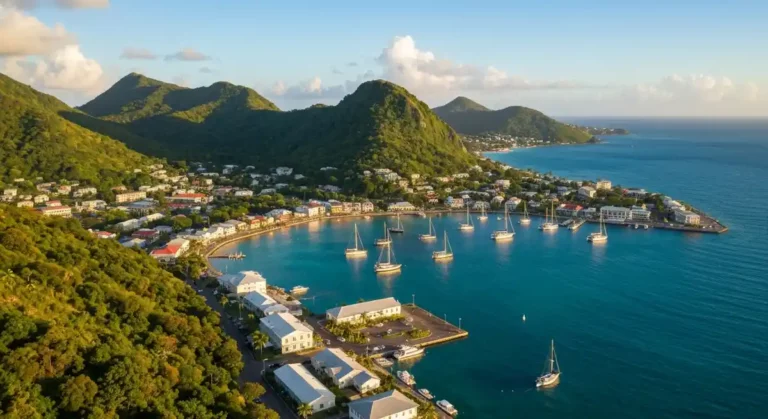
The Saint Vincent CBI program took on a sharper shape this week, with Prime Minister Godwin Friday promising to wall the scheme off from ministers and party operatives before a single passport is sold. Speaking on a regional podcast, he framed the plan as a tightly controlled financing tool, not a cash grab, with the island’s debt sitting near 113 percent of GDP.
KINGSTOWN, Saint Vincent and the Grenadines – 31 May 2026
Friday’s New Democratic Party swept Ralph Gonsalves’ Unity Labour Party out of office in November 2025, ending 24 years of ULP rule, and launching a citizenship scheme was a core campaign promise. Saint Vincent and the Grenadines is now the last independent member of the Organisation of Eastern Caribbean States without an operational program, and the government is targeting a mid-2026 start.
The pitch is unusual coming from Kingstown. Gonsalves spent years attacking Caribbean passport sales as a reputational liability. Now the new administration wants in, but it is trying to learn from the bruises its neighbours collected first.
Put your assets beyond reach in 57 jurisdictions.
Pick where you want your company. We handle the filing, the registered agent, and the bank introduction. From US$1,290, done in days, not months.
- Charging-order protection in jurisdictions courts can't pierce
- Zero tax on foreign income in 30+ territories
- Banking options available
- Fixed price. No surprise fees at closing
What Friday promised for the Saint Vincent CBI program
The headline pledge is distance. There must be “a distance” between how the program runs and the political directorate, Friday said, ruling out ministerial involvement or interference. Voters should be able to see how much money comes in and where it goes, with parliamentary accountability for both the inflows and the spending. In a region where passport revenue has repeatedly turned into a slush fund, that promise is the whole story.
He was just as blunt about scale. The scheme is “not an economy,” he argued, “it’s a financing mechanism.” Citizenship money would feed the sectors the government actually wants to grow, agriculture, tourism, a digital economy, and a blue economy around fisheries and yachting, while helping service the debt. It is not meant to replace production, jobs, or exports. All proceeds are slated to flow through a legislatively ring-fenced national investment fund, with residency conditions attached to applicants.
Why the Saint Vincent CBI program is really a debt play
The math behind the Saint Vincent CBI program is hard to argue with. The International Monetary Fund’s 2026 Article IV review put public debt at 113 percent of GDP in 2025, up a staggering 45 percentage points since 2019, with roughly half of that pile added in just the last two years. Under current policies the IMF projects debt climbing to 145 percent of GDP by 2031, a trajectory it and the World Bank both call unsustainable.
Friday has been candid that the country “can’t borrow much more.” A pandemic, two major natural disasters, and an oil-price shock hammered the budget, and concessional money is scarce. Citizenship revenue sits alongside debt swaps, possible debt relief, and foreign direct investment in his recovery toolkit. For context on how peers use these inflows, see our coverage of the 2026 Caribbean CBI summit and the new regional CBI regulator.
Learning from the neighbours’ mistakes
Being last has its perks. Friday argues that watching Antigua, Dominica, Grenada, Saint Kitts, and Saint Lucia operate for years lets Kingstown copy what worked and skip what blew up. He has backed common regional standards and a stronger oversight role for the Eastern Caribbean Central Bank to stop programs from undercutting one another on price and due diligence. The goal, in his words, is to avoid a “race to the bottom.”
Due diligence came up again and again. Friday tied it directly to the worth of the passport and the “good name” of the state, and said the government will not chase promoters or applicants whose aims clash with national development. Compare that posture with the rapid-fire approach that drove the recent surge of American applicants to Antigua, and you can see two very different philosophies forming.
| Element | Status as of May 2026 |
|---|---|
| Program status | Planned, legislation not yet published |
| Target launch | Mid-2026 |
| Governance | Insulated from ministers; parliamentary accountability |
| Proceeds | Routed through a ring-fenced national investment fund |
| Applicant condition | Residency requirement attached |
| National debt | ~113% of GDP (2025), projected 145% by 2031 (IMF) |
The pressure cooker: US and EU scrutiny
The timing is awkward. Washington paused immigrant visa processing for nationals of 75 countries in January, a list that swept in several Caribbean states including Antigua, Dominica, and Grenada. Brussels, meanwhile, has signalled it views the operation of citizenship-by-investment schemes as grounds to revisit visa-free access for the region. Launching a brand-new program into that headwind is a gamble, and Friday knows the firewall talk is partly aimed at those audiences.
That external heat is exactly why governance is the make-or-break detail. A poorly run scheme could cost Vincentians visa-free travel they already enjoy. A genuinely clean one, with real second citizenship credibility, might thread the needle. The track record across the region is mixed, which is why the smart money looks at programs like Nauru’s citizenship route and Argentina’s emerging program with the same hard questions about durability.
When will the Saint Vincent CBI program launch?
How will the program be kept free of political control?
Why is Saint Vincent launching a CBI program now?
Is Saint Vincent the last Caribbean country to add CBI?
Could US or EU pressure derail the Saint Vincent CBI program?
For now the Saint Vincent CBI program is a promise with good bones and no rulebook. The governance-first framing is genuinely encouraging, and if the statute matches the rhetoric, this could become one of the cleaner Caribbean options on the market. Just keep the champagne on ice until the law lands. Read next: our background on Saint Vincent’s CBI plans as they first emerged.
Sources and References
- International Monetary Fund, IMF Staff Completes 2026 Article IV Mission to Saint Vincent and the Grenadines
- U.S. Department of State, Immigrant Visa Processing Updates for Nationalities at High Risk
- Al Jazeera, Opposition NDP party claims victory in Saint Vincent and the Grenadines
- St Vincent Times, St Vincent to roll out CBI in 2026