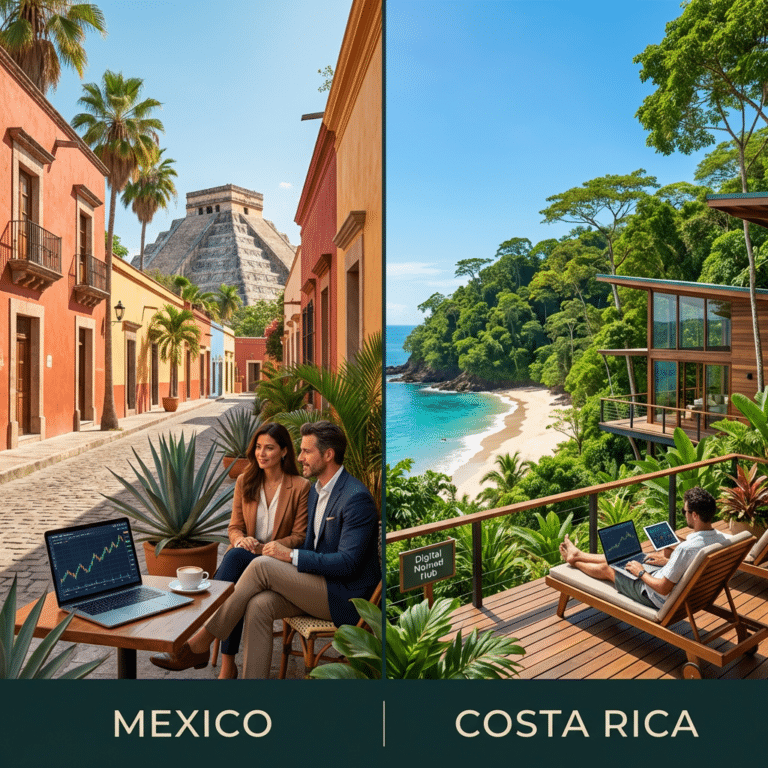
Mexico vs Costa Rica 2026: The Ultimate Residency Showdown for Tax-Conscious Expats
Latin America’s calling your name, and two countries dominate the conversation: Mexico and Costa Rica. Both promise sun-soaked beaches, welcoming communities, and financial advantages that make Western tax rates look downright criminal. But when 2026 rolls around, which destination wins for residency seekers?
The answer depends on your priorities. Mexico offers speed and flexibility. Costa Rica delivers zero foreign income tax. Let’s break down what matters most when choosing your new home base.
The Residency Systems: Different Approaches, Different Results
Mexico’s immigration authority, the INM (Instituto Nacional de Migración), runs a straightforward system. You get temporary residency for up to four years, then transition to permanent status with no renewals needed afterward. Spouses of Mexican citizens or residents catch a break with accelerated processing and reduced financial requirements.
Costa Rica’s DGME (Dirección General de Migración y Extranjería) takes another route. Temporary residency typically lasts two years with renewal options, leading to permanent status after three years for most visa categories. The standout feature? Complete exemption from taxes on foreign-sourced income.
Mexico connects better to North America with superior flight options, Amazon delivery, and Costco warehouses. You’ll find metropolitan areas like Monterrey, Guadalajara, and Mexico City alongside beach towns and mountain villages. Costa Rica leans into its “Pura Vida” reputation with smaller communities, pristine nature, and a slower pace. Most expats skip San José entirely, heading straight for coastal towns or highland coffee regions.
Financial Requirements: Show Me the Money
Mexico’s Proof of Income Standards
Temporary residency demands monthly income between $4,300 and $5,300 (based on minimum wage calculations) over the previous six months. Alternatively, show savings of $70,000 to $87,000. Exchange rate fluctuations affect exact amounts.
Want permanent residency immediately? The bar rises to $7,000-$9,000 monthly income or savings approaching $280,000. Family unity visas slash these requirements if you’re married to a Mexican citizen or resident.
Costa Rica’s Multiple Pathways
The Pensionado visa attracts retirees with guaranteed lifetime pensions of $1,000 monthly. No age restrictions apply, though retirees form the primary user base.
The Rentista visa requires $2,500 in monthly passive income for two years minimum. Don’t have passive income? Deposit $60,000 in a local bank account instead.
Investors qualify with $150,000 to $200,000 placed in real estate, businesses, or approved projects. Many applicants purchase condos or single-family homes to meet this threshold.
Digital nomads need $3,000 monthly foreign income ($4,000 for families) for a visa lasting up to two years. This option rarely makes sense compared to tourist status or other residency paths.
The Application Process: Where and How
Mexico requires consulate applications from outside the country. After approval, you enter Mexico within six months to collect your INM card. The entire process wraps up in one to three months.
Costa Rica flips the script. Most applicants start the process after arriving in-country on tourist status. You receive a “precaria” (temporary permit) while waiting six to twelve months for approval. This approach creates complications for citizens of countries without visa-free access to Costa Rica, who face higher rejection rates when applying through consulates.
Physical Presence: Freedom vs Commitment
Mexico imposes zero physical presence requirements once you hold permanent residency. Visit only when renewing temporary status. After securing permanent residency, come and go as you please without restrictions.
Costa Rica demands more commitment. Official requirements vary from one day annually to four months for certain renewals. Enforcement lacks consistency, but plan on spending four to six months yearly to avoid complications. This makes Costa Rica unsuitable as a backup residency for those seeking minimal commitment.
Healthcare and Hidden Costs
Costa Rica mandates enrollment in the Caja (public healthcare system), costing at least $25 monthly, regardless of usage. This creates an annual carrying cost of $300 for maintaining residency. While the public system offers decent care, most expats supplement with private insurance and facilities.
Mexico skips mandatory healthcare contributions entirely. Private healthcare dominates the expat experience, with excellent facilities and affordable prices. No carrying costs burden your residency status.
Tax Implications: The Big Differentiator
Costa Rica’s territorial tax system exempts all foreign-sourced income. Pensions, online business revenue, investment returns from abroad – none trigger Costa Rican taxes. Most expats never file returns.
Mexico’s tax situation involves more complexity. While treaties and planning strategies reduce obligations, achieving zero tax requires careful structuring. The system treats residents as taxable on worldwide income, though enforcement and interpretation vary. Professional guidance becomes essential for optimizing your Mexican tax position.
Citizenship Timelines
Mexico offers naturalization after two to five years, depending on circumstances. Marriage to a Mexican citizen accelerates the timeline.
Costa Rica stretches the wait to seven years – among Latin America’s longest paths to citizenship. Start with three years to permanent residency, then four more years before naturalization eligibility.
Making the Choice: Lifestyle and Priorities
Pick Mexico when speed matters. The faster processing suits those escaping high-tax jurisdictions quickly. Minimal presence requirements work for “Plan B” residencies. Urban amenities, shopping conveniences, and proximity to the United States appeal to many North Americans. The citizenship timeline beats Costa Rica by years.
Choose Costa Rica for tax simplicity. Zero foreign income tax creates straightforward planning. The slower pace suits those genuinely wanting tropical living rather than paper residency. Pristine beaches, mountain coffee farms, and abundant wildlife define daily life. Healthcare inclusion provides peace of mind despite the added cost.
Southern Mexico offers jungle experiences rivaling Costa Rica. States like Chiapas, Oaxaca, and the Yucatan Peninsula feature monkeys, jaguars, and tropical rainforests. Don’t assume Mexico lacks natural beauty – it delivers both urban sophistication and wilderness adventure.
The Bottom Line
Both nations welcome expats with stable governments, friendly populations, and lifestyle improvements over Western alternatives. Your choice hinges on personal priorities rather than objective superiority.
Tax optimization favors Costa Rica’s transparent territorial system. Flexibility and convenience point toward Mexico. Retirees with guaranteed pensions find Costa Rica’s Pensionado visa attractive. Digital entrepreneurs appreciate Mexico’s connectivity and infrastructure. Families value Mexico’s education options and youth activities. Nature lovers embrace Costa Rica’s biodiversity and conservation focus.
Consider your non-negotiables first. Need banking that works? Mexico wins. Want guaranteed zero tax on foreign income? Costa Rica delivers. Prefer city life? Mexico offers options. Crave off-grid beach living? Both countries provide paradise, though Costa Rica specializes in eco-conscious development.
The 2026 residency landscape continues evolving, but core differences persist. Mexico prioritizes accessibility and flexibility, while Costa Rica emphasizes commitment and tax advantages. Neither choice disappoints those seeking Latin American residency – only different flavors of freedom await.
If you’d like to find out the best strategies to protect your assets, get second citizenships and live more freely in 2026 and beyond, consider joining Liberty Mundo’s Insider list. It’s completely free and when you join you’ll receive a 52 page report titled Your Secret Wealth, worth $99. It will show you the exact strategies used by the super-rich to protect their assets in this age of hyper-surveillance, while gaining multiple citizenships and living more freely in an increasingly authoritarian world. Click here for instant access.