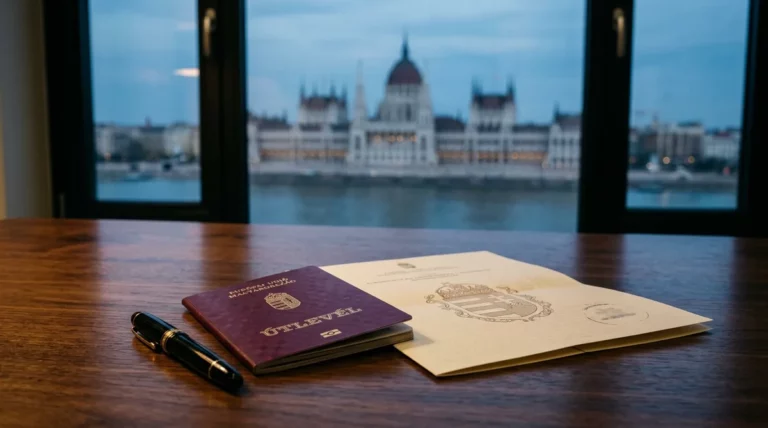
The Hungary citizenship scandal broke wide open this week, with the country’s new government accusing officials from the Orban era of quietly selling European Union passports for cash. Most of the buyers, the ministry says, were Canadians with no Hungarian roots and none of the ties the law normally demands.
BUDAPEST, Hungary · 18 June 2026
Deputy foreign minister György László Velkey laid out the allegations on June 16, describing a discretionary naturalization route that he says was turned into a paid product. The accusations target the administration of Viktor Orban, voted out at the April 2026 election and replaced by Peter Magyar’s Tisza government. Fidesz, Orban’s party, rejects the claims and says everything was done by the book.
Here’s why this matters to anyone chasing a second passport. When citizenship comes through a backroom favour instead of a transparent statute, it becomes a liability a future government can rip up. That is the real story underneath the headlines.
Put your assets beyond reach in 57 jurisdictions.
Pick where you want your company. We handle the filing, the registered agent, and the bank introduction. From US$1,290, done in days, not months.
- Charging-order protection in jurisdictions courts can't pierce
- Zero tax on foreign income in 30+ territories
- Banking options available
- Fixed price. No surprise fees at closing
How the Hungary Citizenship Scandal Unfolded
At the heart of the Hungary citizenship scandal sits a phrase most people have never heard: allamerdekbol torteno honositas, or naturalization in the national interest. Under Act LV of 1993, the Hungarian president can grant citizenship on a minister’s submission, skipping the usual residence and language conditions. It was built for genuinely exceptional cases. According to Velkey, it became a price list.
The numbers he put forward are blunt. Intermediary fees ran between 30,000 and 50,000 Canadian dollars, roughly 22,000 to 36,000 US dollars per applicant, a figure he traced to the ministry’s internal review rather than a published tariff. Some applicants, he said, turned up at consulates barely aware of what they were applying for, while others treated their new citizenship as a premium service. No buyers have been named, and the estimates rest on his account.
Let’s be blunt about what is established here. These are allegations from a new government auditing its predecessor, not findings from a court, and Fidesz says the previous administration followed the law at every step. That denial belongs in the story. Still, the mechanism is real, and it is exactly the kind of discretionary second citizenship shortcut that makes transparency-minded jurisdictions nervous.
The Canadian Firm at the Center of the Claims
The most pointed allegation involves a Canadian private company under Hungarian ownership, Hungarian Citizenship Consulting. Velkey says it managed applicants for a fee, and that its founders included an official responsible for the state naturalization programs alongside a diaspora leader who issued the very recommendation letters Hungarian missions relied on. If accurate, that is a textbook conflict of interest.
Velkey went further, alleging that consulates accepted these files on the strength of support letters from then deputy prime minister Zsolt Semjen, overriding warnings from career diplomats who had flagged the cases as irregular. The applications, he said, moved through the foreign ministry then run by Peter Szijjarto.
From 1,500 Diplomatic Passports to Revocation
The citizenship claims are one thread of a wider audit, and the diplomatic passport numbers are where it started. Velkey says nearly 1,500 diplomatic passports were issued at Szijjarto’s discretion, against one or two hundred in earlier cycles. New foreign minister Anita Orban has proposed withdrawing 943 of them from people who are not diplomats.
Who got them? By Velkey’s account, sports officials, friends, second and third-tier politicians and their relatives, plus foreigners tied to the former government through business. He called that a serious national security risk. The numbers don’t lie about the scale, even before you weigh the intent.
| What the audit alleges | Figure cited by the ministry |
|---|---|
| Diplomatic passports issued under Szijjarto | Nearly 1,500 |
| Diplomatic passports proposed for revocation | 943 |
| Typical earlier-cycle issuance | 100 to 200 |
| Intermediary fee per citizenship applicant | CAD 30,000 to 50,000 (about USD 22,000 to 36,000) |
Hungarian law lets the president revoke citizenship obtained by fraud, again on a ministerial submission. Velkey says the ministry is weighing whether the disputed grants qualify, and he expects the Canadian files are not the last of it.
What the Hungary Citizenship Scandal Means for Your Second Passport
This story does not land in a vacuum. The European Union has spent years hardening its stance against the sale of member-state citizenship, and the European Court of Justice struck down Malta’s citizenship-by-investment program in April 2025. A homegrown cash-for-passport row inside an EU member is exactly the ammunition Brussels uses to tighten the screws on every program, the legitimate ones included.
Hungary has been here before, in a softer form. Since 2010 it has naturalized more than a million people of Hungarian descent abroad, many of whom never lived in the country. That mass program drew fraud worries, and in 2022 the United States curbed visa-waiver access for Hungarian citizens born outside the country. Reputation, once dented, is expensive to rebuild.
The takeaway for anyone building a Plan B is not to panic about EU passports. It is to be picky about how you get one. A citizenship earned through a clear, statutory route with a genuine link to the country is durable. A grant pushed through a discretionary backdoor is a revocable liability dressed up as an asset, and citizenship can be revoked when fraud is in play.
How do you get a Hungarian passport?
You get a Hungarian passport by becoming a Hungarian citizen first, and the cleanest route for most foreigners is simplified naturalisation under Section 4(3) of Act LV of 1993. You need an ancestor who was a Hungarian citizen (or proof of Hungarian origin), a clean criminal record and working Hungarian. You don’t have to live in Hungary.
This is where people get burned. The consulate in New York expects you to hand in the file yourself and answer the officer’s questions in Hungarian, and no exemption covers weak language skills. As of October 2026, consulates quote roughly 6 to 12 months to a decision. Then comes an oath, which you must take within a year of the summons.
No Hungarian ancestry? Ordinary naturalisation asks for eight years’ continuous residence, enough money to live on and a pass in a basic civics test taken in Hungarian. Three years of marriage to a Hungarian citizen cuts the residence period to three. The Guest Investor Program gives a residence permit of up to 10 years for a EUR 250,000 real estate fund stake or a EUR 1 million university donation. That’s residency only, and the Citizenship Act gives investors no shortcut.
After the oath, you book an in-person passport appointment with your naturalisation document. Anyone over 12 attends for fingerprints. Our guide to Hungarian citizenship by descent covers the paperwork step by step.
What is the Hungary citizenship scandal about?
What is naturalization in the national interest?
Could the disputed Hungarian citizenships be revoked?
Does this affect legitimate EU citizenship and golden visa programs?
Is a Hungarian passport still worth holding?
The lesson out of Budapest is older than this news cycle. A passport is only as strong as the process that granted it. If you want a second citizenship that holds up when governments change, read our breakdown of dual citizenship pros and cons and why Malta’s program ran into trouble before you commit a cent.
Sources and References
- Budapest Business Journal, Ministry Uncovered Abuse of Hungarian Citizenship in Canada
- Budapest Business Journal, Hungary’s Tisza Gov’t Planning to Revoke Nearly 1,000 Fidesz-era Diplomatic Passports
- Court of Justice of the European Union, Judgment in Case C-181/23, Commission v Malta (investor citizenship)
- European Commission, Investor Citizenship Schemes: Commission Position
- Euronews, Coverage of Hungary’s foreign ministry transition
- National Legislation Database (Hungary), Act LV of 1993 on Hungarian Citizenship
- Consulate General of Hungary in Toronto, Simplified Hungarian Naturalization
- Consulate General of Hungary in New York, Simplified Naturalization
- National Directorate-General for Aliens Policing, Residence Permit for Guest Investor
- Consulate General of Hungary in Los Angeles, Conditions for Issuing a Hungarian Passport