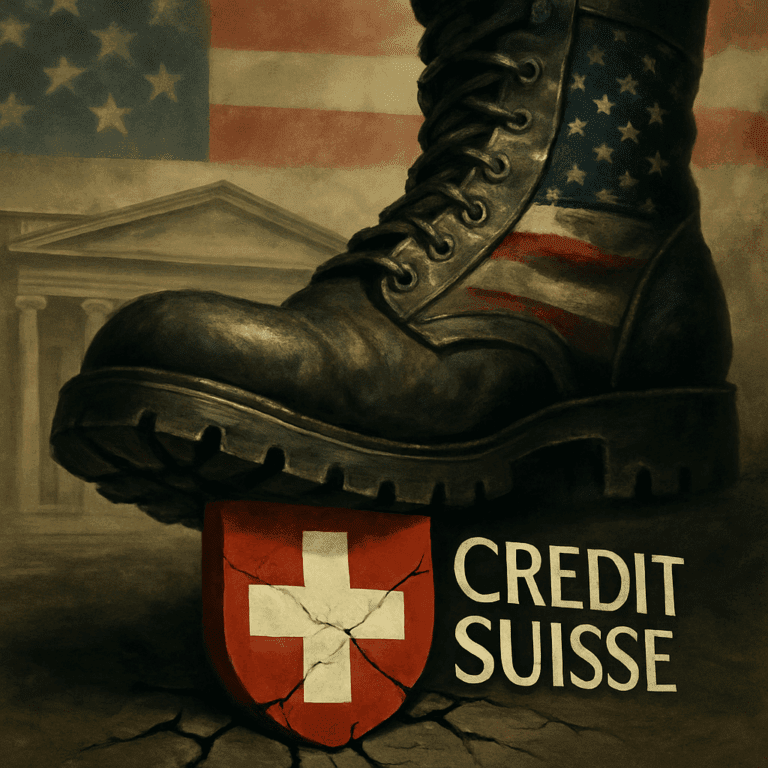
The Latest Government Shakedown
The leviathan state has struck again. In what can only be described as another brazen attack on financial privacy and property rights, the U.S. Department of Justice has extracted a $511 million settlement from Credit Suisse for allegedly helping Americans “evade” taxes. This settlement, announced on May 5, 2025, represents yet another chapter in the government’s relentless crusade against Americans who dare to seek financial refuge beyond the watchful eye of the tax collector.
Let us be clear about what has happened here. Credit Suisse, now owned by UBS following a government-engineered takeover in 2023, has been forced to plead guilty to “tax crimes” and pay a massive fine for the supposed sin of providing banking services to American citizens. The DOJ claims Credit Suisse helped U.S. customers “conceal their ownership and control of assets and funds” between January 2010 and July 2021, allegedly violating a 2014 plea agreement where the bank had previously paid $2.6 billion to U.S. authorities.
The State’s Deceptive Narrative
The state’s narrative is predictable: wealthy Americans were “hiding” money offshore to “evade” taxes, and the Swiss bank was their willing accomplice. But this framing deliberately obscures the fundamental issue at stake – the right of individuals to protect their legitimately earned wealth from confiscatory taxation and government surveillance.
What the bureaucrats at the Treasury Department and their enforcement arm at the DOJ call “tax evasion,” I call self-defense. When the state claims ownership over 40% or more of your income and demands to know every detail of your financial life, seeking privacy becomes not just reasonable but necessary. The government has no inherent right to this information or this wealth – it simply has the guns and prisons to enforce its demands.
The Settlement Details
According to the settlement details, Credit Suisse admitted to conspiring with American clients to conceal over $4 billion in at least 475 undeclared accounts in Switzerland and more than $2 billion in undeclared U.S. assets booked in Singapore. The bank’s alleged misdeeds included creating fake donation documents and misrepresenting account holders – actions that would be unnecessary in a truly free society where financial privacy was respected as a fundamental right.
The settlement includes $371.9 million tied to Swiss-based accounts and $138.7 million relating to Singapore operations. This is merely the latest shakedown in a long history of the U.S. government’s assault on foreign financial institutions that dare to serve American clients without becoming unpaid IRS informants.
The Hypocrisy of “Tax Fairness”
What’s particularly telling is that this attack comes from an administration that constantly preaches about “tax fairness” while ensuring that the truly wealthy and connected can navigate the labyrinthine tax code through armies of lawyers and accountants. Meanwhile, ordinary Americans seeking basic financial privacy are branded as criminals.
This case exemplifies the state’s two-pronged strategy: first, criminalize normal financial behavior; then use the threat of prosecution to force foreign institutions to become extensions of the U.S. surveillance apparatus. The result is a de facto system of capital controls that doesn’t officially exist on paper but functions effectively in practice.
FATCA: The Global Tax Dragnet
Consider the broader context. Since the passage of the Foreign Account Tax Compliance Act (FATCA) in 2010, the U.S. government has imposed an unprecedented global tax reporting regime on foreign financial institutions. Any bank anywhere in the world with American clients must report detailed account information directly to the IRS or face crippling penalties. The compliance costs are so enormous, and the potential penalties so severe, that many foreign banks have simply chosen to refuse service to American citizens altogether.
This is the soft capital control regime that now ensnares Americans: you are technically “free” to bank overseas, but good luck finding a foreign institution willing to accept you as a client. The government doesn’t need to formally prohibit offshore accounts when it can simply make servicing them too risky and expensive for foreign banks.
The Message to Foreign Banks
The Credit Suisse case reveals the iron fist inside this velvet glove. Even after paying billions in earlier settlements and promising to comply with U.S. demands, the bank found itself targeted again. The message to other financial institutions is clear: no matter how much you cooperate, you’re never safe from U.S. prosecution if you serve American clients.
What’s particularly galling about this case is that it involves a bank that no longer exists as an independent entity. Credit Suisse was essentially forced into UBS’s arms in 2023 after a crisis that was partly precipitated by regulatory pressures. Now UBS, which had nothing to do with the alleged misconduct, must pay for the sins of its absorbed competitor. This is how the state operates – creating problems through regulation, then using those problems to justify more regulation and extraction.
The Financial Berlin Wall
The victims here are not just wealthy Americans seeking financial privacy. The real victims are all Americans, who now face a de facto financial Berlin Wall. Unlike citizens of virtually every other country, Americans are taxed on their worldwide income regardless of where they live. Combined with FATCA reporting requirements and the threat of prosecution hanging over any foreign bank that serves them, Americans face what amounts to a financial prison.
Foreign banks increasingly refuse to open accounts for American citizens or residents, not because of any inherent risk in serving Americans, but because of the regulatory burden imposed by the U.S. government. This is the definition of soft capital controls – you don’t explicitly prohibit citizens from moving money abroad; you just make it practically impossible for them to do so.
The Moral Case for Financial Privacy
The state’s defenders will claim this is all necessary to prevent “tax evasion.” But this argument presupposes that the government has a legitimate claim to whatever portion of your wealth it decides to take. It doesn’t. Taxation is theft, dressed up in the language of “social obligation” and enforced at gunpoint. When individuals attempt to protect their property from this theft, they are exercising a natural right to self-defense, not committing a crime.
Moreover, the hypocrisy is stunning. The same U.S. government that hounds Americans for having offshore accounts has created the world’s largest tax haven for wealthy foreigners in states like Delaware, Nevada, and South Dakota. Foreign billionaires can park assets in opaque U.S. structures with minimal reporting, while American citizens face a draconian reporting regime for even modest foreign accounts.
Control, Not Justice
The Credit Suisse settlement is not about “tax justice” – it’s about control. The state cannot tolerate financial privacy because privacy limits power. Every dollar held beyond the government’s immediate reach is a dollar that cannot be inflated away, confiscated, or monitored. Financial privacy is essential to personal liberty, which is precisely why the state is so determined to eliminate it.
The Path Forward
What can be done? In the short term, Americans must understand that they live under an unacknowledged system of financial surveillance and soft capital controls. The freedom to move and hold assets internationally – a freedom taken for granted by citizens of most developed nations – has been severely curtailed for Americans through regulatory fiat rather than explicit legislation.
In the longer term, technological innovations like cryptocurrency offer some hope for restoring financial privacy and freedom of movement. But make no mistake – the state will fight these innovations tooth and nail, using the same tactics of criminalization and regulatory strangulation that it has deployed against traditional financial privacy.
A Wake-Up Call
The Credit Suisse case should serve as a wake-up call. The U.S. government’s war on financial privacy is not about catching “tax cheats” – it’s about ensuring that no wealth escapes the grasp of the state. Until Americans recognize this assault on their fundamental rights and demand change, the financial Berlin Wall will only grow higher and more impenetrable.
The FATCA regime, combined with aggressive prosecution of foreign banks, has created a system where Americans are effectively trapped in the U.S. financial system. This is not freedom – it’s a gilded cage, where your movements are tracked, your assets are monitored, and your financial choices are severely constrained by the ever-present threat of state violence.
Soft Exchange Controls: The Uncomfortable Truth
It’s time to call this what it is: soft exchange controls implemented through regulatory terrorism. The state doesn’t need to formally prohibit capital movement when it can simply make foreign banking so legally hazardous that few institutions will serve Americans. The result is the same – a population whose financial choices are constrained and whose wealth is perpetually vulnerable to confiscation.
Freedom requires financial privacy. Until we reclaim this fundamental right, all our other liberties remain precarious and contingent on the whims of the state. The Credit Suisse settlement is not just about a bank – it’s about the cage being built around every American with assets to protect.