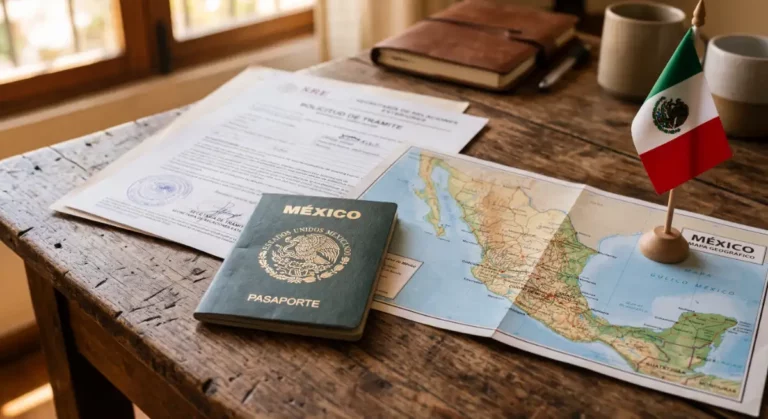
Mexico citizenship is one of the most underrated second nationality plays on the planet right now. While everyone chases Caribbean CBI programs at $100,000+ or fights through European bureaucracy for three generations of apostilled documents, Mexico quietly offers a path to a second passport that costs under $500 in government fees, grants visa-free access to 157 countries, and lets you hold dual nationality without giving up your current passport. The numbers don’t lie. And yet most people overlook it completely.
That is about to change. Between the growing wave of Americans relocating south of the border, tight property ownership rules that punish foreigners in coastal zones, and a Mexican passport that now ranks 21st globally on the Henley Passport Index, the case for Mexico citizenship has never been stronger. Whether you qualify through ancestry, marriage, or plain old residency, this guide breaks down every pathway, every cost, every document, and every mistake that trips people up.
Travel power is only half the story. Visa-free access tells you where Mexico’s passport can take you, not how free the country behind it leaves you. The Liberty Mundo Passport Freedom Index re-ranks 197 passports on tax, extradition protection, conscription and civil liberties, not just visa-free travel, so you can see where Mexico really lands once freedom is in the mix.
No fluff. No filler. Just the information you actually need to get it done.
Why Mexico Citizenship Deserves Your Attention in 2026
Mexico is not some obscure jurisdiction that only passport nerds talk about. It is the 13th largest economy on earth, a member of the OECD and the G20, and has free trade agreements with over 50 countries. The Mexican passport punches well above its weight, providing visa-free access to the entire Schengen Area, the United Kingdom, Japan, South Korea, Canada, and 157 destinations in total.
But the passport is only part of the story.
Mexico citizenship removes the single biggest headache foreigners face when buying property along the coast or near international borders. Under Article 27 of the Mexican Constitution, foreigners cannot directly own land within 50 kilometres of the coastline or 100 kilometres of an international border. This “restricted zone” covers some of the most desirable real estate in the country: Cancun, Playa del Carmen, Los Cabos, Puerto Vallarta, Tulum. As a foreigner, you are forced to buy through a fideicomiso (bank trust) that costs $500 to $2,000 annually in maintenance fees. Become a citizen, and you can hold the title directly in your own name. That ship has sailed for the trust fees.
Mexico also allows full dual citizenship. The Mexican Constitution was amended in 1998 to permit dual nationality, meaning you will never be forced to renounce your American, Canadian, British, or any other passport to become Mexican. Compare that to countries like Singapore, Japan, or Austria that still demand you pick one.
Four Pathways to Mexico Citizenship
Mexico recognizes four distinct routes to nationality. Your eligibility, timeline, and costs depend entirely on which one you qualify for. Some people can claim Mexican nationality in a matter of months with zero residency. Others need to live in the country for five years first. Knowing which pathway fits your situation saves you years of wasted effort.
| Pathway | Residency Required | Timeline | Government Cost | Best For |
|---|---|---|---|---|
| Birth (Jus Soli) | None | Immediate | Free (registration) | Anyone born on Mexican soil |
| Descent (Jus Sanguinis) | None | 3 to 12 months | Free (registration) | Children/grandchildren of Mexican nationals |
| Marriage | 2 years | 2 to 3 years total | ~$500 USD | Spouses of Mexican citizens |
| Naturalization (Residency) | 5 years (or 2 years accelerated) | 3 to 6 years total | ~$500 USD | Long-term residents and expats |
Mexico Citizenship by Descent: The Fastest Route Most People Miss
If one of your parents was born in Mexico, or was a Mexican citizen at the time of your birth, you already have a claim to Mexico citizenship. Full stop. You do not need to live in Mexico. You do not need to pass a language test. You do not need to pay naturalization fees. The registration process is free, and you can complete it at any Mexican consulate worldwide.
Here’s the kicker. This extends to grandchildren too, but with a catch. Mexico does not grant nationality directly through grandparents. Instead, you need to build the chain link by link. Your parent must first be registered as a Mexican citizen (even posthumously), and then you register through your newly recognized Mexican parent. It sounds like a bureaucratic headache, and it can be. But the payoff is a second passport for under $200 in document costs.
The legal basis sits in the Mexican Constitution, Article 30, which defines Mexican nationality by birth as extending to anyone born abroad to a Mexican father or mother. The Secretaría de Relaciones Exteriores (SRE) handles the registration process, and applications can be submitted at any of the 50+ Mexican consulates across the United States.
Documents You Need for the Descent Pathway
- Your original birth certificate (apostilled and translated into Spanish by a certified translator)
- Your Mexican parent’s birth certificate (original, issued by the Mexican Civil Registry)
- Your Mexican parent’s proof of nationality (passport, voter ID/INE, or naturalization certificate)
- Valid government-issued photo ID (passport or driver’s licence)
- Proof of address (utility bill or bank statement, recent)
- If claiming through a grandparent: your parent’s registration as a Mexican national must be completed first
- If your parent is deceased: death certificate plus all of the above
Mexico Citizenship Through Marriage
Married to a Mexican citizen? Your path is cut from five years to two. You still need to hold legal residency (temporary or permanent) and live in Mexico for at least two consecutive years. But that is a significant shortcut compared to the standard naturalization track.
The SRE requires proof of marriage, which needs to be a Mexican marriage certificate or a foreign certificate that has been apostilled and translated. You also need to demonstrate continuous physical presence in Mexico, specifically at least 18 months within the 24 months prior to your application. Taking a three-month vacation back home might reset the clock, so plan carefully.
One thing that catches people off guard: you still need to pass the naturalization exam. Being married to a Mexican does not exempt you from the history, culture, and Spanish language components. More on that exam in the sections below.
Mexico Citizenship by Naturalization: The Standard 5-Year Route
For most expats and long-term residents, Mexico citizenship through naturalization is the main pathway. The requirements are straightforward on paper, but the execution trips people up constantly.
You need five years of continuous legal residency in Mexico. This can include time spent on both temporary resident (residente temporal) and permanent resident (residente permanente) visas. The clock starts from the date your first residency card was issued, not from when you entered the country on a tourist visa.
A two-year accelerated track exists for applicants who meet specific criteria. You qualify for the shortened timeline if you are married to a Mexican national, if you have Mexican-born children, if you were born in a Latin American country, or if you are a citizen of Spain or Portugal. These categories reflect Mexico’s historical and cultural ties to the Iberian Peninsula and its Latin American neighbours.
Physical Presence Requirement
This is where people slip up. Holding a residency card is not enough. You must demonstrate physical presence in Mexico for at least 18 of the 24 months immediately before your application date. The SRE checks immigration entry and exit records, so do not assume nobody is tracking your movements. If you spent seven months abroad in the past two years, your application will be denied.
The Naturalization Exam: History, Culture, and Spanish
Every applicant going through naturalization or marriage must pass an exam administered by the Instituto Matías Romero, which operates under the SRE. The test has two components.
The history and culture exam consists of 10 multiple-choice questions covering pre-Hispanic civilizations (Aztec, Maya, Olmec), the Spanish conquest, Mexican independence, the Revolution of 1910, modern political history, geography, famous Mexican figures, and the Constitution. You need 8 out of 10 correct to pass. Before 2018, the SRE published an official list of 100 potential questions. That list was scrapped, and the exam became significantly harder.
The Spanish language exam tests your ability to read, write, and speak Spanish at a conversational level. You need 5 out of 6 correct. Let’s be blunt: this is where most applicants fail. If your Spanish is rusty or limited to ordering tacos, start studying now. The exam is not a formality.
Full Cost Breakdown for Mexico Citizenship in 2026
One of the biggest advantages of Mexico citizenship is how affordable it is compared to Caribbean CBI programs or European golden visas. The government fees are modest. The real costs come from document preparation, translation, and legal assistance if you need it.
| Cost Item | Approximate USD | Notes |
|---|---|---|
| Naturalization application fee (SRE) | $440 to $500 | 8,755 MXN as of January 2025, adjusted annually |
| Descent registration | Free | No government fee for birth registration at consulate |
| Birth certificate apostille | $10 to $50 | Varies by US state |
| Certified Spanish translation | $50 to $150 per document | Must be done by a perito traductor (certified translator) in Mexico |
| Mexican birth certificate copies | $5 to $15 each | Obtained from the Civil Registry (Registro Civil) |
| Mexican passport (after naturalization) | $70 to $170 | Depends on validity period: 1, 3, 6, or 10 years |
| INE voter ID card | Free | Issued by INE (Instituto Nacional Electoral) after naturalization |
| Immigration lawyer (optional) | $1,500 to $5,000 | Recommended for complex descent claims or denied applications |
Bottom line: if you qualify through descent, you can become a Mexican national for under $300 in total out-of-pocket costs. Naturalization runs $500 to $700 in government fees and documents, plus whatever you spent on five years of living in the country. Compare that to $100,000+ for a St. Kitts or Antigua CBI passport, and the value becomes obvious.
Put your assets beyond reach in 57 jurisdictions.
Pick where you want your company. We handle the filing, the registered agent, and the bank introduction. From US$1,290, done in days, not months.
- Charging-order protection in jurisdictions courts can't pierce
- Zero tax on foreign income in 30+ territories
- Banking options available
- Fixed price. No surprise fees at closing
Tax Implications of Becoming a Mexican Citizen
This is where most guides fall short. They cover the passport benefits and skip the tax picture entirely. That is a dangerous omission, because making assumptions about Mexican taxes can cost you a fortune.
Mexico citizenship by itself does not trigger any tax obligations. Mexico taxes based on residency, not nationality. This is a critical distinction. If you hold a Mexican passport but live and pay taxes in another country, the Mexican government does not come after your worldwide income. You are only taxed on Mexican-source income (rental income from property in Mexico, local employment, etc.).
The picture changes the moment you become a Mexican tax resident. You are considered a tax resident if you spend more than 183 days in the country during a calendar year, or if your “centre of vital interests” is there (your primary home, spouse, or principal source of income). As a tax resident, Mexico applies a progressive scale that tops out at 35% for income above approximately $500,000 MXN (~$25,000 USD).
For Americans, this creates a dual filing obligation. The United States taxes its citizens on worldwide income regardless of where they live. If you are both a US citizen and a Mexican tax resident, you will file returns in both countries. The US-Mexico tax treaty and foreign tax credits generally prevent double taxation, but the compliance burden is real. FBAR (FinCEN Form 114) and FATCA (Form 8938) reporting requirements apply to any financial accounts you hold in Mexico.
Property Rights: Why Citizenship Changes Everything for Mexican Real Estate
The restricted zone rule under Article 27 of the Mexican Constitution is a wake-up call for anyone buying coastal property as a foreigner. Within 50 kilometres of any coastline and 100 kilometres of any international border, non-citizens cannot hold direct title to residential real estate. Period.
The workaround is a fideicomiso, a bank trust where a Mexican bank holds legal title on your behalf. You retain full beneficial rights (you can live in the property, rent it, sell it, bequeath it), but the bank charges annual fees of $500 to $2,000 for the privilege. The trust runs for 50 years and is renewable, but the costs add up. Over 20 years, you might spend $10,000 to $40,000 in trust fees alone.
Secure Mexico citizenship, and the entire restricted zone framework stops applying to you. You can hold title directly, cancel your fideicomiso, and never pay another peso in trust maintenance. For anyone who owns or plans to own property in Riviera Maya, Puerto Vallarta, Los Cabos, Mazatlán, or any border city, naturalization pays for itself through trust fee savings alone.
How to Get Mexico Citizenship by Naturalization: Step by Step
Step 1: Obtain a Mexican residency visa. Apply for a temporary resident visa (visa de residente temporal) at a Mexican consulate in your home country. You will need to demonstrate sufficient financial means: either monthly income of approximately $4,500 USD or savings of $75,000 USD over the past 12 months. Alternatively, you can qualify through employment, family ties, or property ownership valued at roughly $220,000 USD. The consulate issues a visa sticker, and you complete the immigration process at the Instituto Nacional de Migración (INM) office once you arrive.
Step 2: Maintain continuous legal residency for 5 years (or 2 years if eligible for the accelerated track). Renew your temporary residency annually for up to 4 years, then convert to permanent residency. You can also enter directly on a permanent resident visa if you qualify. The critical requirement is maintaining at least 18 months of physical presence within every 24-month rolling window. Keep copies of every entry/exit stamp and residency card renewal. The SRE will check these records.
Step 3: Prepare your naturalization documents. Gather your current residency card, valid foreign passport (with at least 6 months validity), two passport-sized colour photographs, original birth certificate (apostilled and translated by a certified Mexican translator), proof of address in Mexico, and the application fee payment receipt. If applying through marriage, include your Mexican marriage certificate. All foreign documents must be apostilled under the Hague Convention and translated by a perito traductor authorized by the Mexican judiciary.
Step 4: Submit your application at the SRE office. File your naturalization application (solicitud de carta de naturalización) at the Secretaría de Relaciones Exteriores office nearest to your Mexican address. Pay the application fee of 8,755 MXN (approximately $500 USD). You will receive a confirmation and a date for your naturalization exam.
Step 5: Pass the naturalization exam. Attend your exam at the scheduled date. The test covers Mexican history, culture, and geography (10 questions, need 8 correct) and Spanish language proficiency (6 questions, need 5 correct). Study resources are available through the Quiero Ser Mexicano website and the Instituto Matías Romero study materials. Failing is not the end. You can retake it, though you may wait several months for the next available date.
Step 6: Attend your interview and receive your naturalization certificate. After passing the exam, you attend an interview at the SRE where officials confirm your intent to become a Mexican citizen. Once approved, you receive your carta de naturalización (naturalization certificate). The entire process from application to certificate takes approximately 6 to 12 months after you file.
Step 7: Apply for your Mexican passport and INE voter card. With your naturalization certificate in hand, apply for a Mexican passport at any SRE office and register for your INE (Instituto Nacional Electoral) voter identification card. The INE card functions as the primary national ID and is essential for banking, property transactions, and daily life. Your Mexican passport is available in 1-year, 3-year, 6-year, or 10-year validity options.
Common Mistakes That Delay or Derail Applications
After working with hundreds of people pursuing second passports and nationality options, the same mistakes keep showing up. Avoiding these will save you months of frustration and potentially thousands of dollars in wasted legal fees.
Mistake 1: Leaving Mexico too often. The 18-out-of-24-months physical presence rule is not a suggestion. The SRE cross-references your passport stamps with INM records. Even short trips add up. If you are at month 40 of your residency and planning a two-month trip home for the holidays, do the maths first. One extra week abroad could push your application back by a full year.
Mistake 2: Ignoring the ancestry route. Absolute lunacy. Thousands of Americans with Mexican parents or grandparents sit through five years of residency when they could have claimed nationality by descent in months for free. Before committing to the naturalization track, check your family tree. Ask your parents and grandparents where they were born. Dig out old birth certificates. The effort is worth it.
Mistake 3: Using tourist visa time toward the residency requirement. Time spent on a tourist permit (FMM) does not count toward the five-year residency requirement. Not even a single day. The clock starts only when your formal residency card is issued. People who spend a year “testing out” Mexico on tourist runs before applying for residency have lost a year.
Mistake 4: Submitting untranslated or improperly apostilled documents. Every foreign document must carry a Hague Apostille from the issuing country and be translated by a perito traductor certified by a Mexican state court. Using an uncertified translator, even a fluent bilingual friend, will get your application bounced. One mistranslated birth certificate can set you back 18 months.
Mistake 5: Underestimating the naturalization exam. The old 100-question study guide from the SRE is gone. Since 2018, the exam draws from a much broader pool covering everything from Olmec archaeology to the names of all 32 Mexican states and their capitals. If you cannot name the three branches of the federal government or explain the significance of September 16th, you are not ready.
Mexico Citizenship vs. Other Latin American Options
Mexico is not the only country in the region offering a path to a second nationality. How does it stack up against the most popular alternatives? The comparison matters because your time and money are finite, and choosing the wrong jurisdiction could mean years of regret.
| Country | Residency to Citizenship | Dual Citizenship | Passport Visa-Free Score | Cost | Language Requirement |
|---|---|---|---|---|---|
| Mexico | 5 years (2 accelerated) | Yes | 157 countries | ~$500 USD | Yes (Spanish exam) |
| Paraguay | 3 years | Yes | 146 countries | ~$300 USD | No formal exam |
| Panama | 5 years | Yes | 143 countries | ~$800 USD | Yes (Spanish exam) |
| Colombia | 5 years | Yes | 133 countries | ~$250 USD | No formal exam |
| Brazil | 4 years (1 year accelerated) | Yes | 170 countries | ~$200 USD | Yes (Portuguese exam) |
| Argentina | 2 years | Yes | 171 countries | ~$100 USD | Yes (Spanish exam) |
Mexico stands out for its passport strength (only Brazil and Argentina beat it regionally) combined with practical benefits like asset protection, direct coastal property ownership, and proximity to the United States. Argentina offers a faster timeline at two years, but the country’s economic volatility and capital controls make it a harder place to actually live and do business. Paraguay is fast and cheap, but its passport opens fewer doors.
For someone already living in Mexico or planning to relocate, the maths is dead simple. Five years of residency in a country you are choosing to live in anyway, followed by $500 in fees and an exam. The ROI on the passport alone, measured in trust fee savings and travel flexibility, makes it one of the best deals in the Americas.
The Mexican Passport: What You Get After Naturalization
Once you complete the process, you become eligible for a Mexican passport issued by the SRE. As of 2026, it ranks 21st on the Henley Passport Index, granting visa-free or visa-on-arrival access to 157 countries and territories.
Notable visa-free destinations include the entire European Schengen Area (90 days within 180 days), the United Kingdom (6 months), Canada, Japan, South Korea, Singapore, the UAE, and virtually all of Latin America. For business travellers and digital nomads, this covers the vast majority of global economic hubs without requiring advance visa applications.
The passport is available in four validity tiers: 1 year, 3 years, 6 years, and 10 years. Costs range from approximately $70 to $170 USD depending on the validity period. First-time applicants should plan for a processing time of 4 to 6 weeks.
Rights Beyond the Passport
Citizenship opens doors that permanent residency cannot. As a Mexican national, you gain the right to vote in federal, state, and municipal elections. You can run for certain public offices (with some restrictions for naturalized citizens under the Constitution). You can work in any profession without needing a work permit. You gain access to the IMSS public healthcare system and ISSSTE if employed in the public sector. And you eliminate the risk of deportation or visa revocation that permanent residents technically still face.
Mexico Citizenship for Americans: Special Considerations
Americans make up the single largest group of foreigners pursuing Mexico citizenship, and they face a unique set of considerations that other nationalities do not.
The US Embassy in Mexico officially recognizes that US citizens may hold dual nationality. Acquiring Mexico citizenship does not affect your American nationality in any way. You will not lose your US passport, your voting rights, or your Social Security benefits.
The tax compliance burden is real, though. As a US citizen living in Mexico, you must file a federal tax return every year reporting your worldwide income, regardless of where that income was earned. If you also become a Mexican tax resident (183+ days per year), you file in both countries. The US-Mexico tax treaty and the Foreign Tax Credit (Form 1116) generally prevent double taxation, but you need a tax professional who understands both systems. This is not a DIY situation.
FBAR reporting (FinCEN Form 114) applies if your aggregate Mexican bank accounts exceed $10,000 at any point during the year. FATCA reporting (Form 8938) kicks in at higher thresholds. Penalties for non-compliance are severe, starting at $10,000 per unreported account per year.
Maintaining Your Mexican Nationality After Naturalization
Unlike some countries where nationality is essentially permanent once granted, Mexico has a quirk that naturalized citizens need to know about. Under Article 37 of the Constitution, naturalized Mexicans can lose their nationality if they reside continuously abroad for five years. Citizens by birth and by descent are not subject to this restriction.
In practice, this means naturalized citizens should maintain some connection to Mexico, whether through occasional visits, property ownership, or keeping their Mexican address active. The five-year clock resets every time you enter the country, so even a brief annual visit keeps your status intact.
The clock is ticking for anyone who naturalizes and immediately moves away. If you plan to get Mexico citizenship but live elsewhere long-term, factor this maintenance requirement into your decision. A quick trip to Cancun once a year is a small price to pay for keeping a passport that opens 157 countries.
Frequently Asked Questions About Mexico Citizenship
How long does it take to become a Mexican citizen?
Does Mexico allow dual citizenship?
Can I get Mexico citizenship through my grandparents?
How much does Mexican naturalization cost in 2026?
Do I need to speak Spanish to become a Mexican citizen?
Can foreigners buy property in Mexico without citizenship?
Will I owe Mexican taxes after becoming a citizen?
What is the Mexican naturalization exam like?
Can I lose my Mexican nationality after being naturalized?
How many countries can I visit visa-free with a Mexican passport?
Is there a Mexican citizenship by investment program?
Where do I apply to become a Mexican citizen?
Final Thoughts on Becoming a Mexican Citizen
Mexico citizenship is quietly one of the best second passport options available. The costs are a fraction of what CBI programs charge. The passport grants access to 157 countries. Dual nationality is fully protected by the Constitution. And the practical benefits, from direct coastal property ownership to eliminated fideicomiso fees, deliver tangible financial value year after year.
Whether you are claiming nationality through Mexican parents or grandparents, marrying a Mexican citizen, or building toward naturalization through five years of residency, the process rewards preparation. Get your documents right. Study for the exam. Track your physical presence carefully. And if you have any doubts about which pathway applies to your situation, get professional guidance before you file.
Mexico is not going to stay under the radar forever. The growing expat wave, combined with tightening residency rules across Europe and rising CBI prices in the Caribbean, is pushing more people toward Latin American naturalization options every year. If you qualify, the smart move is to start now.
For a side-by-side comparison of Mexico against 50+ other citizenship pathways including costs, timelines, and back-door methods, the Second Passport Blueprint covers everything in one place. And for anyone looking at offshore company formation alongside their nationality plans, Tax Free Companies specializes in tax-efficient structures that complement a second passport.
Sources and References
- Government of Mexico, Political Constitution of the United Mexican States (Articles 27, 30, 37)
- Secretaría de Relaciones Exteriores (SRE), Mexican Nationality and Naturalization Services
- US Embassy Mexico, Dual Nationality Information for US Citizens
- Henley & Partners, Henley Passport Index 2026
- Internal Revenue Service (IRS), US-Mexico Tax Treaty Documents
- PwC, Mexico Individual Tax Summary: Taxes on Personal Income
- OECD, OECD Member Countries and Partners
- Instituto Matías Romero / Quiero Ser Mexicano, Mexican Citizenship Exam Preparation Resources