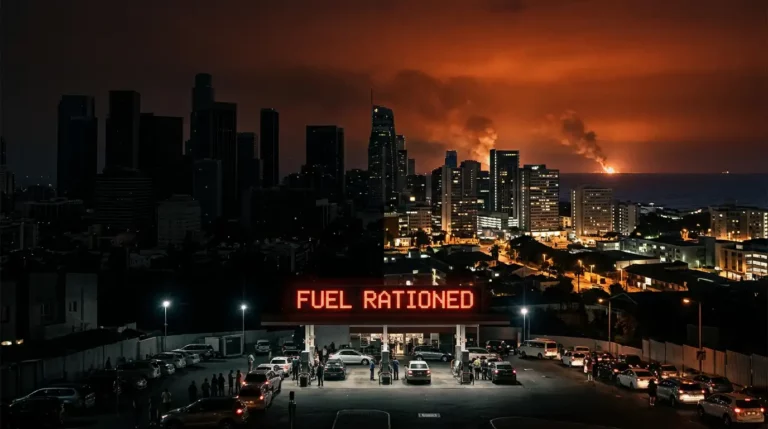
Energy lockdowns are no longer a conspiracy theory. They are happening right now, across multiple continents, and the governments imposing them are borrowing straight from the COVID playbook. Fuel rationing in Slovenia. Four-day work weeks in Pakistan. Schools shuttered in Bangladesh. Petrol pumps shut down entirely in Cambodia. And the crisis is barely a month old.
The trigger? A full-scale military conflict between the United States, Israel, and Iran that has effectively closed the Strait of Hormuz, the narrow waterway responsible for 20% of the world’s oil supply. Roughly 20 million barrels per day have vanished from global markets. Oil prices have blown past $120 per barrel and Wall Street analysts are whispering about $200. The International Energy Agency has called it the largest supply disruption in the history of global oil markets. Worse than 1973. Worse than 1979. Worse than anything.
And for anyone paying attention, the fuel rationing and restrictions rolling out across the developing world are just the opening act. The question is not whether energy lockdowns will spread to wealthier nations. The question is which countries will be hit hardest, which will weather the storm, and what you can do right now to make sure you are standing in the right place when the lights go out.
The countries safest from these restrictions are also the hardest to get into without the right residency or citizenship. The Second Passport Blueprint covers 50+ countries with step-by-step citizenship processes, back-door methods, and 12 months of updates so you can position yourself in an energy-secure nation before the next crisis wave hits.
Get the Second Passport BlueprintWhy Energy Lockdowns Are Inevitable (Not Just Possible)
People keep asking whether these restrictions will come to their country. Wrong question. The right question is how severe they will be.
The maths are brutal. Before the Strait of Hormuz closed, roughly 20 million barrels of oil passed through that 33-kilometre chokepoint every single day. That is one fifth of global petroleum consumption. The IEA coordinated the release of 400 million barrels from emergency strategic reserves, the largest release in its 52-year history, and it was not enough. Not even close. The supply gap is estimated at 8 million barrels per day and climbing. By mid-April, analysts expect it to double.
When supply drops that fast, prices spike. Brent crude has already blown past $120. Goldman Sachs is modelling scenarios at $170. Some analysts are not ruling out $200. At those prices, entire economies start to seize up. Transport costs explode. Food prices follow. Manufacturing grinds down. And governments, faced with angry populations and dwindling reserves, reach for the only lever they have left: demand destruction.
That is a polite way of saying they force people to use less energy. They ration fuel. They shorten work weeks. They close schools. They impose curfews on businesses. They restrict private vehicle access. They mandate remote work. Sound familiar? It should. The IEA’s own 10-point emergency plan, published on 20 March 2026, explicitly recommends that governments impose these measures “through regulations and mandates,” not as voluntary suggestions.
Bottom line: energy lockdowns are not a worst-case scenario. They are the official policy recommendation from the world’s most influential energy body.
The Strait of Hormuz: Why This Chokepoint Changes Everything
Every energy analyst worth their salary has war-gamed a Strait of Hormuz closure for decades. Now it has actually happened, and the reality is worse than the models predicted.
The strait sits between Iran and Oman, connecting the Persian Gulf to the Gulf of Oman and the open ocean beyond. At its narrowest point, it is just 33 kilometres wide, with shipping lanes only 3 kilometres across in each direction. Every day before the crisis, roughly 20 million barrels of oil and significant volumes of liquefied natural gas (LNG) flowed through this bottleneck. In 2024, 84% of all crude oil and 83% of all LNG transiting the strait went to Asian markets.
On 28 February 2026, joint US-Israeli military strikes hit Iran. Iran’s Islamic Revolutionary Guard Corps responded by declaring the strait closed to all shipping. Tanker traffic collapsed. Insurance premiums for vessels attempting the passage became prohibitive overnight. The effect was immediate and catastrophic.
The Dallas Federal Reserve estimates the closure will raise the average WTI oil price to $98 per barrel in Q2 2026 and lower global real GDP growth by 2.9 percentage points. That was the conservative estimate. Prices have already overshot those projections. The real damage is measured in countries scrambling to impose consumption restrictions before their reserves run dry.
Countries Facing the Worst Energy Lockdowns
Not every country is equally exposed. Geography, geology, energy policy decisions made decades ago, and strategic reserve levels are now separating nations into two camps: those that will ride this out and those that face genuine rationing with COVID-era restrictions on daily life.
The pain is concentrated in a handful of economies that made terrible bets on permanent global supply chains.
Japan: 95% Dependent and Running Out of Options
Japan scores the highest risk of any major economy from the Strait of Hormuz disruption, with a vulnerability score of 6.4 out of 10. The numbers explain why. Japan depends on imported fossil fuels for 87% of its total energy use. A staggering 95% of its crude oil imports originate from the Middle East, and nearly all of it passes through Hormuz. The country imports 1.6 million barrels per day through the strait.
One saving grace: Japan holds the largest strategic petroleum reserves of any IEA member at 230 days of supply. That buys time. But time is all it buys. A sustained closure would widen Japan’s trade deficit, weaken the yen, and tip the economy toward stagflation. Restrictions in Japan would likely take the form of industrial demand curtailment, reduced operating hours for businesses, and aggressive public transport mandates.
South Korea: 68% of Crude Through Hormuz
South Korea channels approximately 68% of its crude imports through the Strait of Hormuz, roughly 1.7 million barrels per day. Net oil imports represent 2.7% of GDP, one of the highest ratios among developed economies. Nomura has flagged South Korea as among the most vulnerable nations on the current account front.
South Korea has some strategic reserves, but its near-total dependence on imported energy leaves it with no domestic production to fall back on. The country faces severe fuel rationing if the crisis extends beyond three months. Already, Seoul is exploring number-plate rotation schemes and considering shortened operating hours for commercial buildings.
Australia: 30 Days From Disaster
Australia might be the most shocking entry on this list. A country sitting on 1.8 billion barrels of proven oil reserves, yet importing 80-90% of the oil it consumes. In the year 2000, Australia was largely self-sufficient. It operated eight refineries that supplied 98% of domestic petroleum consumption. Today? Domestic production covers just 5.6% of demand. Two refineries remain. The rest were shut down.
The numbers that should keep every Australian awake at night: 37 days of petrol reserves. 30 days or less of diesel and jet fuel. Those are the lowest stockpiles of any IEA member nation. Australia’s refined fuel comes primarily from Singapore and South Korea, both of which are themselves scrambling for supply. On 22 March, Australia’s Energy Minister confirmed that six tankers carrying refined products had been cancelled or deferred.
Australia went from energy self-sufficiency to energy dependency in a single generation. That is what happens when governments close refineries, discourage domestic production, and assume global supply chains will always function. Absolute lunacy, and Australians are about to pay the price with strict fuel rationing and consumption mandates.
| Country | Oil Import Dependence | % from Middle East / Hormuz | Strategic Reserves (Days) | Energy Lockdown Risk |
|---|---|---|---|---|
| Japan | 87% of total energy | 95% of crude | 230 days | High (buffered by reserves) |
| South Korea | ~95% of oil imported | 68% through Hormuz | ~90 days | Very High |
| Australia | 80-90% of oil imported | Indirect (via Singapore/Korea) | 30-37 days | Extreme |
| India | 88.5% of oil imported | 46-55% from Middle East | 10 days | Extreme |
| UK | 44% of energy imported | Low direct, high indirect | ~90 days | High |
| Pakistan | ~85% of oil imported | 99% of LNG from Gulf | Minimal | Already in lockdown |
| Bangladesh | Nearly all imported | 72% of LNG from Gulf | Minimal | Already in lockdown |
| Singapore | 97%+ imported | 90%+ from Middle East | ~90 days | Very High |
Australia has 30 days of diesel. India has 10 days of strategic reserves. If you are living in an energy-vulnerable country, the time to establish residency or citizenship in a safer jurisdiction was yesterday. A strategy call can map out your fastest route to an energy-secure nation based on your passport, budget, and timeline.
Book Your Strategy CallIndia: 10 Days of Strategic Reserves
India’s energy position is precarious and getting worse by the week. The country imports 88.5% of its crude oil. That figure has been climbing steadily, up from 83.8% in 2019. India’s strategic petroleum reserves cover a grand total of 10 days of supply. Ten. Japan has 230 days. India has 10.
The country diversified its oil sources in recent years, pulling 36% of imports from Russia in 2024 to reduce Middle Eastern dependence. Smart move. But the data from January 2026 shows Middle Eastern oil climbing back to 55% of India’s crude imports as Russian supply became more complicated. So India is now more exposed to the Hormuz closure than it was a year ago.
And the kicker: 53% of India’s LNG imports come from Qatar and the UAE, both of which ship through the strait. India consumes over 5 million barrels of oil per day and produces only about 600,000 domestically. The gap is enormous. The government has so far resisted declaring formal consumption restrictions, insisting fuel supplies remain sufficient. But with global oil at $120+ and climbing, and strategic reserves measured in single-digit days, the pressure to impose rationing will become overwhelming.
The United Kingdom: Sleepwalking Into an Energy Crisis
The UK is not as directly exposed to the Strait of Hormuz as Asian economies. Most British oil now comes from the US (37%) and Norway (31%), with 76% of gas imports arriving via Norwegian pipelines. That sounds reassuring until you examine the structural vulnerabilities.
First: 44% of UK energy was imported in 2024, up 4 percentage points from the previous year. That trend is accelerating, not reversing. North Sea production fell to 30.4 million tonnes in 2024, continuing a long-term decline. Net primary oil imports jumped 11.7% in a single year.
Second: the UK’s refining capacity has collapsed. The Grangemouth refinery closed in April 2025. The Lindsey refinery followed in July 2025. Four major refineries remain. The country that once refined its own fuel now imports 44% of its oil products.
Third: the UK sits at the end of a European energy market that is already in crisis. European gas storage hit just 30% capacity after a harsh 2025-2026 winter. Dutch TTF gas benchmarks have nearly doubled. The UK is competing with continental Europe for every molecule of imported gas, and there is not enough to go around.
The restrictions in the UK may not look like Pakistan’s four-day work weeks. They are more likely to resemble spiralling energy bills, rolling industrial demand curtailment, and government pressure on businesses to reduce consumption. The effect on ordinary people will be the same: less energy, higher costs, restricted activity.
Countries That Will Weather the Energy Lockdowns
Not every country is staring down the barrel of forced rationing. A handful of nations, through geological luck, strategic foresight, or aggressive energy policy, have positioned themselves to ride out even a prolonged Strait of Hormuz closure. If you have the mobility and foresight to position yourself in one of these jurisdictions, you will barely notice the crisis that is crippling the rest of the world.
United States: The World’s Largest Oil Producer
The US produces 13.6 million barrels of crude oil per day, an all-time record set in 2025 and expected to hold or increase in 2026. Natural gas production is equally dominant at 109 billion cubic feet per day, also a record. The country is a net energy exporter. It does not need the Strait of Hormuz for its own supply.
That does not mean Americans will be unaffected. Oil is a globally priced commodity. When Brent crude spikes, American gasoline prices spike too, regardless of domestic production levels. But the critical difference is this: the US will not face mandatory consumption restrictions. There will be no fuel rationing, no shortened work weeks, no school closures. The pain shows up at the pump and in electricity bills, not in government mandates restricting movement and economic activity.
For anyone with US residency or citizenship, the rationing and restrictions sweeping Asia, parts of Europe, and the developing world are a crisis you can watch from a position of relative comfort.
Russia: Energy Superpower With Nothing to Fear
Russia is the world’s third-largest oil producer at 10.8 million barrels per day, the second-largest natural gas producer, and sits on the planet’s largest proven natural gas reserves. The country produces roughly double the diesel it needs domestically. It is a petrostate in the truest sense of the word, and the one scenario where being a petrostate is an unqualified advantage is a global supply crisis triggered by chokepoint closure elsewhere.
Russia has zero Strait of Hormuz exposure. Its oil and gas are piped or shipped from its own territory. The current crisis has actually benefited Russia financially: higher global oil prices mean higher revenue, even with Western sanctions limiting some export channels. Russian refiners prioritise domestic fuel supply, which means Russian citizens face none of the rationing measures being imposed across Asia and parts of Europe.
The geopolitical irony is hard to miss. Western nations that sanctioned Russian energy exports after the Ukraine invasion are now watching their own citizens queue for rationed fuel while Russia sits on an ocean of hydrocarbons with no supply concerns whatsoever.
France: The Nuclear Fortress
France made a bet on nuclear power after the 1973 oil shock, and that bet is paying off spectacularly right now. Nuclear energy generates 65-70% of French electricity, the highest share of any country on earth. When you add hydroelectric and other renewables, 97% of French electricity comes from low-carbon sources. France is the world’s largest net exporter of electricity.
That electricity independence does not eliminate oil dependence entirely. France still imports oil for transport and industrial use. But the country’s exposure to consumption restrictions is dramatically lower than its European neighbours because the one thing that keeps an economy functioning, electricity, is generated almost entirely from domestic uranium fuel that can be stockpiled years in advance.
While Germany scrambles to replace Russian gas it voluntarily cut off, and while the UK watches its last refineries struggle, France keeps the lights on with 57 nuclear reactors humming away. The French made a politically unpopular decision 50 years ago and it has made them one of the most energy-secure nations in the developed world during the worst supply crisis in history.
The safest countries during this crisis are also the ones with the strongest economies and the highest quality of life. The Second Passport Blueprint maps out 50+ citizenship pathways, including descent-based options that cost under $5,000, so you can legally establish yourself in an energy-independent nation.
Get the Second Passport BlueprintNorway: Hydropower and Oil Exports
Norway generates virtually all its electricity from hydropower. It is also one of the world’s largest oil and gas exporters, producing roughly 4.1 million barrels of oil equivalent per day. After Russia’s gas supplies to Europe were disrupted during the Ukraine conflict, Norway became Europe’s single largest gas supplier.
Norwegians face essentially zero risk of supply restrictions. Domestic electricity is clean and abundant. Domestic fuel supply is more than adequate. The country actually benefits from the current crisis because higher global oil and gas prices boost Norwegian government revenue.
One caveat: Norway is operating at maximum production capacity with limited ability to surge output. That matters for Europe, which depends on Norwegian gas. But for Norway itself, energy security is about as close to guaranteed as it gets.
Canada: Oil, Gas, and Hydroelectric Power
Canada is the world’s fourth-largest oil producer at 4.6 million barrels per day and the sixth-largest natural gas producer. Hydroelectricity generates 61% of Canadian electricity, with nuclear adding another 12%. The country is a massive net energy exporter with diversified domestic supply across oil, gas, hydro, and nuclear.
Fuel rationing in Canada? Not happening. The country has more energy than it can use and exports the surplus. The current crisis represents an economic windfall for Canadian energy producers, not a threat to Canadian energy consumers.
Brazil: Oil, Hydro, and Biofuels
Brazil quietly became one of the most energy-secure nations on earth. It produces 3.7 million barrels of oil per day against domestic consumption of 2.5 million, making it a net oil exporter since 2017. On the electricity side, 88.2% of generation comes from renewable sources, dominated by hydropower but increasingly supplemented by wind and solar.
Brazil also has a massive biofuel infrastructure. Ethanol from sugarcane provides a domestic transport fuel alternative that reduces dependence on imported petroleum products. The combination of domestic oil surplus, renewable electricity, and biofuel capacity makes Brazil one of the most resilient nations against supply-driven consumption restrictions on the planet.
| Country | Energy Self-Sufficiency | Key Advantage | Energy Lockdown Risk |
|---|---|---|---|
| United States | Net energy exporter | 13.6M bbl/day oil production, record gas output | None (price impact only) |
| Russia | Major net exporter | 10.8M bbl/day oil, world’s largest gas reserves | None |
| France | Electricity exporter | 65-70% nuclear power, 97% low-carbon electricity | Very Low |
| Norway | Major net exporter | Near 100% hydropower electricity, massive oil/gas exports | None |
| Canada | Major net exporter | 4th largest oil producer, 61% hydroelectric | None |
| Brazil | Net oil exporter | 3.7M bbl/day production, 88% renewable electricity | Very Low |
Energy Lockdowns Already Happening: A Country-by-Country Breakdown
This is not theoretical. Fuel restrictions are already being enforced in multiple countries. The measures read like a carbon copy of COVID restrictions, repackaged with an energy label.
Pakistan: Four-day work week for government offices. Schools shifted to reduced schedules. Fuel rationing discussions underway.
Bangladesh: Long queues at petrol pumps. Fuel prices past 300 taka per litre. Schools closed. Many fuel stations shut entirely. Power cuts intensifying daily.
Sri Lanka: QR-code fuel rationing system implemented. Citizens limited to 15 litres of petrol per week. Public transport allocated up to 200 litres per vehicle.
Slovenia: First EU country to implement fuel rationing. Private drivers limited to 50 litres per week.
Cambodia: One third of petrol pumps shut down entirely.
Myanmar: Odd-even licence plate rationing. If your plate ends in an even number, you cannot buy fuel on odd-numbered days.
Vietnam: Fuel prices up 60%. Airlines cutting flights. Offices mandating work-from-home. Non-essential travel restricted.
Philippines: Temporary four-day work week implemented.
The pattern is clear. These restrictions start with “voluntary” conservation measures, escalate to formal rationing, and end with enforced restrictions on movement and economic activity. The countries at the bottom of the strategic reserves table get there first. The rest follow.
A four-day work week mandate or fuel rationing scheme does not care about your revenue targets. If your business, assets, and income are all concentrated in a single energy-vulnerable jurisdiction, one government decree can cut your operating capacity by 20-50%. A strategy call maps out how to diversify across energy-secure jurisdictions before restrictions hit your country.
Book Your Strategy CallThe IEA’s 10-Point Plan: Energy Lockdowns by Another Name
On 20 March 2026, the International Energy Agency published “Sheltering from Oil Shocks,” a 10-point emergency plan to cut global oil demand by 2.7 million barrels per day within four months. The language is diplomatic. The substance is forced demand destruction dressed in policy-speak.
The ten measures target road transport, which accounts for 45% of global oil demand:
- Mandatory work-from-home where possible
- Reduced highway speed limits by at least 10 km/h
- Shift from private cars to public transport
- Number-plate rotation schemes restricting city driving on alternate days
- Increased car-sharing mandates
- Efficient driving practice requirements
- Reduced airline flight schedules
- Freight transport shifted from road to rail where possible
- Shortened business operating hours
- Temporary speed-limit enforcement and urban access restrictions
The IEA was explicit: these measures should be imposed “through regulations and mandates,” not left to voluntary compliance. The agency had already coordinated a 400-million-barrel emergency reserve release, the largest in history, and it was not enough. Demand destruction through mandatory rationing is the only remaining option when supply cannot be restored.
Let’s be blunt. When an international organisation staffed by energy economists tells governments to restrict driving, shorten business hours, and mandate remote work, you are looking at government-enforced consumption controls. The only difference from COVID is the trigger. The playbook is identical.
Why This Crisis Will Last Longer Than Anyone Expects
Most people assume the Strait of Hormuz will reopen quickly once hostilities wind down. That assumption ignores several realities.
First, the strait is mined and contested. Even if a ceasefire occurs tomorrow, de-mining operations and re-establishing safe shipping lanes will take months. Insurance companies will not cover tanker passage until the waterway is certified safe, and insurers are notoriously conservative after an active military closure.
Second, Iran’s oil infrastructure has been damaged by the strikes. Iranian production, which was roughly 3.2 million barrels per day before the conflict, will not snap back to pre-war levels. Reconstruction of damaged facilities takes years, not months.
Third, the conflict has exposed a vulnerability that the market will now price in permanently. The “Hormuz risk premium” on oil will persist long after the physical crisis ends. Higher sustained oil prices mean sustained economic pressure on import-dependent nations, which means the political and economic conditions that produce forced rationing will linger even after the acute supply disruption eases.
The clock is ticking. Anyone who thinks this is a three-week crisis that resolves itself is not paying attention to the fundamentals.
What This Means for You: Practical Steps to Avoid Energy Lockdowns
If you are reading Liberty Mundo, you already understand that governments do not hesitate to restrict individual freedom when they decide circumstances warrant it. COVID proved that conclusively. These measures follow the same logic: a crisis creates the justification, and restrictions follow regardless of whether they actually solve the underlying problem.
The difference with supply-driven restrictions is that your exposure depends almost entirely on where you are physically located. A British citizen sitting in London faces energy price spikes, potential rationing, and economic slowdown. That same British citizen with residency in the United States, Canada, or Norway barely notices the crisis.
These are the moves that matter right now:
Establish residency or citizenship in an energy-secure country. The six nations outlined above (USA, Russia, France, Norway, Canada, Brazil) all offer various pathways to legal residency. Some, like citizenship by descent through European ancestry, cost virtually nothing. Others require investment or professional qualifications. The point is to have a legal right to be somewhere that will not impose fuel rationing on you.
Diversify your income sources geographically. If your entire income depends on economic activity in a country facing fuel rationing, you are one government mandate away from a revenue collapse. A US LLC structure with clients in energy-secure markets insulates your income from rationing restrictions in your home country.
Move liquid assets to jurisdictions with stable energy supply. Banks in countries facing severe economic disruption from supply shortages may impose capital controls. This is not speculation. It happened in Greece, Cyprus, and Lebanon. Offshore asset protection structures in energy-secure jurisdictions ensure your wealth is not trapped behind a government desperate for revenue during a crisis.
Build physical resilience where you live now. Solar panels, battery storage, fuel reserves, and generator capacity reduce your personal dependence on grid energy. This is not a permanent solution, but it buys time while you execute longer-term geographic diversification.
Your diversification across citizenship, residency, banking, assets, and income determines how much a supply crisis can actually affect your life. The free Freedom Score quiz takes 2 minutes and scores you across all five pillars. Find out where the gaps are before the next wave of restrictions hits.
Take the Freedom Score QuizHistorical Precedent: Energy Crises Always Produce Government Overreach
Anyone who thinks government-imposed consumption restrictions are a new phenomenon has not studied history. Governments have restricted civilian energy use during every major supply crisis in the past century.
The 1973 Arab oil embargo triggered speed limit reductions, fuel rationing, and even bans on Sunday driving across Western Europe. The Netherlands imposed car-free Sundays. The UK enacted a three-day work week in 1974 to conserve coal during a miners’ strike combined with the oil shock. American gas stations ran dry. President Nixon imposed a 55 mph national speed limit.
The 1979 Iranian Revolution produced another round of fuel rationing across the United States. Odd-even licence plate schemes restricted which days you could buy fuel, an identical measure to what Myanmar is implementing right now in 2026.
The pattern is always the same: supply disruption, price spike, government panic, restrictions on civilian behaviour. The only variable is severity. The 2026 Hormuz closure represents a supply disruption larger than 1973 and 1979 combined. The restrictions will be proportional.
The Countries Nobody Is Talking About: Emerging Energy Lockdown Risks
The focus has been on the obvious cases, but several countries face supply-crisis risks that mainstream media is largely ignoring.
Germany: After voluntarily abandoning nuclear power and cutting Russian gas dependence, Germany entered this crisis with a fragile energy mix and depleted gas storage at 30% capacity. The country that lectured others about energy transition now faces the possibility of industrial consumption mandates that could gut its manufacturing sector.
Singapore: Over 97% of energy comes from fossil fuels, almost entirely imported. Singapore is the most vulnerable advanced economy on earth to a sustained oil supply disruption. Its strategic reserves provide a buffer, but if the Hormuz closure extends beyond three months, Singapore faces severe rationing that would shock its population.
New Zealand: Already exploring “car-free days” as a demand reduction measure. Like Australia, New Zealand has minimal refining capacity and depends on imported petroleum products that are now competing with every other import-dependent nation for a shrinking global supply.
Italy and Spain: Both are significant importers of Algerian and Middle Eastern gas. With European gas storage critically low and LNG cargoes being rerouted and cancelled, southern European nations face a winter 2026-2027 that could produce rationing comparable to what developing nations are experiencing now.
Energy Lockdowns and Your Offshore Strategy: Why This Matters for Liberty Mundo Readers
If you have been reading Liberty Mundo for a while, you know the core message: do not keep all your eggs in one basket, especially when that basket is controlled by a government that has demonstrated its willingness to restrict your freedom during a crisis.
Forced rationing is the latest proof point. A government that can ration your fuel, mandate your work schedule, close your children’s school, and restrict your travel is a government that holds too much power over your life. The solution is the same as it has always been: geographic diversification across multiple jurisdictions.
The people who built their offshore asset protection structures, established second residencies, and secured second passports before this crisis hit are the ones sleeping soundly right now. They have options. They can relocate. They can access their assets. They can continue doing business. Everyone else is at the mercy of whatever their government decides to impose.
That ship has sailed for this particular crisis. But the next one is coming. It always does. The question is whether you will be ready for it.
Every major energy disruption in the past 50 years has been followed by a bigger one. The infrastructure to protect yourself, second citizenship, offshore banking, asset protection structures, geographic income diversification, takes months to build. Start now while the urgency is clear and the window is still open.
Get the Second Passport BlueprintFrequently Asked Questions About Energy Lockdowns
What exactly are energy lockdowns?
Which countries are most at risk of energy lockdowns in 2026?
Are energy lockdowns the same as COVID lockdowns?
Which countries are safest from energy lockdowns?
How long will the Strait of Hormuz crisis last?
Can energy lockdowns affect my business or investments?
Why is Australia so vulnerable to energy lockdowns despite having oil reserves?
What did the IEA recommend in its 2026 emergency oil plan?
How can a second passport protect me from energy lockdowns?
Will energy lockdowns come to the United States?
Final Thoughts: The Wake-Up Call Nobody Wanted
These restrictions are not some distant hypothetical threat for preppers to worry about. They are happening today, in real countries, affecting real people. Pakistan has a four-day work week. Sri Lanka is rationing fuel with QR codes. Slovenia is capping how many litres you can buy. The IEA is telling every government on earth to start enforcing demand reduction through mandates.
This is the wake-up call. The 2026 Strait of Hormuz crisis has revealed, with devastating clarity, which countries are energy-secure and which are not. The dividing line between comfort and crisis comes down to a handful of factors: domestic energy production, strategic reserves, refining capacity, and the political will to maintain energy independence when it was unfashionable to do so.
You cannot change your country’s energy policy. But you can change where you live, where you hold your assets, where your business operates, and which passport you carry. That has always been the Liberty Mundo message. This crisis just made it more urgent than ever.
The countries that invested in energy independence, the United States, Russia, France, Norway, Canada, Brazil, are the ones where life continues normally while the rest of the world scrambles. Position yourself accordingly. The next Strait of Hormuz, the next supply crisis trigger, is a matter of when, not if.
Start building your offshore strategy now. Explore citizenship by descent options for European passports. Look into residency programs in energy-secure nations. Get your asset protection structures in place before the next crisis. And if the global energy market is screaming at you to act, maybe listen this time.
The people who secured second passports and offshore structures before COVID were the ones who could leave when borders closed. The people who diversified before the restrictions hit are the ones who can still operate freely. The Second Passport Blueprint gives you the roadmap to be in the right group next time. 50+ countries, step-by-step processes, 12 months of updates.
Get the Second Passport BlueprintSources and References
- U.S. Energy Information Administration, Amid Regional Conflict, the Strait of Hormuz Remains Critical Oil Chokepoint
- International Energy Agency, A 10-Point Plan to Cut Oil Use: Sheltering from Oil Shocks
- Dallas Federal Reserve, What the Closure of the Strait of Hormuz Means for the Global Economy
- UN Trade and Development (UNCTAD), Strait of Hormuz Disruptions: Implications for Global Trade and Development
- UK Government, Statutory Security of Supply Report 2025
- Zero Carbon Analytics, Asian Countries Most at Risk from Oil and Gas Supply Disruptions in Strait of Hormuz
- Institute for Energy Economics and Financial Analysis (IEEFA), A Perfect Storm to Boost Australia’s Energy Security