
Turkey vs Monaco vs Dubai is the comparison I get asked about more than any other right now. The honest answer depends on one number: how much of your money you’re willing to park just to be allowed in. All three let you keep 100% of the income you earn outside their borders. Beyond that shared headline, they’ve almost nothing in common. One costs €57,569 per square metre to buy into. Another got hit by Iranian missiles this spring. The third hands you a passport in under six months for a $400,000 flat, and cancelled 6,134 of those passports in a single August sweep.
I’ve spent the last few months moving clients into all three. Two things changed the picture in 2026. Turkey gazetted a 20-year exemption on foreign income for new residents, which puts it in the zero-tax club for the first time. And Dubai’s property market, after a 19.8% run in 2025, dropped roughly 10% from its February peak once the Iran war started. So the old shorthand (Monaco for the rich, Dubai for everyone else, Turkey for a cheap passport) needs a rewrite.
What follows compares the three on the things that decide the choice for someone whose income comes from abroad: what property costs to buy and rent, how you get residency and what it costs, whether citizenship is on the table, how each treats your foreign dividends and capital gains, and what could go wrong. Every figure comes from an official source, a Big 4 guide, or a named market report, with links at the bottom.
Put your assets beyond reach in 57 jurisdictions.
Pick where you want your company. We handle the filing, the registered agent, and the bank introduction. From US$1,290, done in days, not months.
- Charging-order protection in jurisdictions courts can't pierce
- Zero tax on foreign income in 30+ territories
- Banking options available
- Fixed price. No surprise fees at closing
Turkey vs Monaco vs Dubai at a Glance
Before the detail, the whole Turkey vs Monaco vs Dubai comparison on one screen. Prices are the latest published figures from IMSEE (Monaco), ValuStrat, haus & haus and Bayut (Dubai) and Endeksa via the Turkish press, converted at early-September rates (EUR/USD 1.16, USD/TRY 48.4, AED pegged at 3.6725).
| Factor | Turkey (Istanbul) | Monaco | Dubai |
|---|---|---|---|
| Tax on foreign income for residents | 0% for 20 years under Law 7582 (new residents); otherwise worldwide, up to 40% | 0% (French nationals excepted) | 0% |
| Corporate tax | 25% | 25% only if over 25% of turnover is earned outside Monaco | 9% above AED 375,000; 0% on qualifying free-zone income |
| Wealth / inheritance tax | No wealth tax; inheritance 1% to 10% (flat 1% during the exemption period) | No wealth tax; inheritance 0% direct line, up to 16% unrelated, Monaco assets only | Neither |
| Average city price per m² | TRY 65,078 (~$1,340); prime Beşiktaş ~$3,500 | €57,569 (~$66,900); Larvotto €71,167 | AED 18,200 to 20,400 (~$4,950 to $5,560); Downtown ~$9,800 |
| One-bedroom rent, central | ~$975 a month (Numbeo) | €6,750 (~$7,840) a month (Numbeo) | Marina AED 103,000 a year, ~$2,340 a month (Bayut) |
| Residency entry ticket | $200,000 property (short-term permit) | Bank deposit, police cite €500,000 minimum, plus adequate housing | AED 2m property (Golden Visa) or free-zone company |
| Years to citizenship | 3 to 6 months via $400,000 investment; 5 years by residence | 10 years, then Prince’s discretion; 21 granted in 2025 | No application route; nomination only |
| Passport Freedom Index visa-free score | 118 | 176 | 187 |
| Dual citizenship for new citizens | Yes | No, must renounce | Only for nominated categories |
| Physical presence to keep status | Permit-based; tax residence at 6 months | More than 6 months a year, sworn | Enter once every 6 months (Golden Visa exempt) |
Three cells in that table do most of the work. Monaco’s €57,569 per square metre is about twelve times Dubai’s price and fifty times Istanbul’s. Turkey’s “3 to 6 months” citizenship line has no equivalent anywhere else in this comparison. And Dubai’s physical-presence rule, one entry every six months, is the loosest of the three by a wide margin. That’s why so many people who “live in Dubai” on paper end up with a tax problem at home.
Monaco vs Dubai Tax: Same 0%, Different Fine Print
Monaco vs Dubai tax, the pairing that dominates the Turkey vs Monaco vs Dubai search, works out identically on the headline. Neither levies personal income tax, capital gains tax or wealth tax on a resident’s foreign income. Monaco abolished income tax by sovereign ordinance in 1869; the UAE has never introduced one. The differences sit underneath. Monaco taxes French nationals under a 1963 treaty and charges up to 16% inheritance duty on Monaco assets. The UAE has levied a 9% corporate tax since June 2023.
Start with the official pages. The Monaco government’s own tax page lists four taxes: VAT at 20% (mirroring France), corporate income tax (the ISB), registration and stamp duties, and inheritance duty. There’s no line for personal income, capital gains or net wealth, because none exists. The catch for French nationals is real and permanent. Under Article 7-1 of the 1963 Franco-Monegasque convention, a French citizen who moved to the Principality after 13 October 1957 is taxed by France as if they’d never left. A French passport and a Monaco address is a combination that buys you nothing.
The UAE’s federal position is the same on personal tax. The Ministry of Finance’s corporate tax FAQ confirms it. Salaries, personal investment income (interest, dividends) and real-estate income earned without a business licence all sit outside the 9% UAE corporate tax. A natural person only gets pulled into corporate tax if they run a business in the UAE with turnover above AED 1 million. So a resident living off a foreign portfolio, a foreign pension, or dividends from a company abroad pays nothing in either place.
Where they part ways is the company. A Monaco company pays 25% ISB only if more than a quarter of its turnover comes from outside Monaco, which for an international business is almost always. A Dubai free-zone company pays 0% on qualifying income and 9% on the rest above AED 375,000. Small-business relief for revenue under AED 3 million was just extended to periods ending on or before 31 December 2029. For a consultant or founder who wants an operating company where they live, Dubai’s regime is simpler and cheaper. For someone who just needs a tax-free place to be a person, they tie, and Turkey now joins them.
Where Turkey Now Fits: The 20-Year Foreign-Income Holiday
Turkey taxes residents on worldwide income at rates up to 40%. For years that kept it out of any serious low-tax shortlist, and made Turkey vs Monaco vs Dubai a comparison nobody bothered to write. That changed on 4 June 2026 when Law 7582 was published in the Official Gazette, adding Article 20/D to the Income Tax Law. Anyone who becomes Turkish tax-resident, and wasn’t tax-resident there in the three previous calendar years, pays no Turkish income tax on foreign-source earnings for 20 years. It took effect on 1 January 2026.
Read the conditions before you get excited, because this is where people get burned. The exemption covers foreign-source income only. A Turkish salary, a Turkish rental property or a Turkish company’s dividends stay fully taxable at the normal progressive rates (15% on the first TRY 190,000, rising to 40% above TRY 5.3 million). You file no return for the exempt income, which sounds convenient until you realise it also means no foreign tax credit and no deduction of related expenses. And you need an exemption certificate from your tax office by year-end, under Circular 333. Miss that and you’re an ordinary worldwide-taxed resident. We’ve covered the mechanics in full in our guide to Turkey’s 20-year territorial tax holiday.
One client of ours who’d been sitting on a Turkish citizenship-by-investment flat since 2023, without ever living there, asked in July whether he could now move in and claim the holiday. He could, because he’d never been tax-resident. Someone who’d already spent two winters in Bodrum on a tourist permit and tripped the six-month rule would fail the three-year look-back. The order you do things in matters more here than in either of the other two jurisdictions.
There’s a sweetener buried in the same law: inheritance transfers during the exemption period are taxed at a flat 1%, instead of the normal 1% to 10% sliding scale. Gifts don’t get the same treatment. Turkey still has no wealth tax, a 15% dividend withholding on Turkish companies (raised in December 2024), and a 25% corporate rate, none of which touch a resident whose money is made abroad.
Property Prices: Turkey vs Monaco vs Dubai per Square Metre
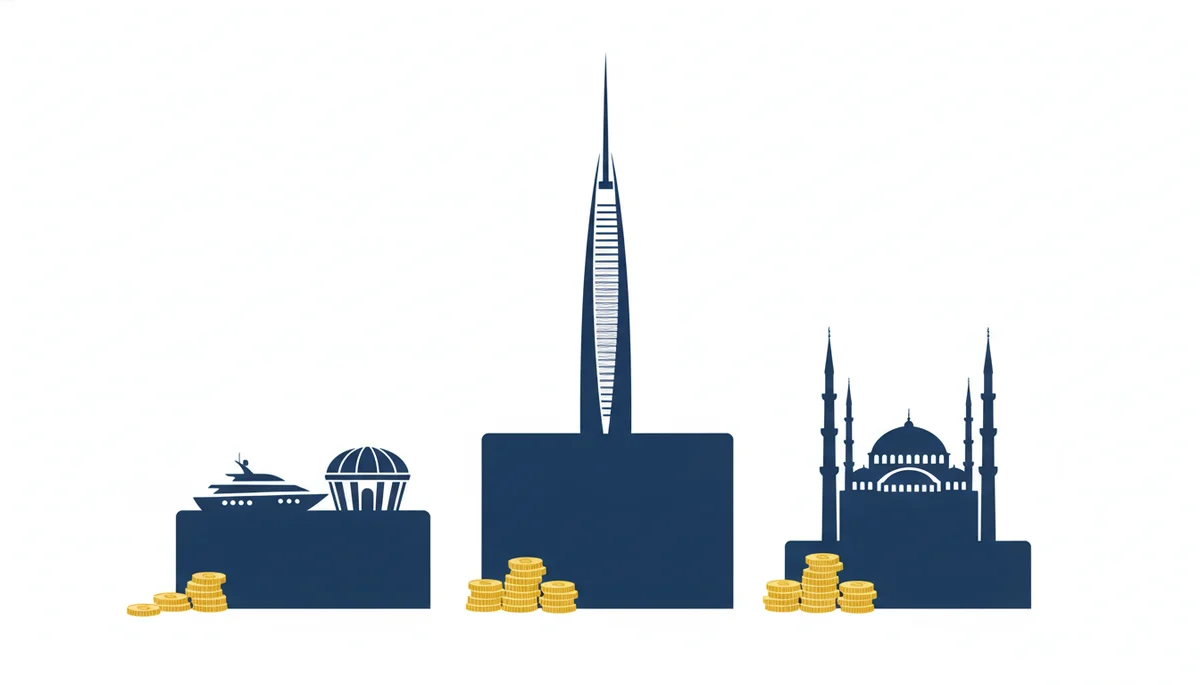
Property in the Turkey vs Monaco vs Dubai comparison runs from about $1,340 per square metre for an average Istanbul apartment to €57,569 (roughly $66,900) for a resale flat in Monaco. Dubai’s citywide average sits in between at around $5,000 to $5,600 per square metre. Monaco’s cheapest district, Moneghetti at €43,797, costs more than Dubai’s most expensive freehold tower.
Monaco’s numbers come from IMSEE, the Principality’s statistics office, which reworked its methodology for the 2025 edition of the Observatoire de l’immobilier and now counts new-builds alongside resales. Resale apartments averaged €57,569 per square metre across 429 transactions. The average resale price was €7.6 million. Larvotto led at €71,167 per square metre (the district that includes the Mareterra reclamation), followed by Monte-Carlo at €54,009, Fontvieille at €52,518 and La Condamine at €52,104. Sixty-four new-build sales averaged €40.8 million each. The 2026 headline was a €471 million five-floor apartment in Le Renzo on Mareterra, roughly €188,000 per square metre. Our piece on real estate in Monaco puts it in context against the rest of the market.
Dubai’s market is in a different phase. ValuStrat’s price index climbed 19.8% across 2025, then fell about 10% between the end of February and June 2026 once Iranian strikes hit the emirate. By June the index was flat year on year, with villas up 2% and apartments down 3%. Ready apartments traded at AED 1,691 per square foot in the first quarter (about AED 18,200 per square metre, or $4,950), off-plan at AED 2,030. Area pricing from Bayut’s 2025 data: Downtown around AED 3,343 per square foot (about $9,800 per square metre), Dubai Marina AED 2,188, Business Bay AED 2,307, JVC AED 1,469, and Palm Jumeirah villas AED 6,160.
Istanbul is cheap in dollars and getting cheaper in real terms. Endeksa’s July 2026 data puts the city average at TRY 65,078 per square metre, about $1,340, up 26.5% in lira, while the Central Bank’s national house price index is down 5.1% after inflation. Prime districts run higher: Beşiktaş at TRY 169,615 (about $3,500), Kadıköy at TRY 158,820, Sarıyer at TRY 147,889. Muğla province, home to Bodrum, is the priciest in the country at TRY 87,244 per square metre. Foreigners bought 2,120 homes in July, about 1.7% of the market.
| Location | Local price per m² | Approx. USD per m² | 100 m² apartment, approx. USD | Source |
|---|---|---|---|---|
| Istanbul average | TRY 65,078 | $1,340 | $134,000 | Endeksa, July 2026 |
| Istanbul, Beşiktaş | TRY 169,615 | $3,500 | $350,000 | Endeksa, March 2026 |
| Antalya average | TRY 55,495 | $1,145 | $114,500 | Endeksa, July 2026 |
| Dubai, ready apartments | AED 1,691/sq ft | $4,950 | $495,000 | ValuStrat, Q1 2026 |
| Dubai, Downtown | AED 3,343/sq ft | $9,800 | $980,000 | Bayut, 2025 |
| Dubai, JVC | AED 1,469/sq ft | $4,300 | $430,000 | Bayut, 2025 |
| Monaco resale average | €57,569 | $66,900 | $6,690,000 | IMSEE, 2025 |
| Monaco, Larvotto | €71,167 | $82,700 | $8,270,000 | IMSEE, 2025 |
| Monaco, Moneghetti | €43,797 | $50,900 | $5,090,000 | IMSEE, 2025 |
Purchase costs in the Turkey vs Monaco vs Dubai comparison follow the same order. In Turkey the title deed fee is 4% of the declared value, legally split between buyer and seller but usually pushed onto the buyer. New-builds carry VAT unless you qualify for the foreign-buyer exemption by paying in foreign currency and observing the holding period, commonly cited as one year. Monaco charges 4.5% registration duty for a buyer in their own name (7.5% through an opaque company), plus a 3% buyer’s agency fee under the Chambre Immobilière tariff. There’s no annual property tax. Dubai takes a 4% Dubai Land Department transfer fee, a 2% agency commission plus VAT, and a trustee fee of AED 4,000 on anything over AED 500,000. No annual tax either, although tenants and owner-occupiers both pay a 5% “housing fee” on the assessed annual rent through their DEWA bill.
Monaco vs Dubai Cost of Living, With Turkey as the Control
Monaco vs Dubai cost of living comes down to rent. Numbeo’s September 2026 data puts a central one-bedroom at €6,750 a month in Monaco against AED 9,175 (about $2,500) in Dubai and TRY 47,297 (about $975) in Istanbul. Strip out housing and the gap shrinks fast: a single person’s monthly expenses excluding rent run about €1,763 in Monaco, $1,149 in Dubai and $779 in Istanbul.
Renting is how almost every new Monaco resident starts, because the residence permit needs proof of adequate housing before the bank deposit even gets counted. Numbeo’s 18 contributors put a central three-bedroom at €9,433 a month, and agency data from 2025 shows rents per square metre ranging from about €77 in Moneghetti to €190 in the Carré d’Or. The cash you need on day one is the part the brochures skip: three months’ deposit, the first quarter in advance, an agency fee of 10% of the annual rent (with 20% VAT charged on the fee itself, since rent in Monaco carries no VAT), and a 1% registration duty on the lease. On a €6,750 flat that’s €50,000 to €60,000 out the door before you’ve unpacked. Our rundown of the disadvantages of living in Monaco goes deeper on the squeeze.
Dubai rents grew 3.1% year on year in the second quarter of 2026, according to Betterhomes, but softened in the newer mid-market districts. JVC, Arjan and Business Bay saw flat to 5% lower rents on new contracts, and Business Bay’s median one-bedroom dropped from about AED 105,000 to AED 85,000. Bayut’s first-half averages: Dubai Marina one-bedroom AED 103,000 a year, Downtown AED 133,000, Palm Jumeirah AED 169,000, JVC AED 79,000. A four-bedroom villa in Dubai Hills averaged AED 359,000. Rent increases are capped by Decree 43 of 2013 in tiers from 0% to 20% against the Smart Rental Index, and every lease has to be registered through Ejari.
Istanbul rents rose 32.4% in nominal terms in the year to July per the Central Bank’s new-tenant index, which after 31.5% inflation is a real-terms fall. The 25% rent cap that ran from 2022 lapsed in June 2024; annual increases are now limited to the trailing twelve-month average CPI, which stood at 31.9% in August. In dollar terms a central one-bedroom is around $975, a three-bedroom around $1,940, and Antalya runs 40% to 50% cheaper. Health insurance, a Turkish tax number and a Turkish mobile number are the practical prerequisites for signing anything.
| Monthly cost item | Istanbul | Monaco | Dubai |
|---|---|---|---|
| One-bedroom, central | TRY 47,297 (~$975) | €6,750 (~$7,840) | AED 9,175 (~$2,500) |
| Three-bedroom, central | TRY 93,891 (~$1,940) | €9,433 (~$10,960) | AED 16,821 (~$4,580) |
| Single person, excluding rent | ~$779 | €1,763 (~$2,050) | AED 4,218 (~$1,149) |
| Family of four, excluding rent | ~$2,891 | €6,389 (~$7,420) | AED 14,823 (~$4,036) |
| International primary school, per year | Varies widely | €29,000 to €34,400 at ISM (ages 5 to 14) | AED 65,896 average |
| Health cover | Private insurance mandatory for the permit | Private cover in practice for non-working residents | Mandatory; comprehensive AED 7,000 to 14,000 a year |
Upfront rental cash is the one Turkey vs Monaco vs Dubai line I always make people write down. €50,000 to €60,000 to move into a Monaco one-bedroom. Around AED 15,000 to 20,000 in Dubai for deposit plus agency fee, with rent often paid in one to four cheques. A month or two of rent in Istanbul.

Residency: What Each Country Actually Asks For
Residency in the Turkey vs Monaco vs Dubai comparison starts at a $200,000 property purchase in Turkey. Dubai wants AED 2 million (about $545,000) in real estate for a 10-year Golden Visa. Monaco wants a rented or owned home plus a bank reference, which the Sûreté Publique says in practice means €500,000 on deposit. Processing runs seven to ten working days in Dubai and 72 to 85 days in Monaco after the French visa stage; Turkey’s permit timing varies by province and is measured in weeks to months.
Monaco Residency
A non-EU applicant first needs a French type-D long-stay visa from a French consulate; EU and EEA citizens skip that step. Then the file goes to the Sûreté Publique. It needs proof of accommodation “large enough to accommodate those living there” (a lease, a deed, or a relative’s home), a criminal record extract from every country you lived in over the last five years, and a bank reference from a Monaco bank less than a month old. The official checklist gives no deposit figure. The police commissioner in charge of residents did, in February 2026: €500,000 as the minimum a bank will attest to, and several banks want more. First-year processing averaged 72 days for EU applicants and 85 for non-EU. Fees are trivial (€80 for the first temporary card). The card runs for a year, renews three times, then converts to a three-year ordinary card, and after ten years to a ten-year privileged card. Our Monaco residency guide has the full walk-through.
The presence requirement is the tripwire. To get the fiscal certificate of residence that makes your Monaco status mean anything to your old tax office, you sign a sworn declaration that you spend more than six months a year in the Principality, or that your main centre of activity is there. The police said plainly in February that six months’ presence is required to keep resident status. Monaco is small and the authorities notice.
Dubai Residency
Dubai has more residency doors than Turkey and Monaco combined. The best known is the property Golden Visa. It takes AED 2 million of real estate wholly owned by the investor. Mortgaged property is allowed with a bank letter showing what’s been paid, and off-plan has been allowed since 2022 as long as AED 2 million has been paid in. The Dubai Land Department’s own fee schedule for the ten-year visa comes to AED 9,884.75 (medical, Emirates ID, residency permit, DLD fee and admin), plus AED 5,774.50 per dependant. Processing takes seven to ten working days with the applicant physically present. GDRFA Dubai issued 66,078 Golden Visas in the first half of 2026 alone. Our list of seven ways to get a UAE 10-year Golden Visa covers the deposit, company and talent routes too.
Below that, the two-year property investor visa lost its AED 750,000 floor on 29 April 2026 for sole owners (joint owners still need a AED 400,000 share each), which we broke down in the Dubai property investor visa 2026 update. A free-zone company remains the cheapest reliable route: Meydan Free Zone licences start at AED 12,500 with the first investor visa around AED 7,850 all in, and RAKEZ packages start at AED 6,000. There’s a one-year remote-work visa for anyone earning $3,500 a month from outside the UAE, and a five-year retirement visa at 55 for AED 1 million in property or savings or AED 240,000 a year of income.
Residency and tax residency are separate things in the UAE, and this is the point most people miss. A residence visa keeps you legal. A Tax Residency Certificate from the Federal Tax Authority is what your home country’s tax office wants to see. Under Cabinet Decision 85 of 2022 that requires 183 days in the country, or 90 days plus a residence permit and a UAE home or job, or proof that your centre of financial and personal interests is there. It costs AED 1,050 if you have no tax registration number. We explain the mechanics in our piece on the tax residency certificate.
Turkey Residency
The property-owner short-term permit needs a residential property valued by a licensed appraiser at $200,000 or more, a threshold that’s been national since October 2023 and that law firms confirm still applies in 2026. Permits run up to two years per issue, need private health insurance, and stack towards a long-term permit after eight uninterrupted years. Two frictions worth knowing about. Tourist-purpose renewals are being refused. And Turkey closed 1,169 neighbourhoods nationwide to new foreign registrations in 2022 on density grounds, including ten Istanbul districts in 2023. Reports that Istanbul’s closures were lifted in June 2026 come from consultancies, with no official announcement from the migration directorate, so verify the specific address before you buy. Our residency in Turkey guide tracks the current list.
Turkish tax residence kicks in after more than six months in a calendar year, or on establishing a legal domicile. That’s the trigger for the 20-year exemption, which is why the sequence of buy, register, obtain the exemption certificate, then move in, matters so much.
Turkey Citizenship vs Dubai Golden Visa: Passport or Permit?
Turkey citizenship vs Dubai Golden Visa is a comparison between two different products. Full citizenship, with a passport scoring 118 on the Passport Freedom Index, comes in three to six months for a $400,000 property held three years or a $500,000 deposit. The Dubai Golden Visa grants ten years of renewable residency for AED 2 million, and leads to no citizenship at all under any application route.
Turkey’s programme has been stable on price since June 2022: $400,000 in real estate with a three-year no-sale annotation on the title, or $500,000 in a bank deposit, government bonds, a fund or fixed capital, or 50 jobs. The spouse and children under 18 come in on the same file, there’s no residence or language test, and Turkey permits dual citizenship. It’s also one of the few CBI passports that qualifies for the US E-2 treaty investor visa, since Turkey has been an E-2 treaty country since 1990. The Turkey citizenship programme page has the current documents list.
Then there’s the August problem. On 6 August 2026 Turkey revoked 6,134 investment citizenships in one sweep: 1,413 principal applicants plus their families, 5,391 of them for collusive or inflated property valuations and 743 on security grounds. That followed the 451 citizenship revocations the year before. The message from Ankara: the programme stays open, but a valuation that says $400,000 for a flat worth $250,000 is a citizenship that can be pulled years later. Since March 2024, citizenship valuations go through a central appraiser, and the honest ones clear.
The UAE has no citizenship application. The 2021 amendment allows investors, doctors, scientists, inventors and artists to be nominated by a Ruler’s or Crown Prince’s court, an executive council or the Cabinet. Nobody applies; you’re chosen. The old 1972 law’s 30-year residence route for non-Arabs exists on paper and functions as a rarity in practice. The UAE passport scores 187 on the Passport Freedom Index, second in the world, and you won’t be getting one.
Monaco sits in between and closer to Dubai. Naturalisation is by sovereign ordinance at the Prince’s discretion after ten years of residence from age 18, and you must renounce your previous nationality before the ordinance is published. Twenty-one people were naturalised that way in 2025 out of roughly 400 applications. Marriage to a Monegasque now takes 20 years (10 for marriages before July 2022). A Monaco passport scores 176, and in practice it’s reserved for people born into it.
| Citizenship route | Turkey | Monaco | UAE |
|---|---|---|---|
| By investment | $400,000 property (3-yr hold) or $500,000 deposit/bonds/fund; 3 to 6 months | None | None; nomination only |
| By residence | 5 years uninterrupted, Turkish language, income | 10 years, discretionary, renounce other nationality | 30 years on paper, discretionary |
| Dual citizenship | Allowed | Not for naturalised citizens | Nominated categories only |
| Family included | Spouse and under-18 children | Case by case | Case by case |
| Passport Freedom Index score | 118 | 176 | 187 |
| Revocation risk | Medium; 6,134 revoked Aug 2026 | Low | High for naturalised |
The pattern we see across files: people who start out asking about the Dubai Golden Visa as a “second citizenship” plan end up splitting the job. Turkish citizenship for the passport and the E-2 option, then residency wherever they want to live. The two products stack neatly on top of each other. That’s the whole logic behind treating a second passport as insurance and residency as lifestyle.
How Each Country Treats Your Foreign Dividends, Gains and Pensions
For a resident with foreign-source income, Monaco and the UAE tax dividends, interest, capital gains, rental income and pensions from abroad at 0%, with no filing. Turkey does the same for 20 years under Law 7582, provided the exemption certificate is in place. Without that certificate a Turkish resident declares foreign dividends and interest above TRY 22,000 and pays progressive rates up to 40%.
| Foreign income type | Turkey (with Law 7582 certificate) | Turkey (ordinary resident) | Monaco | UAE |
|---|---|---|---|---|
| Dividends from a foreign company | 0% | Declarable above TRY 22,000; up to 40% | 0% | 0% |
| Interest on foreign accounts | 0% | Declarable above TRY 22,000; up to 40% | 0% | 0% |
| Capital gains on foreign securities | 0% | Self-assessed at progressive rates | 0% | 0% |
| Foreign rental income | 0% | Progressive rates | 0% | 0% |
| Foreign pension | 0% | Treaty-dependent | 0% | 0% |
| Salary from a foreign employer | 0% | Worldwide, up to 40% | 0% | 0% |
| Foreign tax credit available? | No (exempt income) | Yes, under 94 treaties | Only 10 treaties | 137 signed, about 104 in force |
Treaty coverage is the sleeper issue in any Turkey vs Monaco vs Dubai tax comparison. Monaco has just ten double tax conventions (France, Luxembourg, Liechtenstein, Malta, the UAE and a handful of small states). So the withholding tax a foreign country deducts at source on your dividends is usually the final cost. The UAE has signed 137 treaties with roughly 104 in force, which for a portfolio investor is worth real money in reduced withholding. Turkey has 94, but the exemption regime sits outside the treaty credit mechanism, so you take the foreign withholding and move on. All three are in the Common Reporting Standard, meaning your bank reports balances back to wherever you’re tax-resident. If that’s your new home, the report goes to a country that doesn’t tax you. Our guide to CRS reporting explains why that’s the point of the exercise.

Banking, Currency and the Boring Stuff That Decides It
Money has to sit somewhere, and the banks in Turkey vs Monaco vs Dubai treat a new arrival differently. Monaco’s roughly 30 banks operate under French prudential supervision. Private-banking entry starts in the high six figures. The €500,000 deposit that unlocks the residence permit is the working floor, and opening the account takes a few weeks of source-of-funds questions, usually under a month. Monaco was placed on the FATF grey list (the money-laundering watchdog’s list of countries under increased monitoring) in June 2024. The June 2026 plenary found the action plan substantially complete and scheduled an on-site visit. Removal at the October 2026 meeting is possible but hasn’t happened yet.
Dubai is the opposite: an Emirates ID and a residence visa open the door to a retail account at Emirates NBD, FAB or Mashreq with a AED 3,000 minimum balance (ADCB asks AED 5,000, waived with a salary transfer). Non-residents get a narrower menu. The UAE came off the FATF grey list in February 2024, and the EU dropped it from its high-risk list in July 2025. Correspondent banking, the foreign banks that route your transfers in and out, runs noticeably smoother than it did three years ago. The dirham is pegged at 3.6725 to the dollar, so currency risk is dollar risk.
Turkey is the one where the currency is the story. Inflation ran at 31.5% in August 2026. The policy rate sits at 37%. The lira lost 17.5% against the dollar over twelve months in a managed slide. Account opening needs a tax number, a Turkish phone and usually a residence permit, and bank practice varies by branch. Foreign-currency accounts are routine, and I’d keep the bulk of your liquidity outside Turkey regardless. The good news for a foreign-income earner is that lira weakness works in your favour on every local bill.
Let’s be blunt about the war. The UAE has been a target in the Iran war since 28 February 2026. Iranian missiles and drones struck Dubai International Airport, Dubai Marina, Palm Jumeirah and Jebel Ali in the spring; 13 people were killed, the airport closed repeatedly, and two ceasefires collapsed. As of early September fighting continues and Strait of Hormuz traffic is a fraction of normal. Dubai’s second-quarter property sales fell 31% by count and 45% by value year on year. Off-plan resales were trading 10% to 15% under original prices. The market has been through worse and came back. Still, anyone comparing Turkey vs Monaco vs Dubai in 2026 has to price in that nobody is firing missiles at Monaco or Istanbul. Our list of the cons of living in Dubai covers the everyday downsides that were there before the war.
How to Choose Between Turkey, Monaco and Dubai: Step by Step
Picking between Turkey, Monaco and Dubai takes five decisions in order. Confirm your home country will release you. Set the liquid capital you can lock up. Decide whether you need a passport or only a permit. Test each city against the days you’ll spend there. Only then look at property. Most people do it backwards and start with the flat.
Step 1: Confirm your home country will let you go. Check your departure country’s residence test, exit tax and temporary non-residence rules before anything else. A UK Statutory Residence Test failure or a lingering “centre of vital interests” in France makes the destination irrelevant. Our guide to choosing a tax residency country starts here for a reason.
Step 2: Set the capital you can lock up. Under $250,000 and Turkey is the only one of the three that works ($200,000 property for a permit). Between $250,000 and $600,000, Turkey’s citizenship route or Dubai’s AED 2 million Golden Visa are both in reach. Monaco needs €500,000 idle in a bank plus roughly €80,000 a year in rent, and that’s the entry level.
Step 3: Decide whether you need a passport or a permit. If a second citizenship is the goal, Turkey is the only answer in this trio, and it can run alongside residency elsewhere. If you only need a legal tax-free base, Dubai and Monaco both deliver on a permit.
Step 4: Test each city against your real calendar. Monaco needs more than six months’ presence and checks. Turkey needs more than six months to become tax-resident at all. Dubai will keep a Golden Visa alive with almost no presence, but a Tax Residency Certificate needs 90 to 183 days. Write down where you’ll be in each of the next three years and see which rule set you can meet without lying.
Step 5: Then, and only then, look at property. Rent first in Monaco and Dubai; buy only when the residency is running and you know the district. In Turkey the purchase is the residency, so use an independent valuer, pay in foreign currency through a Turkish bank to secure the VAT exemption, and stay well clear of any agent whose “$400,000” valuation looks generous. Get the exemption certificate for Law 7582 before you cross the six-month line.
Common Mistakes in the Turkey vs Monaco vs Dubai Decision
The expensive errors in the Turkey vs Monaco vs Dubai decision are the same ones every year. Treating a residence visa as tax residence. Assuming a Turkish passport comes with a Turkish tax holiday automatically. Buying Monaco property before the permit exists. Forgetting that a US passport cancels the whole exercise. Each of these has cost someone we’ve spoken to six figures.
Confusing a Dubai visa with tax residence. The Golden Visa lets you skip the six-month entry rule. Your old tax authority doesn’t care. Without 90 to 183 days in the UAE and a Tax Residency Certificate, you’re a tourist with an Emirates ID, and the home tax office wins the argument.
Assuming Turkish citizenship equals the 20-year exemption. Citizenship by investment has no residence requirement, so most CBI citizens never become tax-resident and never claim anything. The exemption needs actual residence, a clean three-year look-back and a certificate. It’s a separate project from the passport.
Buying in Monaco before the permit is approved. A purchase is a great way to prove accommodation, and a terrible thing to own if the Sûreté Publique declines you. Rent for the first year. The 4.5% duty and 3% agency fee on a €7.6 million average flat is over half a million euros of friction you don’t want to pay twice.
Ignoring the home-country exit. Monaco with a French passport is France. Dubai with a US passport is the IRS with better weather. Turkey with a German shareholding above the exit-tax threshold is a bill on departure. The destination is the easy half.
Trusting the valuation because the agent said so. The 6,134 revocations in August were almost all valuation fraud. If the number on the appraisal is comfortably above what identical flats sell for, you’re buying a citizenship with a fuse on it.
Which Should You Choose? Three Profiles
So who wins Turkey vs Monaco vs Dubai? Turkey suits someone with $200,000 to $500,000 who wants a passport, an E-2 route into the US and a cheap base on the Bosphorus or the Aegean. They’ll need to live with a volatile currency and a bureaucracy that changes its mind. Dubai suits the founder or portfolio investor with $500,000-plus who wants an operating company and deep banking, and who can price a live regional conflict into the decision. Monaco suits someone with €2 million or more of liquid wealth who values a European address, French-supervised banks, the euro and a security record nobody else can match. And who will be there more than half the year.
Read our head-to-head on Dubai vs Monaco if you’ve already ruled Turkey out, and the guide to the best tax havens if none of the three fits the calendar you wrote down in Step 4.
Frequently Asked Questions
Which is the cheapest tax haven in the Turkey vs Monaco vs Dubai comparison?
Does Turkey tax foreign income in 2026?
Is Monaco or Dubai better for taxes?
Is Turkish citizenship by investment better than the Dubai Golden Visa?
Can a Dubai Golden Visa lead to UAE citizenship?
How much do I need in the bank for Monaco residency?
How do property prices compare across Turkey vs Monaco vs Dubai?
Is Dubai still safe after the 2026 Iran strikes, and does it change the Turkey vs Monaco vs Dubai ranking?
What are the physical presence rules in Turkey vs Monaco vs Dubai?
Does a US citizen benefit from moving to Turkey, Monaco or Dubai?
Why did Turkey revoke 6,134 citizenships in August 2026?
Which country wins the Turkey vs Monaco vs Dubai comparison for a family?
Final Thoughts
Turkey vs Monaco vs Dubai ends in a three-way tie on the tax rate: all three now offer a foreign-income earner the same 0%. What you’re buying is the package around it. Monaco sells security, currency and a continental address at a price that filters out almost everyone. Dubai sells business infrastructure and an effortless visa at a moment when the region’s risk premium is no longer theoretical. Turkey sells a passport, low cost and a brand-new 20-year exemption, wrapped in a currency and a bureaucracy that ask for patience. Decide on the calendar and the capital first. The flat can wait.
If you’d like the decision made properly instead of guessed at, we set up residency and citizenship in all three jurisdictions and can tell you within a short call which one your situation supports. Start with our overview of second residency options or the citizenship by investment programmes we run.
Sources and References
- Government of Monaco, Tax in Monaco: general information
- Government of Monaco, How to apply for a residence permit
- IMSEE (Monaco Statistics), Observatoire de l’immobilier 2025
- UAE Government Portal, Taxation in the UAE
- UAE Ministry of Finance, Corporate Tax FAQ
- Dubai Land Department, Request for Golden Visa (Investor)
- UAE Federal Tax Authority, Issuance of Tax Residency Certificates
- PwC Worldwide Tax Summaries, Turkey: Individual taxes on personal income
- EY Türkiye, 20-year tax exemption for those settling in Türkiye (Law 7582)
- Presidency of Migration Management (Türkiye), Types of residence permit
- Library of Congress, Turkey: citizenship-by-investment thresholds amended
- Internal Revenue Service, Foreign Earned Income Exclusion
- FATF, Jurisdictions under increased monitoring, June 2026
- Liberty Mundo, Passport Freedom Index