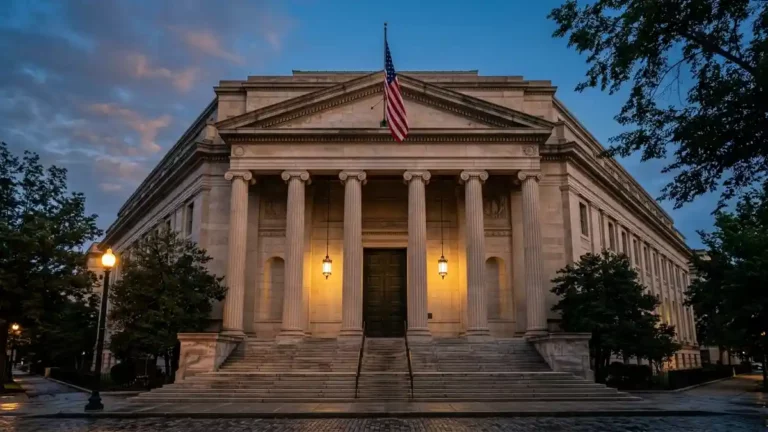
The bunq US bank charter application was denied by the Office of the Comptroller of the Currency in a decision letter dated 4 August 2026 and posted publicly on Friday 7 August. The Amsterdam neobank wanted a national bank charter. It got a list of deficiencies instead.
WASHINGTON, D.C. – 09 August 2026
This is the second fintech charter rejection the OCC has published in under three weeks. The first was Wise, turned away on 21 July over anti-money-laundering compliance concerns. Two public denials that close together, from a regulator that has approved several other fintech applications this year, is a pattern worth reading carefully if you bank across borders.
Bunq is not a fringe operator. It competes with Revolut across Europe, runs a subscription model built on multi-currency accounts, and already holds a FINRA broker-dealer licence. Its stated US target market was European digital nomads living in America. That is exactly the customer Liberty Mundo readers tend to be.
Put your assets beyond reach in 57 jurisdictions.
Pick where you want your company. We handle the filing, the registered agent, and the bank introduction. From US$1,290, done in days, not months.
- Charging-order protection in jurisdictions courts can't pierce
- Zero tax on foreign income in 30+ territories
- Banking options available
- Fixed price. No surprise fees at closing
What did the OCC say about the bunq US bank charter?
The OCC denied the bunq US bank charter on three grounds. Its decision letter points to proposed directors without sufficient experience in US credit and banking regulation, an application that failed to support its initial capitalisation requirements, and a business plan lacking detail on how the bank would reach and hold profitability. The letter concludes the application “does not demonstrate that bunq US Bank can be operated in a safe and sound manner.”
Read that list again. None of it is about technology or product design. Every item is about capital, governance, and durability. The regulator was not asking whether bunq builds good software. It was asking whether a US bank under a Dutch parent could absorb losses and survive a bad cycle. The paperwork did not answer.
Bunq applied in January 2026, two years after withdrawing an earlier attempt. The company said it “would have loved a yes” but knew it had chosen “one of the hardest routes into one of the toughest banking markets in the world.” It will keep working in the US through its broker-dealer licence. The denial letter explicitly leaves the door open to a future de novo filing.
How does this compare with the Wise denial?
Both applicants were European fintechs seeking a US national bank charter, both were refused inside three weeks, but the stated reasons differ. Wise was blocked on anti-money-laundering compliance grounds. Bunq was blocked on capital, board experience, and profitability planning. Different failure modes, same outcome.
| Applicant | Home base | Decision | Grounds cited by the OCC | Current US status |
|---|---|---|---|---|
| Wise | United Kingdom | Denied, 21 July 2026 | Anti-money-laundering compliance concerns | Operating without a US bank charter |
| bunq | Netherlands | Denied, letter dated 4 Aug 2026 | Director experience in US banking regulation, unsupported initial capitalisation, thin profitability plan | FINRA broker-dealer licence only |
The nuance the headlines miss: the OCC approved several other fintech charter applications during 2026. This is not a blanket freeze. It is selective, and the criteria are the boring ones. Capital adequacy. Board depth. A credible path to profit. Foreign ownership disqualifies nobody, but the capital question gets asked harder and answered in Washington, not Amsterdam.
Why does the bunq US bank charter denial matter if you are not American?
It matters because the customer bunq wanted was the internationally mobile non-resident, and that customer just lost a plausible route to a chartered US deposit account. If you were waiting for a European app to hand you clean USD banking with no US entity and no paperwork, that ship has sailed.
We see this pattern constantly. Someone builds their whole dollar setup on one fintech app because onboarding took eleven minutes, then learns a year later that the app is a money transmitter riding on somebody else’s bank. When that partner bank changes its risk appetite, the account closes with no explanation and no appeal. Same dynamic driving the wider wave of bank account closures, and non-residents get caught first because they are the easiest file to exit.
The durable answer has not changed. A properly formed US entity with an EIN gets you into real US business banking, in dollars, at a bank with an actual charter. That is why US LLC for non-residents setups keep outperforming app-only strategies, and why serious offshore company formation work starts with the banking question rather than ending with it.
What the bunq US bank charter refusal signals to everyone else
Two published denials in three weeks is a message to the whole applicant queue. The OCC will approve fintech charters, but it wants applications built specifically for the US market, with directors who have worked inside US banking rules and a capital structure that stands on its own. Analysts covering the decision made the same point: public denials show an agency being selective, not indiscriminate.
For anyone planning around cross-border money, the lesson is unglamorous. Regulatory permission is the scarce resource, not product design. That logic runs through offshore bank account strategy and it is the same force behind reporting expansions like CRS 2.0 and the Swiss beneficial ownership register. Access is being rationed. Structure is how you keep yours.
Why was the bunq US bank charter application denied?
Can bunq apply for a US bank charter again?
Does this affect existing bunq customers in Europe?
Is the OCC rejecting all fintech bank charter applications?
How can a non-resident get a US bank account after the bunq US bank charter denial?
Regulators rarely announce that a door is closing. They just stop opening it, one application at a time. The clock is ticking, so own your banking access through structure you control rather than waiting on a licence somebody else has to win.
Sources and References
- Office of the Comptroller of the Currency, Corporate Decision on the Application to Charter bunq US Bank, N.A. (CD 1384)
- Office of the Comptroller of the Currency, Charters and Licensing: Interpretations and Decisions
- Reuters, US regulator rejects Dutch fintech bunq’s application for national bank charter
- Bloomberg, US Banking Regulator Rejects Fintech Bunq’s Charter Application
- American Banker, OCC denies bunq’s ‘insufficient’ charter application